

A Houston investor has a property under contract, a contractor ready to price the renovation, and a seller who won't wait for a conventional approval process. The deal may look profitable on paper, but the financing choice can decide whether the project reaches resale, refinance, or a forced sale.
Bridge and hard money loans can both provide short-term, asset-backed capital, yet they aren't interchangeable in every situation. Bridge financing generally supports a temporary transition between acquisition and a later sale, refinance, or stabilization. Hard money financing typically emphasizes the property and the borrower's execution plan, especially when the asset needs repairs or doesn't fit conventional underwriting.
The right question isn't just which loan closes faster or carries the lower stated rate. It's whether the property, budget, timeline, and exit can withstand delays. The comparison below gives Houston investors a practical starting point.
| Feature | Bridge Loans | Hard Money Loans |
|---|---|---|
| Primary purpose | Temporary financing during acquisition, repositioning, stabilization, refinance, or sale | Asset-based financing for acquisitions, renovations, distressed properties, and short-term investment projects |
| Typical structure | Interim loan, often interest-only, with principal due at maturity | Short-term, interest-only structure with repayment at maturity |
| Underwriting focus | Collateral, transition plan, operating or stabilization assumptions, and exit | Collateral value, project scope, borrower equity, and sale or refinance exit |
| Common project fit | Transitional properties, multifamily, commercial assets, and time-sensitive acquisitions | Fix-and-flip homes, non-bankable properties, purchase and rehab projects, and distressed assets |
| Main risk | The transition takes longer than expected | Repairs, permits, resale, or refinance fail to support repayment |
| Best decision test | Can the property reach a credible sale, refinance, or stabilization milestone within the term? | Can the asset support the loan if the renovation or resale plan runs late? |
Table of Contents
- Understanding Bridge and Hard Money Loans
- How These Loans Differ
- Underwriting Differences
- Cost and Use Case Analysis
- Evaluating Exit Strategy Risks
- Preparing Your Application
- Making the Right Choice
- Next Steps with Quick Lending
Understanding Bridge and Hard Money Loans
A Houston investor finds a property in a neighborhood with active resale demand, but the house needs work before a bank will consider it financeable. The seller wants a prompt closing, the investor expects to renovate and resell, and the projected profit depends on controlling both the purchase and the construction schedule.
That situation can call for either bridge or hard money financing, but the underlying roles differ. Bridge lending supplies temporary capital while a property moves through acquisition, renovation, leasing, stabilization, refinancing, or sale. Hard money lending is more commonly associated with asset-based financing for properties where condition, timing, or conventional underwriting creates an obstacle.
The distinction matters because a loan can solve the closing problem while creating a maturity problem. A structure that works for a short renovation may not work for a property waiting on lease-up or a refinance appraisal. Investors need to match the loan's repayment date to the project's realistic completion date, not the most optimistic version of the business plan.

Where bridge lending fits
Bridge lending operates inside the broader commercial real-estate credit cycle. The Mortgage Bankers Association estimated total commercial real-estate mortgage borrowing and lending at $498 billion in 2024, up 16% from $429 billion in 2023, but still 39% below the $816 billion recorded in 2022. Those figures illustrate how financing availability changes with interest rates, valuations, lender risk appetite, and investor confidence, although they describe the commercial market rather than residential hard-money originations specifically. The Mortgage Bankers Association's commercial lending report provides the broader market context.
Why the label matters less than the exit
Private lenders may use these labels differently. One lender may call a purchase-and-rehab facility a bridge loan, while another may describe the same structure as hard money. The useful comparison is practical: what is being financed, how long the capital is needed, what secures repayment, and what happens if the planned exit fails?
Investors who want additional educational guidance can review Quick Lending's real estate financing blog, then discuss the specific property with a qualified lending professional.
How These Loans Differ
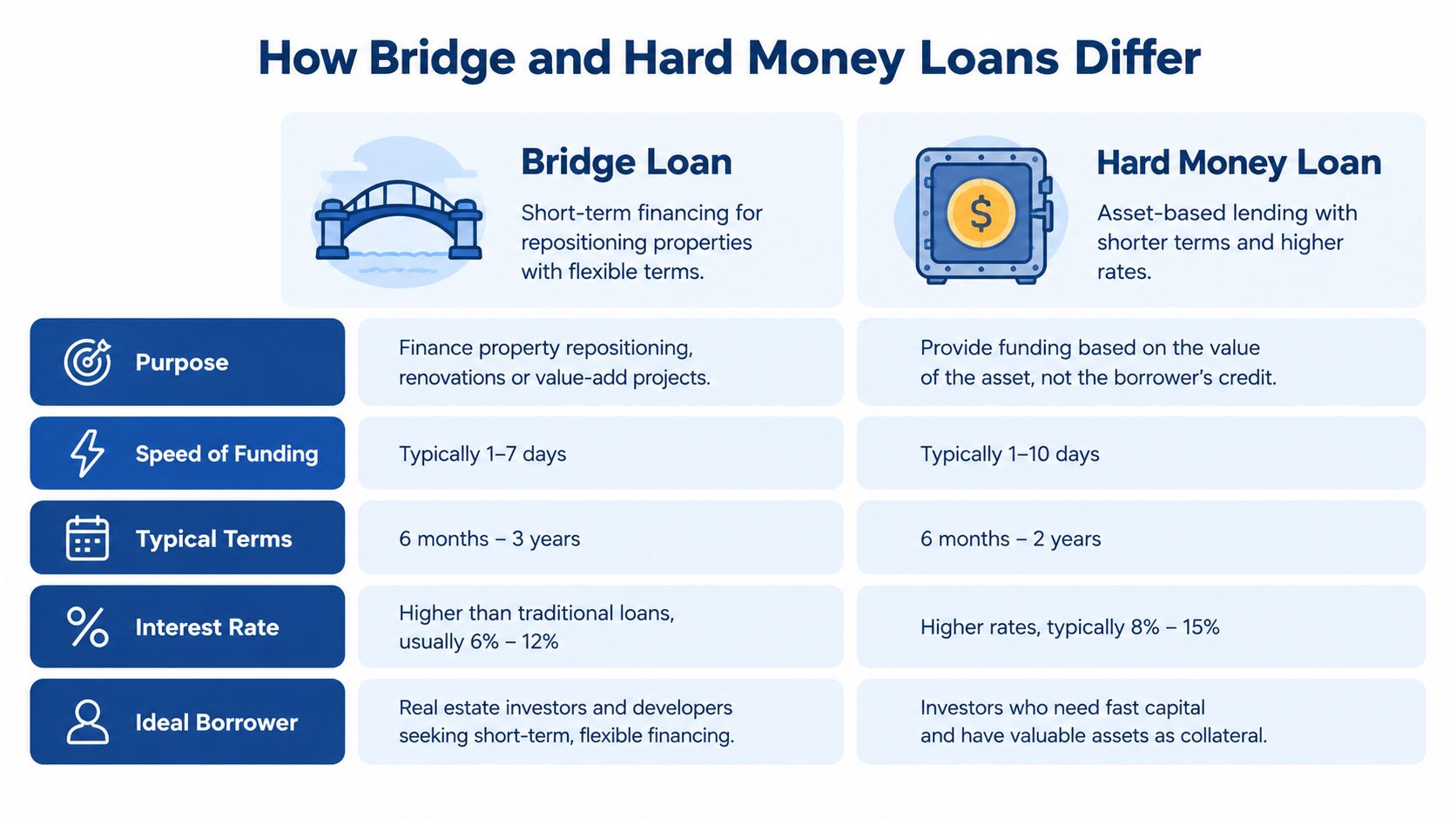
Bridge and hard money loans overlap in speed, collateral, and short-term structure, but they often serve different moments in an investment plan. A bridge loan may carry a property from one financing condition to another. Hard money may help an investor acquire and improve an asset that can't yet qualify for conventional debt.
The table below uses general market conventions, not guaranteed terms. Actual pricing, financing, documentation, repayment provisions, and approval decisions vary by lender, property, borrower, and exit.
| Feature | Bridge Loans | Hard Money Loans |
|---|---|---|
| Purpose | Bridges a temporary gap before sale, refinance, stabilization, or longer-term financing | Funds an acquisition, renovation, or distressed asset based primarily on real-estate collateral |
| Speed of funding | Designed for time-sensitive transactions, subject to title, valuation, documentation, and approval | Often structured for rapid investment-property closings, subject to project review and approval |
| Typical terms | Interim financing, frequently interest-only, with a maturity payoff | Short-term financing, commonly interest-only, with the balance due at maturity |
| Interest rate | Pricing reflects leverage, property risk, term, and exit quality | Pricing generally reflects asset condition, leverage, execution risk, and limited amortization |
| Ideal borrower | An investor with a credible transition plan and a defined sale, refinance, or stabilization event | An investor acquiring, renovating, or repositioning an asset that conventional lenders may not finance |
| Collateral focus | Current value, transition value, income or stabilization assumptions where relevant, and exit | Current collateral, repair plan, equity contribution, and realistic after-repair or resale assumptions |
| Primary failure point | The expected refinance, sale, or stabilization takes longer than the maturity period | Construction costs, permits, resale demand, or valuation undermine the repayment plan |
The practical distinction
A Houston investor purchasing a functioning multifamily property with a clear refinance path may be evaluating bridge financing. A flipper buying a damaged single-family home that needs substantial work may be evaluating hard money. Neither description guarantees approval, and the same property could receive different labels from different lenders.
The more useful approach is to ask what the loan must accomplish. If the capital must cover a transition from acquisition to stabilization, bridge financing may align with the plan. If the property's condition prevents conventional funding and the borrower needs purchase-and-rehab capital, hard money may be more suitable.
Speed still has conditions
Fast Available Funds can matter during a tight option period or competitive purchase, but speed doesn't eliminate due diligence. A lender still needs enough information to understand title, value, scope, insurance, borrower equity, and repayment. A borrower who sends a complete package usually gives the lender a clearer path to a decision than one who relies on urgency alone.
Underwriting Differences
A Houston investor can have a strong property and still face a stalled closing if the repayment plan depends on an unsupported value, an incomplete budget, or a refinance that may not be available on schedule. Underwriting starts with the asset, then tests whether the borrower, project costs, and exit plan fit the loan's maturity.
Loan-to-value, or LTV, compares the loan amount with the property's market value. The OCC's commercial real-estate lending handbook describes the origination calculation as the loan commitment divided by the lower of the purchase price or appraised value. Using the lower figure limits the amount a borrower can request when an appraisal exceeds the contract price. The OCC examination handbook explains the calculation and its underwriting purpose.
What the lender needs to verify
For a bridge request, review typically centers on the property's current condition, stabilization assumptions, existing income where applicable, and the planned refinance or sale. A hard-money request usually requires a closer review of the repair scope, contractor plan, current value, projected completed value, borrower equity, and resale assumptions.
The exit deserves equal attention. If a Houston refinance depends on higher rents, completed improvements, or a favorable valuation, the application should show how those conditions will be reached and what repayment source remains if one of them falls short.
A practical application package should let the lender understand the deal without reconstructing it from scattered documents:
- Purchase details: Provide the executed contract, deposit information, closing requirements, and known title issues.
- Property valuation: Supply available appraisal or valuation information, along with comparable sales supporting the purchase price and expected exit value.
- Scope and budget: Separate required repairs from optional improvements, identify the contractor, and include a contingency reserve.
- Borrower contribution: Show available equity and the source of funds for costs the loan will not cover.
- Exit evidence: Explain whether repayment depends on a sale, refinance, rental stabilization, or another asset sale.
Houston knowledge changes the review
Local conditions affect underwriting because properties with similar square footage can differ substantially in resale liquidity, insurance concerns, permit exposure, and contractor access. A lender familiar with Houston neighborhoods may ask whether the improvements match local buyer expectations, whether the resale price depends on a narrow buyer pool, and whether the schedule allows time for inspections or utility work.
A strong application shows more than potential value. It connects the budget, timeline, market demand, and repayment source, including a workable response if the project takes longer.
Cost and Use Case Analysis
A Houston investor can close quickly and still lose money if the financing schedule leaves no room for delays. Interest rate is only one part of the decision. Short-term debt may also include interest-only payments, origination charges, extension costs, draw requirements, and a maturity payoff. A lower stated rate can become more expensive when the structure forces a rushed sale or makes refinancing difficult.
Bridge loans are generally interim, asset-backed facilities for approximately 6 to 36 months. They commonly use interest-only payments and require the balance to be paid at maturity rather than amortized over a long term. Market benchmarks often place loan-to-value between roughly 65% and 80% LTV. Stronger sponsors and lower-risk properties may receive more flexible terms, but the lender still weighs the asset, borrower, timeline, and repayment plan. The bridge-loan structure and leverage discussion provides these market benchmarks.
How loan-to-value changes the economics
Moving from 65% to 75% LTV can increase the interest rate by approximately 1 to 2 percentage points, because the lender has less collateral protection and the borrower has a smaller equity cushion. Higher loan-to-value preserves cash for other projects, but it also raises carrying costs and reduces the margin available when the property sells or refinancing occurs.
Upfront origination charges commonly run approximately 1% to 3% of principal. On a short hold, that cost can materially increase the effective financing expense. Calculate interest, origination charges, draw-related costs, potential extension fees, taxes, insurance, utilities, and selling expenses before deciding whether the project works.
Match the product to the project
A fix-and-flip investor may need hard money when repairs must be completed before conventional financing becomes available. The practical test is whether the purchase basis, repair budget, contingency, and expected resale value can absorb schedule delays and price movement.
Bridge financing may fit a property in a defined transition, such as acquisition before refinancing, renovation before stabilization, or temporary ownership before sale. A multifamily borrower may need credible operating assumptions and a refinance path. A residential renovator may need a detailed scope, contractor plan, and resale strategy.
Houston conditions can change the calculation. Insurance costs, permitting, contractor availability, and buyer demand may affect both the timeline and the final margin. The same borrower may need different financing for different properties. A fast closing has limited value if the loan leaves too little cash for construction, interest, or other carrying costs.
Evaluating Exit Strategy Risks
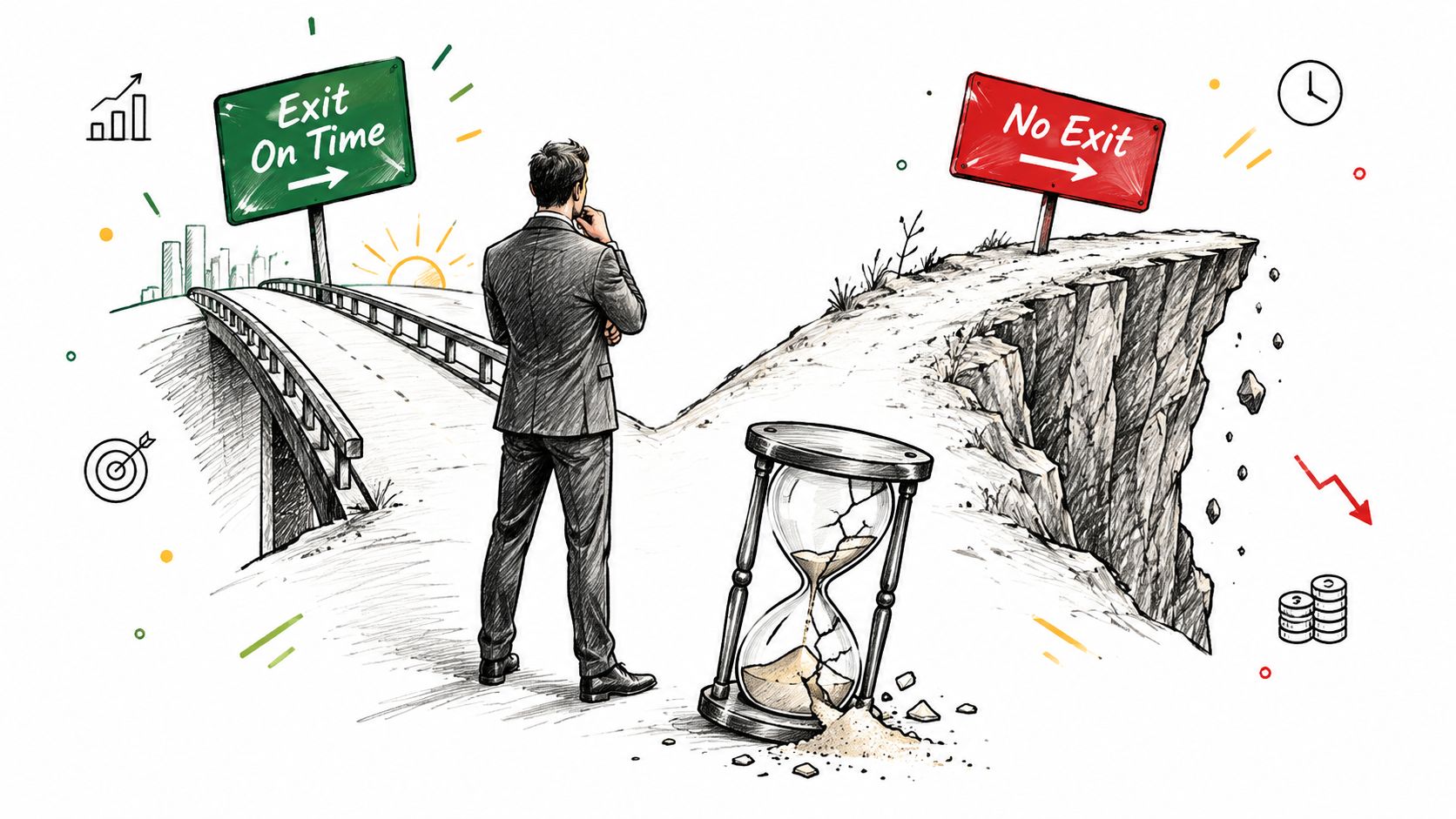
A short-term loan becomes dangerous when the exit exists only in a spreadsheet. Houston investors regularly face delays that have nothing to do with the original purchase decision: permits take longer, a contractor changes the schedule, insurance costs shift, an appraisal misses the target, or a buyer's financing fails.
The broader refinancing environment shows why maturity planning deserves more attention. Approximately 20% of the roughly $4.8 trillion outstanding U.S. commercial-mortgage balance, or $957 billion, was scheduled to mature in 2025, compared with $929 billion maturing in 2024. Those figures are primarily commercial, not residential hard-money data, but they demonstrate how much refinancing pressure can accumulate when debt matures during uncertain valuations and higher debt-service costs. The commercial-mortgage maturity report provides the cited refinancing context.
Build a failed-exit plan before closing
A borrower should model more than the intended resale date. The plan should show what happens if the sale is delayed, the appraisal is lower, or the renovation costs more than expected.
- Sale: Estimate net proceeds after selling costs and compare them with the payoff, accrued interest, and any other secured obligations.
- Refinance: Confirm that the future lender's valuation, income, debt-service coverage, and documentation requirements are realistic.
- Extension: Review whether an extension is available, when it must be requested, and how extension pricing affects the project.
- Additional equity: Identify whether the borrower can fund extra interest, repairs, or a principal reduction without disrupting other investments.
- Partial payoff or liquidation: Determine whether selling part of the collateral, reducing the balance, or ordering an orderly sale is possible before a maturity default.
Documents that expose maturity risk
Before signing, borrowers should request and review the maturity-extension terms, default-rate provisions, draw conditions, prepayment rules, and personal-guarantee language. These terms may matter more than a modest difference in the initial rate because they determine the cost and flexibility of a delayed exit.
The cheapest stated rate isn't necessarily the cheapest loan if the maturity terms leave no practical response to a delayed sale.
Preparing Your Application
A lender can review a Houston project more efficiently when the application presents the property, the work, the capital stack, and the exit in one coherent package. The borrower doesn't need to hide uncertainty. The borrower needs to identify it and show how the budget and timeline address it.
Assemble the core file
Start with the purchase contract, property details, available valuation materials, scope of work, contractor information, and evidence of equity. Add a simple sources-and-uses schedule that separates acquisition costs, repairs, financing costs, reserves, and expected selling expenses.
The scope should identify which work is essential to make the property safe or marketable and which work is intended to improve the resale position. A lender can assess a defined scope more reliably than a broad statement that the property will be “fully renovated.”
Test the local assumptions
Houston project schedules need to account for permits, inspections, insurance, utilities, contractor availability, and neighborhood-level resale liquidity. Recent data from the Dallas Fed show that the metro's single-family permit average fell to 3,872 in August 2025 from 4,127 in May, while multifamily permits declined to 1,156 from 1,618. Those changes don't prove a housing downturn, but they signal shifting development activity that can affect competition, labor availability, rental absorption, and exit timing. The Dallas Fed Houston economic indicators provide the referenced permit data.
A responsible borrower should stress-test the project using the actual neighborhood rather than a broad metro assumption. Ask whether the projected resale depends on a narrow buyer profile, whether comparable properties are moving at the expected pace, and whether a delayed inspection could consume the available loan term.
Choose structure after checking the risks
Staged draws may preserve cash and align advances with completed work, but they can require careful documentation and inspection coordination. Paying for repairs with cash may offer more control, yet it can reduce the reserve available for interest, taxes, insurance, and overruns.
The application should explain the choices. A lender can then evaluate whether the requested structure supports the project without relying on unverified assumptions.
Making the Right Choice
The choice between bridge and hard money loans should follow the project's weakest point. If the transaction fails without a fast acquisition, speed deserves attention. If the renovation is complex, construction controls and reserves may matter more. If repayment depends on a refinance, the borrower needs stronger evidence that the future loan will be available.
Use four decision filters
Acquisition urgency: A hard-money structure may fit a purchase where conventional timing could cause the contract to fail, subject to lender review and approval.
Term length: Bridge financing may suit a transition that requires more time for stabilization, refinance, or sale. The borrower should still confirm maturity and extension provisions before committing.
Property condition: A property needing substantial repairs may align with purchase-and-rehab hard money, especially when the scope, contractor, and draw plan are clear.
Exit certainty: A proven sale or refinance path supports either structure, but a weak exit should push the borrower toward a smaller loan, more reserves, a longer buffer, or a different financing approach.
Compare the full project cost
The decision matrix should include purchase basis, realistic completed value, sale timeline, monthly carrying cost, rehabilitation contingency, and refinance debt-service coverage where relevant. It should also show the result of a modest price reduction or a delayed closing.
Houston investors should avoid choosing a loan solely because it offers the highest proceeds. More proceeds can reduce initial cash needs while increasing interest, equity exposure, and the amount that must be repaid at maturity.
A suitable lender should explain which assumptions drive the approval, which conditions could change the terms, and what the borrower must deliver before closing.
Next Steps with Quick Lending
The right financing conversation starts with the property, not a generic rate request. A Houston flipper may need purchase and rehab funding, while a landlord may need short-term capital to acquire and improve a rental before refinancing. A developer or multifamily investor may need bridge financing during a longer transition involving stabilization or sale.
Quicklending LLC provides short-term hard money loans for Houston-area investment properties, including purchase and rehab financing, acquisition funding for distressed or non-bankable properties, and transitional financing tied to a defined sale or refinance plan. The company's process is designed around responsive communication, closing coordination, and the documentation required to keep a time-sensitive transaction moving. Terms vary by property and borrower, and all financing remains subject to review and approval.
A typical Houston renovation project can change materially when the borrower selects financing that matches the work. A clear scope helps organize draws, a realistic reserve protects the schedule, and an exit plan that includes alternatives reduces pressure to sell at the wrong time. The financing doesn't create the profit. It gives a well-underwritten project room to execute.
Quicklending LLC offers short-term hard money, purchase and rehab, bridge, and transitional financing for qualified Houston-area real estate investors. Visit Quicklending LLC to discuss the property, review financing options, and request a quote without assuming approval or guaranteed funding.