

A Houston investor has a purchase contract signed, a renovation opportunity that could produce a strong return, and a conventional lender moving too slowly to protect the deal. The seller wants certainty, the option period is shrinking, and every lost day can affect the acquisition, contractor schedule, and eventual exit.
That's where the bridge loan pros and cons become practical rather than theoretical. Bridge financing can turn a time-sensitive property opportunity into a closed transaction, but the speed only makes sense when it creates an outcome worth the higher cost and tighter repayment clock. Investors should judge the product by three factors: speed to close, all-in cost of capital, and execution risk on the exit.
| Decision factor | Bridge loan | Conventional mortgage | Cash-out refinance |
|---|---|---|---|
| Primary purpose | Acquire or reposition a property before a sale or permanent refinance | Hold a stabilized property with lower-cost long-term debt | Release equity from an existing property |
| Underwriting focus | Property, equity, project plan, and exit | Income, credit, property, and debt-service capacity | Existing property value, income, and current debt |
| Speed | Designed for time-sensitive transactions | Usually slower and more documentation-heavy | Requires an existing property and a completed refinance process |
| Property condition | May accommodate repairs or repositioning | Usually favors stable, financeable condition | Generally depends on the current property and its income |
| Repayment | Sale, refinance, or another defined payoff event | Long-term amortization | Replacement of existing debt plus released equity |
| Main risk | Higher cost and a short window to execute the exit | Losing a deal while waiting for approval | Refinancing into a larger obligation against an existing asset |
Table of Contents
- When a Bridge Loan Actually Fits an Investor Deal
- How Bridge Loans Work for Real Estate Purchases
- The Real Benefits of a Bridge Loan for Investors
- The Real Costs and Risks of a Bridge Loan
- Bridge Loans Compared to Conventional and Other Short-Term Options
- Scenarios Where a Bridge Loan Is the Right Tool and Where It Is Not
- Your Pre-Application Checklist and Next Steps with Quick Lending
When a Bridge Loan Actually Fits an Investor Deal
A contract has been accepted. The seller's option period closes in five business days, but the buyer's long-term lender says clear-to-close is still 45 days away. That's the exact stress point bridge financing is built to solve. The investor doesn't necessarily need permanent debt immediately. The investor needs reliable acquisition capital before the contract expires.
That situation appears often in Houston investment transactions. A home may need repairs that make a conventional loan impractical, a seller may prefer a clean close, or an auction deadline may leave no room for a lengthy underwriting process. A bridge loan can cover the gap between the acquisition and the planned sale or refinance.
Start with the timing problem
The first question is simple: what does waiting cost? If waiting means losing a property with a favorable basis, missing a contractor's opening, or surrendering a competitive purchase position, speed may have real economic value. If the property will still be available after a conventional approval, speed may not justify bridge pricing.
The second question concerns total capital cost. The rate is only one part of the calculation. Origination points, closing expenses, interest during the hold, extension costs, and the eventual refinance or sale all belong in the project budget.
The third question is exit execution. A bridge loan requires a credible path to repayment. That path may be a resale after renovation, a refinance after stabilization, or repayment from another source of capital. A hopeful resale estimate isn't an exit strategy.
Practical rule: A bridge loan should accelerate a deal that already works. It shouldn't be used to make a weak deal appear workable.
How Bridge Loans Work for Real Estate Purchases
A bridge loan is short-term, asset-based financing used to fund a transaction between an acquisition and a planned payoff event. For real estate investors, the loan is commonly secured by the property and repaid when the property sells, permanent financing closes, or another obligation is satisfied. Terms commonly run from six months to one year, although some lenders extend them to three years, according to Investopedia's bridge-loan overview.
The underwriting model differs from a permanent mortgage. Lenders often examine the property's as-is value, loan-to-value, loan-to-cost, current and projected net operating income, debt yield, and exit plan rather than relying on borrower income alone. Market ranges cited for transitional real estate include approximately 65% to 75% as-is LTV, up to roughly 80% LTC for acquisition plus renovation, and stabilized DSCR targets around 1.20x to 1.25x for refinance planning, as detailed in this bridge-loan requirements guide.
The basic transaction sequence
A typical investor transaction follows this pattern:
- The investor identifies a property that needs a faster or more flexible capital source.
- The lender reviews the asset, proposed financing, borrower experience, equity contribution, project budget, and planned exit.
- Bridge proceeds fund the acquisition, and depending on the structure, may also support approved renovation work or reserves.
- The investor completes the business plan, such as repairs, lease-up, stabilization, or resale preparation.
- The investor repays the bridge loan through a sale, refinance, or other approved payoff source.
Consider a Houston investor purchasing a duplex in the Heights. The property needs light renovation before rents can reflect its potential. Bridge financing could support the acquisition while the investor completes the work, then a long-term DSCR loan could replace the bridge debt once the property's income and condition support permanent financing.
Bridge debt isn't permanent financing with a shorter label. It's a transitional product, and the transaction only works when the transition has been planned in advance.
The Real Benefits of a Bridge Loan for Investors
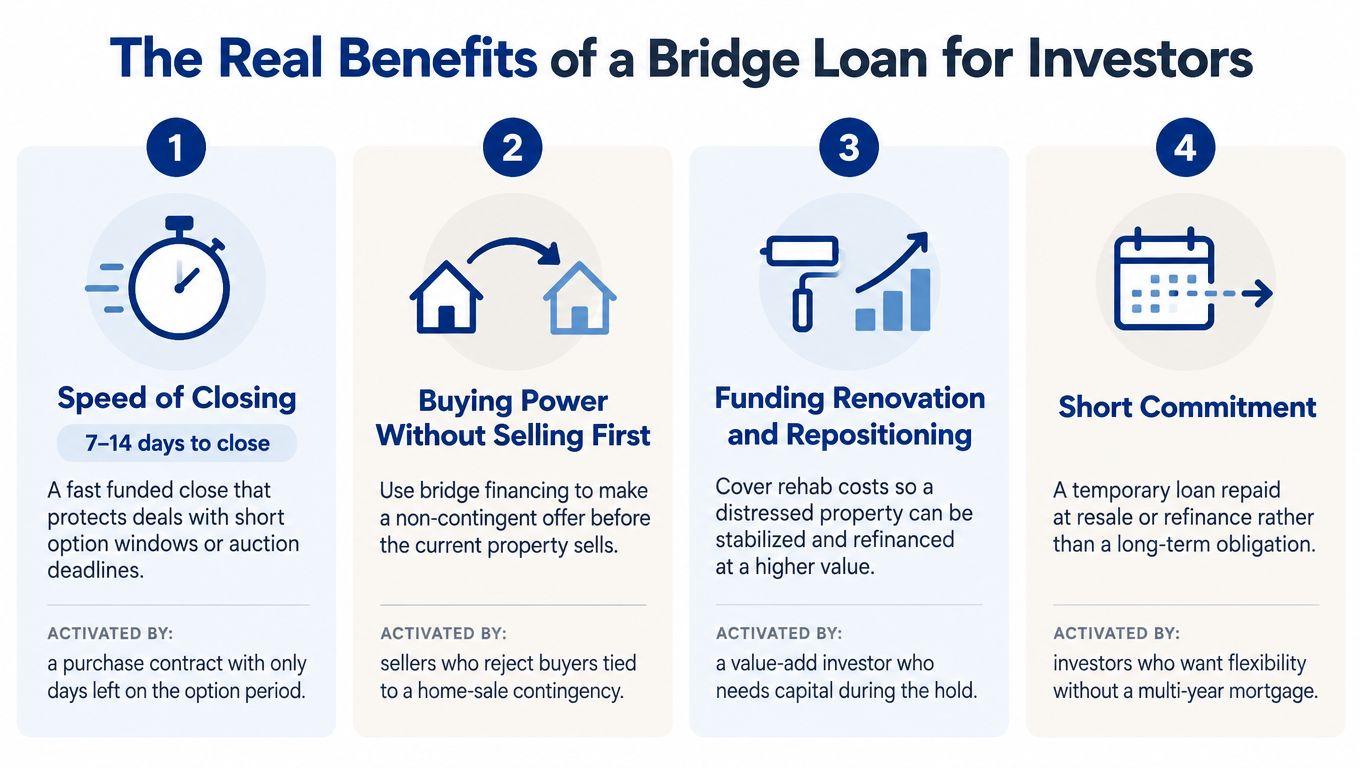
Bridge financing earns its place in an investor's capital stack when it solves a problem that cheaper debt can't solve in time. The most useful benefits aren't abstract promises of flexibility. They're specific advantages tied to specific transaction conditions.
Speed protects the transaction
A seller with a short option period may not wait for a conventional approval. An auction buyer may need funds available before a traditional lender can complete its process. A bridge lender evaluates the project for the transaction at hand, which can help an investor preserve a contract that would otherwise expire.
Speed can also protect execution after closing. An investor who controls a property sooner may secure contractors, order materials, start repairs, or begin leasing work before the opportunity deteriorates. The benefit isn't just closing quickly. The benefit is putting the project into motion while the deal still has an advantage.
Asset-based underwriting helps nontraditional borrowers
Self-employed investors, LLC borrowers, and entrepreneurs may have financial statements that don't fit a standard consumer mortgage process. A bridge lender can place more weight on the collateral, the project economics, the sponsor's relevant experience, and the planned payoff.
That doesn't mean income, credit, liquidity, or experience become irrelevant. It means the property and business plan may carry more influence than a W-2 profile alone. The borrower still needs a credible structure and enough equity to handle setbacks.
Property condition doesn't have to be the finish line
Conventional financing generally works best when the property is already stable, habitable, and easy to value. Investors often find opportunities before a property reaches that condition. A bridge loan may support acquisition and repositioning while the borrower completes repairs, addresses deferred maintenance, or improves the property's income profile.
The right use case is a property with a defined improvement plan, not a project with unknown defects and an optimistic budget.
Flexible payoff can support a quicker exit
A resale or takeout refinance may become available earlier than expected. When the loan structure permits practical prepayment without a prohibitive penalty, the investor can repay the bridge debt as soon as the exit is ready instead of carrying transitional debt unnecessarily.
Some structures may also include renovation draws or interest reserves. Those features can help align funding with project progress, but they don't eliminate the need for accurate budgeting and frequent schedule checks.
The Real Costs and Risks of a Bridge Loan
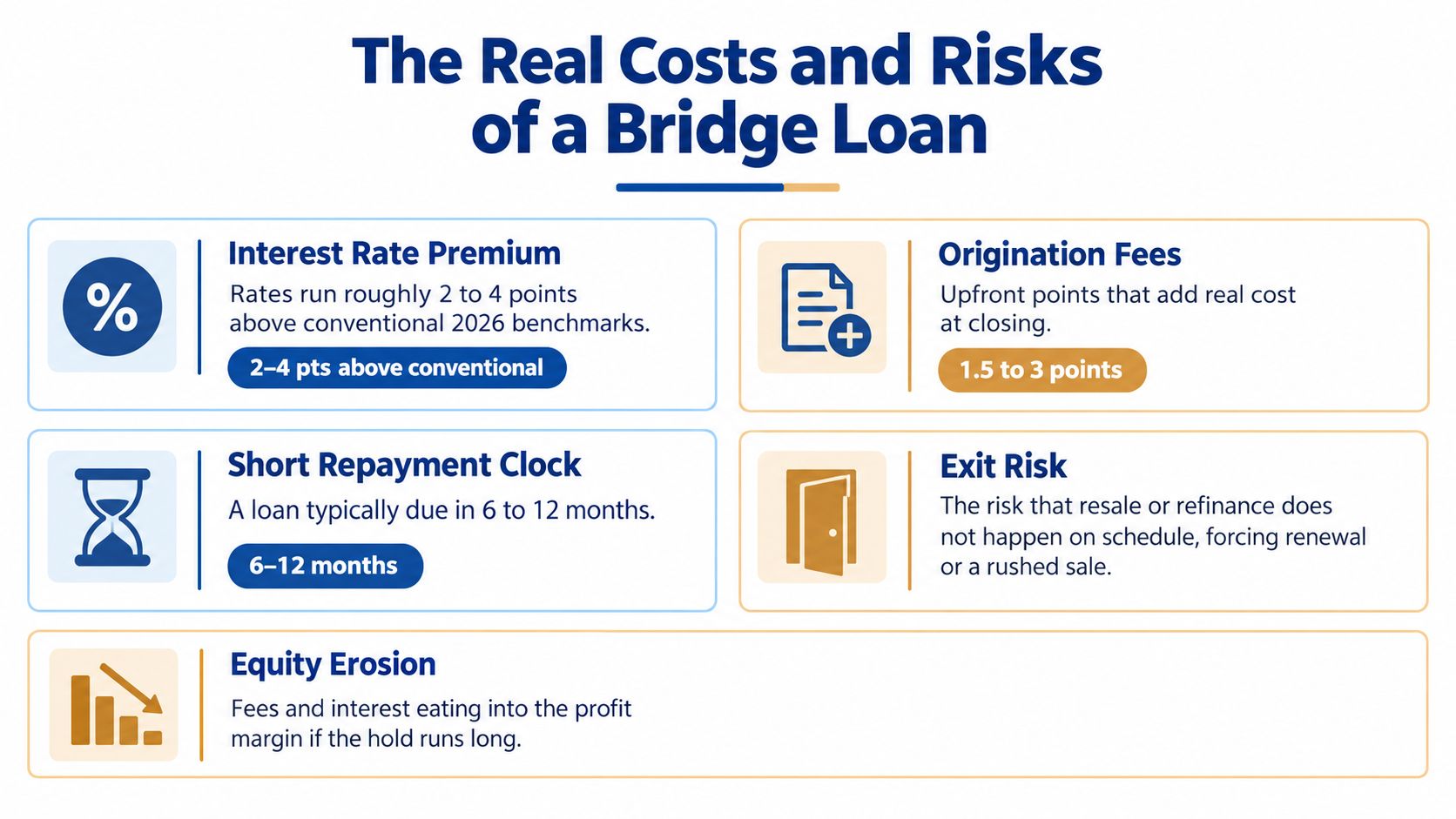
Bridge financing is expensive short-term capital. Recent market summaries place rates around 8% to 13%, origination fees often around 1 to 3 points, and common terms around 6 to 24 months, according to CNBC's explanation of bridge loans. Those figures are market summaries, not a quote for any particular borrower or property.
The cost matters because interest begins before the project produces its final value. An investor may carry the bridge loan while paying contractors, utilities, insurance, taxes, existing debt, or other project expenses. If the property sells or refinances quickly, the premium may be acceptable. If the hold extends, the original margin can disappear.
The repayment clock creates pressure
A bridge loan's maturity date does not shift merely because a contractor is late, a buyer's financing falls through, or an appraisal comes in below expectations. An extension may be available, but it can add cost and requires lender approval. Replacement financing may also take longer than expected.
Interest-only structures can preserve project cash flow during the renovation period, but they usually leave the principal balance largely intact until payoff. That means the investor must be prepared for a substantial payoff event at sale or refinance.
Exit risk is the central failure point
A bridge loan without a credible exit is a liability waiting for a deadline. A resale may take longer, a refinance may fail to support the projected value, or market conditions may weaken before stabilization. Since the property secures the debt, failure to repay can lead to default, foreclosure, or a forced sale.
Coverage of bridge financing often emphasizes speed while giving less attention to the cost of delay. Independent finance coverage of bridge-loan timing risk highlights the danger of overlapping obligations and the pressure created when the prior property or planned exit doesn't occur on time.
The most important number in a bridge deal isn't the quoted rate. It's the number of months the project can survive if the exit slips.
An investor should model the deal with a delayed sale, a delayed refinance, higher repair costs, and a slower stabilization period. If the project only works under the most favorable schedule, the bridge premium is buying exposure rather than control.
Bridge Loans Compared to Conventional and Other Short-Term Options
Bridge loans aren't automatically superior to conventional debt. They solve a different problem. Conventional financing usually wins when the property is stable, the borrower can document income and credit, and the transaction can wait for a longer approval process.
Cash-out refinancing serves a different purpose again. It uses an existing property to release equity, which can help fund another acquisition or project. It doesn't replace the need for acquisition financing when the investor has no usable stabilized asset or when the transaction requires immediate closing.
| Criteria | Bridge Loan | Conventional Mortgage | Cash-Out Refinance |
|---|---|---|---|
| Best fit | Time-sensitive acquisition, renovation, repositioning, or transition | Stabilized property and long-term hold | Equity release from an existing property |
| Funding source | Asset-backed transitional debt | Permanent mortgage debt | Replacement debt secured by an existing property |
| Underwriting | Property, project, equity, borrower profile, and exit | Income, credit, debt obligations, property, and repayment capacity | Existing value, current debt, income, and refinance capacity |
| Cost profile | Higher pricing and upfront fees are common | Usually lower total borrowing cost when the borrower qualifies | Varies by property, debt balance, and borrower profile |
| Maturity | Short, with payoff expected from sale or refinance | Long-term repayment structure | Long-term replacement obligation |
| Condition tolerance | May accommodate properties needing work, subject to review | Usually favors stabilized, financeable condition | Depends on the condition and income of the existing property |
| Main advantage | Preserves a time-sensitive opportunity | Reduces long-term financing cost | Converts existing equity into usable capital |
| Main weakness | Exit deadline and higher carrying cost | Slower process and stricter documentation | Adds debt to an existing asset |
For transitional real estate, the lender may focus on as-is LTV, LTC, projected NOI, debt yield, and the exit rather than borrower income alone. For a stabilized property, conventional underwriting may offer a better economic result because the investor has time to document performance and secure permanent debt.
The decision should follow the deal, not the marketing label. If a Houston investor can wait without losing the property or damaging the project schedule, lower-cost permanent financing deserves serious priority. If waiting destroys the opportunity, bridge financing may be rational despite the premium.
Scenarios Where a Bridge Loan Is the Right Tool and Where It Is Not
A bridge loan is the right tool when timing changes the outcome. It's the wrong tool when timing is merely convenient.
Situations that can justify bridge financing
Tight option periods: A seller may have accepted an offer but won't allow enough time for a conventional lender to finish. Bridge capital can protect the acquisition when the purchase price and project plan already support the risk.
Auction and trustee foreclosure purchases: These transactions may require cash-like certainty and a firm closing plan. A bridge structure can be useful when the investor has completed due diligence and understands the property's condition.
Value-add repositioning: A property may need repairs, updated finishes, improved leasing, or operational stabilization before a permanent lender will consider it attractive. Transitional capital can carry the project through that improvement period.
Wholesale double closes: A wholesaler may need to complete an acquisition before the end buyer's financing is ready. Bridge financing can support the interim purchase, subject to the transaction structure, title review, and a clear payoff plan.
Non-contingent offers: A buyer competing against cash purchasers may need to remove a financing or sale contingency. That can improve the offer's certainty, but only if the bridge lender has reviewed the property and the buyer can execute the exit.
Situations that usually call for another option
Long-hold rental acquisitions generally deserve permanent financing when the property is already stable and the investor doesn't need speed. A bridge loan adds a short deadline to an investment intended to last for years.
A stabilized property with ample time before closing also may not justify transitional pricing. The same applies to a borrower with strong W-2 income and a financeable property who can qualify for a slower, lower-cost conventional loan.
Thin-margin flips are especially dangerous. If fees and carrying costs consume the expected profit, a fast close doesn't fix the underlying economics. The same warning applies when resale demand is uncertain or the refinance depends on an unsupported future valuation.
Decision test: If speed doesn't measurably improve the acquisition, construction schedule, resale position, or refinance outcome, the bridge premium is probably wasted money.
Your Pre-Application Checklist and Next Steps with Quick Lending
A strong application starts before the quote request. The borrower should make the deal easy to understand, easy to value, and easy to connect to a repayment event.
Assemble the deal package
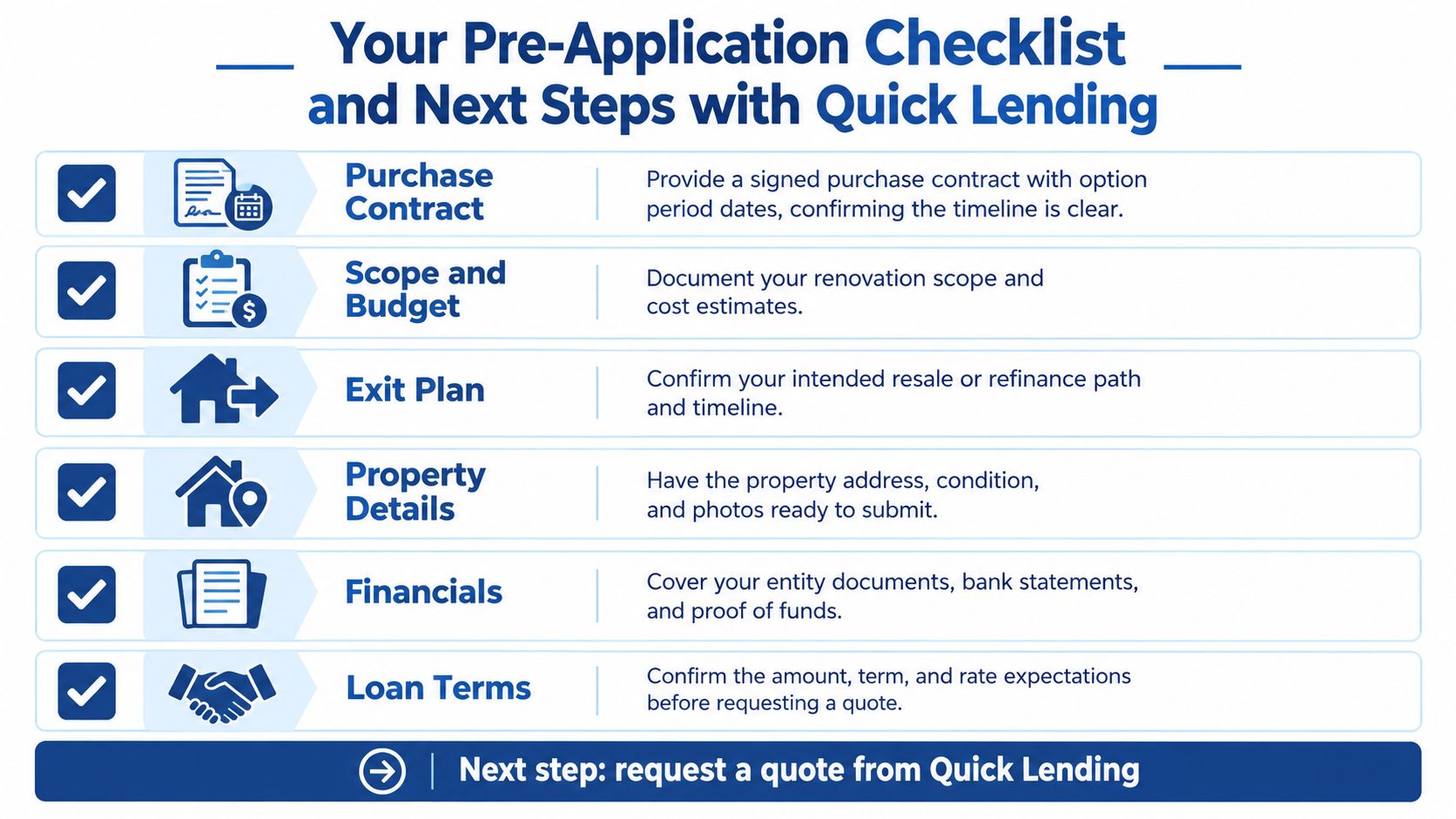
The following items help a lender evaluate the transaction:
- Purchase contract: Include the signed contract and the option-period dates so the closing deadline is clear.
- Scope and budget: Show the repair plan, expected costs, and assumptions behind the renovation schedule.
- Exit plan: Identify whether the intended payoff comes from resale, refinance, stabilization, or another documented source.
- Property details: Prepare the address, condition notes, photographs, comparable-sale support, and any known title or access issues.
- Financial information: Organize entity documents, bank statements, proof of funds, and relevant project history.
- Loan expectations: State the desired amount, likely term, intended use of proceeds, and the borrower's understanding that terms are subject to review and approval.
The borrower should also prepare a clear explanation of sponsor experience, property type, equity position, and the reason conventional financing doesn't fit the timeline or condition. A lender can't evaluate a project efficiently when the schedule, budget, or exit remains vague.
Quick Lending provides short-term hard money, purchase and rehab, bridge, acquisition, and transitional financing for Houston-area investment properties, subject to property and borrower review. Its process is built around time-sensitive transactions, renovation periods, and defined sale or refinance exits. Investors comparing financing approaches can also review practical guidance on the Quick Lending blog.
The best next step isn't automatically accepting the fastest proposal. It's comparing the bridge structure against the project's delay cost, total carry, equity cushion, and exit risk. A quote should be evaluated alongside the full deal budget, not viewed as a substitute for it.
Quicklending LLC offers short-term financing for Houston-area real estate investors handling acquisitions, renovations, and transition periods before a sale or permanent refinance. Investors with a time-sensitive project can visit Quicklending LLC to discuss the property, requested financing, and planned exit, with all terms subject to review and approval.