

Capital market real estate refers to how institutional investors, lenders, and securities such as REITs and CMBS provide large-scale funding that eventually reaches local hard money lenders serving investors. In 2025, 166 institutions from 26 countries reported more than US$14.7 trillion in assets under management, including approximately US$1.4 trillion invested in real estate.
A Houston fix-and-flipper can feel far removed from pension funds, insurance companies, and public securities markets. The connection becomes clear when a distressed property is under contract and the buyer needs acquisition and renovation funds within days, not months. The lender evaluating that deal is part of a broader funding ecosystem shaped by institutional capital, debt markets, property valuations, and refinancing conditions.
Capital markets may sound remote, but they influence whether a local investor can obtain bridge financing, how cautiously a lender underwrites value, and whether a project's exit strategy remains realistic. Understanding that flow helps investors compare financing options without treating every loan as interchangeable.
Table of Contents
- What Is Capital Market Real Estate
- How Debt and Equity Capital Flow Into Real Estate
- The Role of Securitization in Real Estate Finance
- Why the Maturity Wall Matters to Local Investors
- Understanding the Public-Private Valuation Gap
- How Capital Market Dynamics Affect Hard Money Lending
- Choosing the Right Financing Path for Your Deal
- Next Steps for Houston Real Estate Investors
What Is Capital Market Real Estate
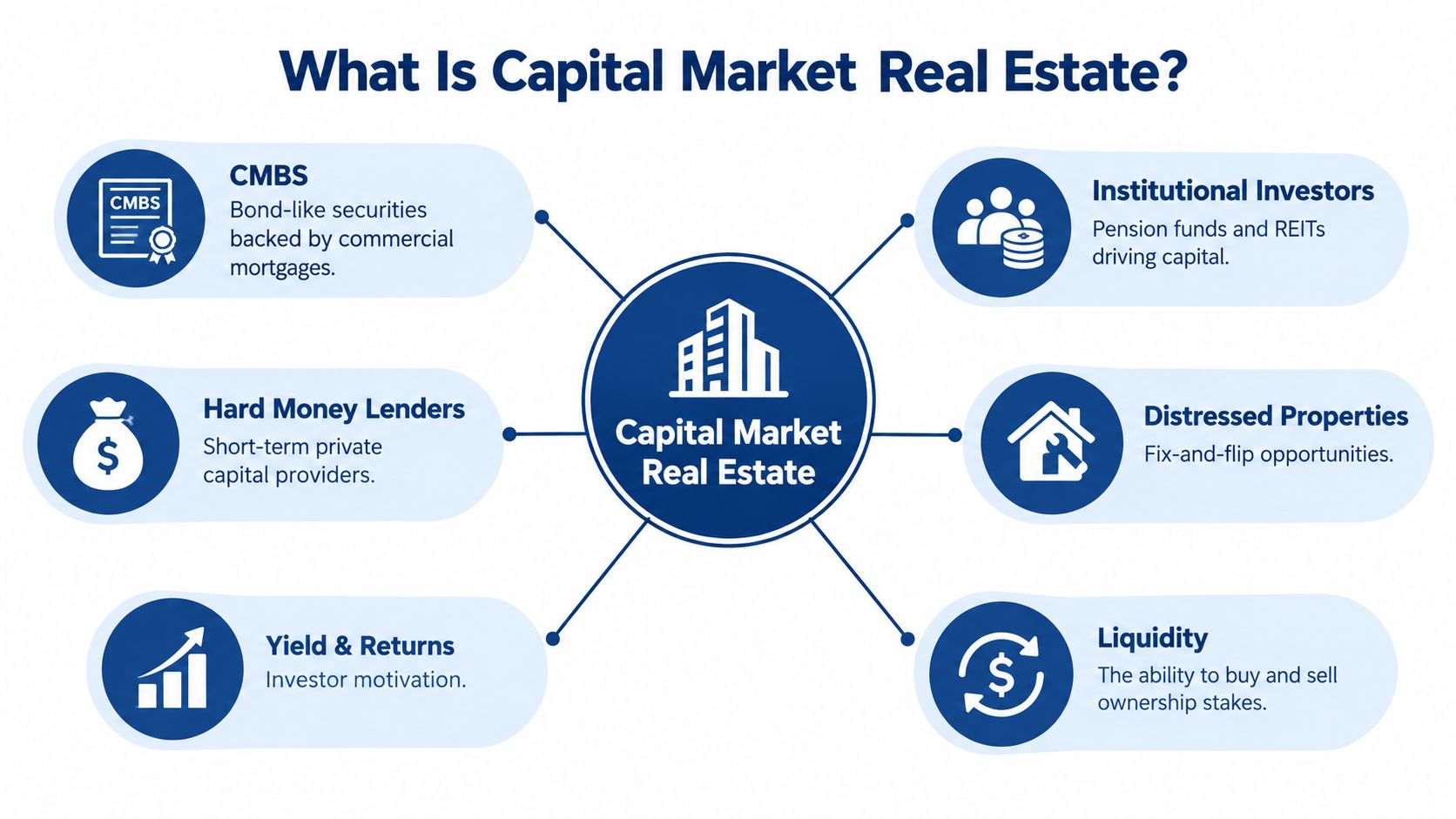
Capital market real estate is the financial system used to move money into and out of property investments. It includes equity capital, commercial real estate debt, public companies such as REITs, private funds, mortgage lenders, and securities backed by property loans.
For a Houston investor, the process often looks like this:
An institutional investor allocates capital to real estate through a fund, REIT, direct investment, or debt strategy.
A financial institution or private lender uses available capital to fund property acquisitions and improvements.
The borrower purchases, renovates, leases, refinances, or sells the property.
Loan payments, rental income, sale proceeds, or investment distributions move back through the system.
The institutional scale is substantial. The 2025 Institutional Real Estate Allocations Monitor records more than US$14.7 trillion in aggregate assets under management among the surveyed institutions, with approximately US$1.4 trillion invested in real estate. The same monitor reports a 10.7% target allocation to real estate in 2025 and an actual portfolio underallocation of about 90 basis points, indicating continued institutional interest in real estate exposure despite uncertainty.
Why the local connection matters
A local hard money loan isn't necessarily isolated private capital. It may be supported directly or indirectly by broader investor demand for real estate debt and property-backed returns. The local lender still evaluates the specific property, borrower, budget, and exit plan, but market liquidity and institutional risk tolerance can influence available terms.
This matters most when a property isn't ready for conventional financing. A house needing significant repairs, a rental requiring stabilization, or a small development with a time-sensitive closing may not fit a bank's process. Asset-based financing can provide a bridge while the investor creates value and works toward a sale or longer-term refinance.
Practical rule: The property and the exit plan should be evaluated together. A loan that solves the purchase problem but ignores repayment may create a second problem later.
How Debt and Equity Capital Flow Into Real Estate
Real estate receives funding through two broad channels, equity and debt. Equity investors accept ownership risk in exchange for potential income and appreciation. Debt investors lend against property or a borrower's obligations and expect repayment with interest under agreed terms.
Equity can enter through a REIT, private real estate fund, joint venture, or direct ownership. A REIT allows investors to purchase an interest in a company that owns or finances income-producing real estate. A private fund may acquire a portfolio of apartments, industrial buildings, or other assets. A direct investor may contribute capital to a specific acquisition.
Debt follows a different path. Banks, commercial mortgage lenders, CMBS lenders, bridge lenders, and private lenders provide loans secured by real estate or supported by the property's expected value. Each lender applies a different risk framework. Stabilized properties with predictable income may fit institutional or bank financing, while transitional properties may require a lender willing to assess the asset's improvement plan and projected exit.
Why the channels don't always meet
Institutional capital generally favors scale, repeatable underwriting, documentation, and assets that can be monitored across a portfolio. A Houston investor buying one distressed property may have a sound project but still fall outside that structure. The issue isn't necessarily that the property lacks potential. The issue may be that the deal is too small, too specialized, too urgent, or too dependent on renovation work for a conventional process.
The modern U.S. framework expanded sharply during the 1990s. Equity REIT market capitalization grew from less than US$10 billion in 1992 to nearly US$128 billion by 1997, a 13-fold increase, according to the historical review of institutional real estate allocations. That growth helped make real estate more investable, more visible to institutional buyers, and easier to price through public markets.
The result is a layered system rather than a single funding source. Equity may support ownership, debt may fund acquisition, and private lenders may cover a temporary gap between purchase and stabilization. Investors should ask which layer fits the property's current condition, rather than selecting financing based only on the lowest advertised cost.
The Role of Securitization in Real Estate Finance
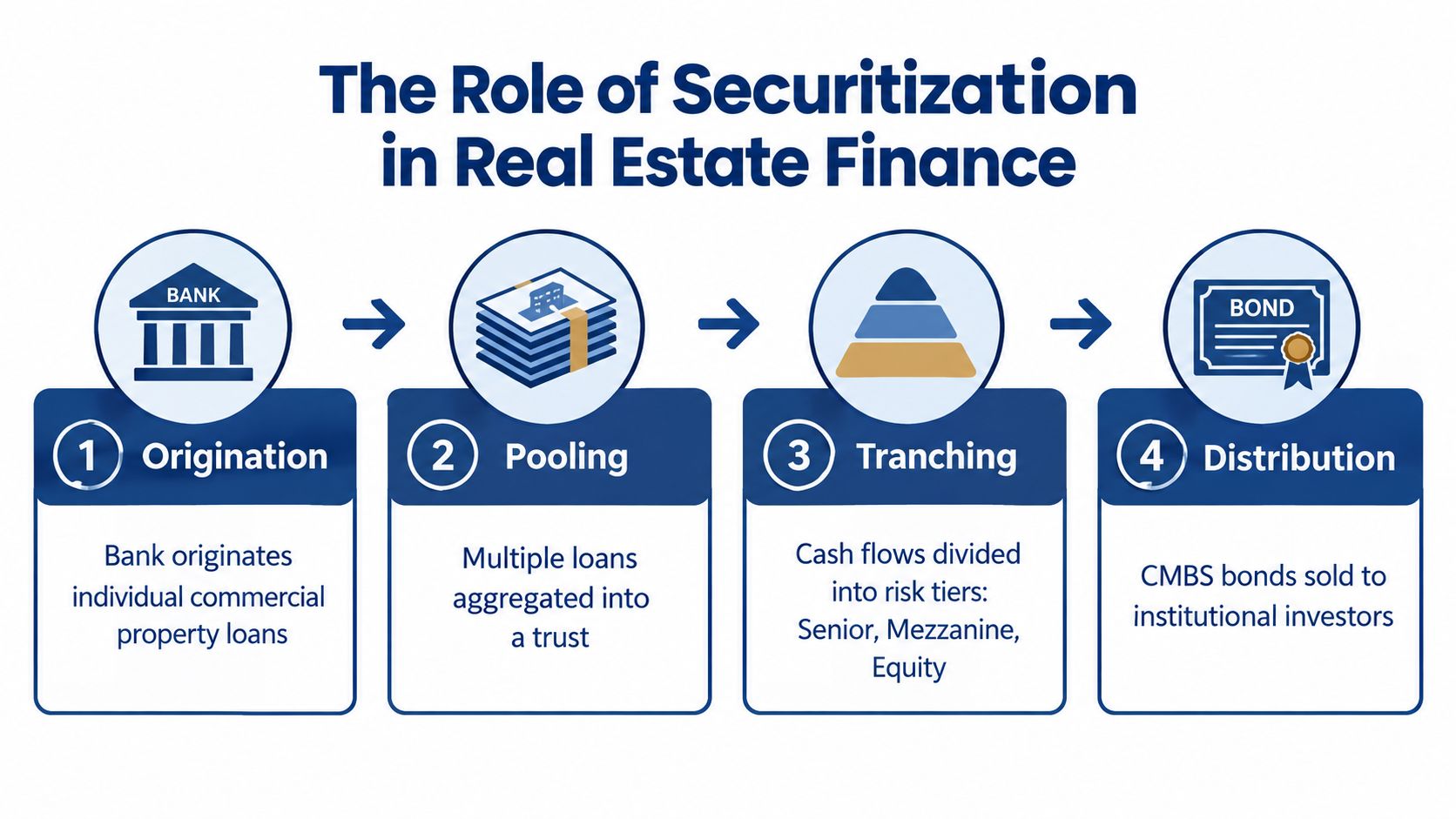
Securitization turns a collection of individual commercial property loans into securities that investors can buy. The basic idea resembles bundling many loans into one investment product. Borrowers still make payments on their property loans, but the cash flows are collected, organized, and distributed to security holders.
A simplified CMBS process works like this:
A lender originates commercial mortgage loans.
Multiple loans are placed into a trust.
The trust divides expected cash flows into risk tiers, called tranches.
Investors purchase the resulting commercial mortgage-backed securities.
How tranches change risk
Senior tranches receive payments before subordinate tranches. Subordinate tranches absorb losses first, which gives senior investors a different risk profile from investors in lower-ranking portions of the structure. This ordering helps securities appeal to investors with different return and risk objectives.
A CMBS loan is still tied to a real property and its income. If a shopping center, office building, apartment complex, or other commercial asset performs poorly, the loan's cash flow can come under pressure. Investor demand for the securities also affects the pricing available for new loans, as explained in this overview of commercial mortgage-backed securities loans.
The balloon payment problem
A standard CMBS loan often carries a 5- to 10-year term and ends with a balloon payment. Individual CMBS loan sizes typically range from $15 million to $75 million, according to this explanation of CMBS loan structure and maturity risk. The borrower may make scheduled payments during the term, but a large balance can remain due at maturity.
That structure creates refinancing risk. If property values decline, interest rates rise, or lenders tighten standards, the borrower may not qualify for a replacement loan large enough to repay the balloon balance. A local investor can face a similar issue on a smaller project when a bridge loan matures before renovations, leasing, or a sale is complete.
Securitization provides liquidity when investors are willing to buy the resulting securities. During periods of stress, that appetite can weaken. Transitional projects may then need alternative lenders that can evaluate the property directly instead of relying on a securitized loan channel.
Why the Maturity Wall Matters to Local Investors
A maturity wall develops when many loans reach their due dates during the same period. Borrowers must refinance, sell, contribute additional equity, or otherwise repay those obligations. The challenge becomes more serious when the replacement loan is based on a lower property value or more conservative debt assumptions.
Newmark reports that U.S. commercial real estate debt originations rose 42% year over year in the first quarter of 2025, while volumes remained below pre-pandemic norms as the market prepared to absorb approximately $2.0 trillion in debt maturities from 2025 through 2027. The Newmark U.S. capital markets report shows why a rise in new lending doesn't automatically mean that every borrower can refinance easily.
How a large problem reaches Houston
A local investor may not own a large office tower or institutional portfolio, but the same financing logic still affects smaller deals. When large lenders become more selective, borrowers across the market may encounter slower underwriting, stricter property requirements, lower proceeds, or more attention to the repayment plan.
That can increase demand for bridge and hard money loans. A hard money lender may focus more heavily on the property's current value, planned improvements, borrower experience, and expected exit than a conventional lender focused on standardized income and documentation. Terms still vary by loan and project, and approval remains subject to review.
MSCI describes capital markets reporting through measures such as cap rates, transaction volume, pricing trends, liquidity, deal structures, and sector-level investor behavior in its U.S. commercial real estate capital trends report. For an investor, those measures translate into practical questions: Is the asset liquid enough to sell? Can the projected refinance support repayment? Will the lender value the property based on its current condition or its completed condition?
A maturity date isn't just a date on a loan document. It is a test of whether the project, valuation, and exit strategy will still work when repayment becomes due.
Understanding the Public-Private Valuation Gap
A Houston investor can face two different values for the same property. Publicly traded real estate companies receive continuous market pricing, while private properties are usually valued through appraisals and negotiated sales. These methods can react at different speeds, especially when borrowing costs, transaction activity, and lender requirements are changing.
Listed real estate currently trades at implied cap rates about 130 basis points higher than private-market appraisals, down from roughly 240 basis points in 2023, according to McKinsey's real estate market analysis. With income held constant, a higher implied cap rate generally means a lower valuation. The smaller gap suggests the markets are moving closer together, though they have not reached one agreed price.
What the gap means for a borrower
Suppose a seller relies on a recent private appraisal or an optimistic asking price. A lender may reach a lower value after reviewing current comparable sales, property condition, income reliability, repair costs, and the likely sale or refinance outcome. The difference affects proceeds, equity requirements, and whether the loan can carry the project through a maturity wall.
For a fix-and-flip or transitional property, projected after-repair value can support the financing discussion. It cannot replace a defensible basis for the acquisition or the planned exit. If repayment depends on selling at the highest value proposed by the seller, a modest valuation adjustment can leave the borrower short.
Recovery does not create uniform pricing
Total transaction volume rose about 19% in 2025, while pricing remained only partially stabilized, according to the same McKinsey real estate report. More transactions therefore do not prove that buyers, sellers, and lenders agree on value. Each party may still price uncertainty differently.
Houston investors should model the deal below the expected sale price, allow for a longer holding period, and test refinancing against current property performance. For a local hard money lender, that analysis clarifies whether the collateral and exit remain workable if private-market valuations lag public-market signals.
How Capital Market Dynamics Affect Hard Money Lending
Capital market conditions influence hard money lending through liquidity, lender competition, property valuations, and the availability of replacement financing. When institutional and bank capital flows smoothly, borrowers may have more options. When larger lenders tighten their standards, asset-based lenders can become more relevant for projects that need a flexible bridge.
The recovery has been selective. Commercial real estate debt markets reengaged in 2025, with new loan originations up more than 30% year over year in the first half, while year-end fundraising potentially reached $129 billion, up 38% from 2024, according to Cushman & Wakefield's analysis of CRE capital formation. Private-market volumes nevertheless remained below prior-cycle levels despite the rebound.

Where hard money can fit
A local investor may seek hard money when a property needs repairs, the purchase requires a prompt closing, or conventional underwriting doesn't match the project's transitional nature. The financing can serve as a bridge to a sale, refinance, stabilization, or another defined exit. It doesn't remove project risk, and it shouldn't replace a realistic budget and timeline.
For a Houston-area investor, Quick Lending may provide short-term hard money, purchase and rehab financing, bridge financing, acquisition funding for distressed properties, and transitional loans. Its process is oriented toward investment properties and may involve purchases through an LLC or corporation, subject to property and borrower review.
The central question isn't whether hard money is always preferable. It isn't. The question is whether the financing structure matches the deal's timing and condition. A lower-cost loan that arrives after the contract deadline may not serve the project, while a flexible loan with clearly understood costs may help preserve a viable acquisition.
Choosing the Right Financing Path for Your Deal
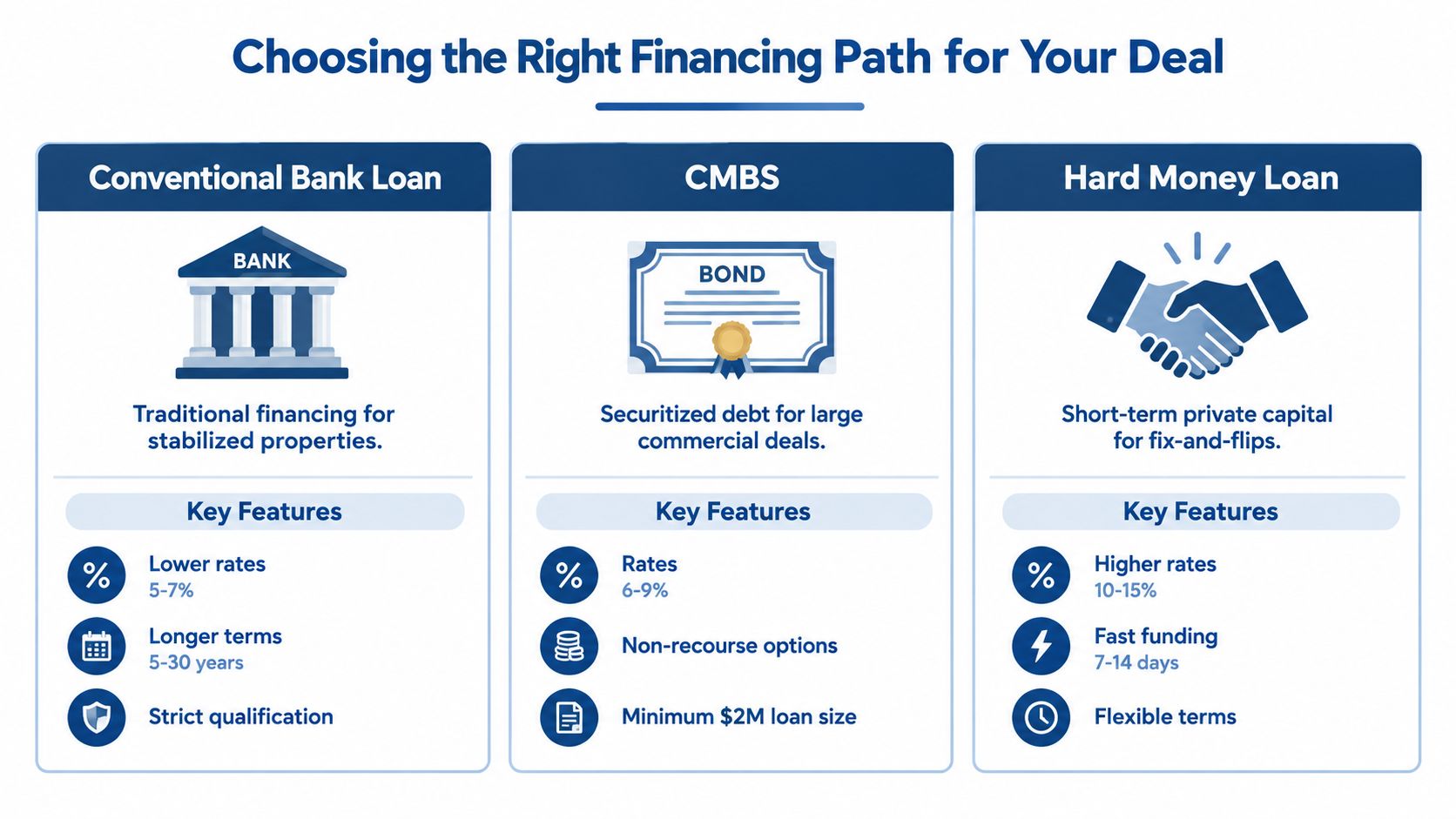
Financing should follow the project rather than the other way around. A stabilized property with dependable income may suit conventional debt. A larger commercial property may fit a securitized structure. A distressed acquisition with a short option period may call for private bridge capital while repairs or repositioning take place.
Four questions for the financing decision
1. What is the property's current condition?
A property needing substantial repairs may not qualify for a loan designed for stabilized assets. The renovation scope, permits, contractor plan, and projected completed value should be organized before financing is requested.
2. How urgent is the closing?
A conventional process may be appropriate when the seller, contract, and project timeline allow extended review. A private lender may be more suitable when an auction, tight option period, or multiple-offer situation makes timing central to the transaction.
3. What is the exit strategy?
The borrower should identify whether repayment is expected through resale, refinance, rental stabilization, or another source. The plan should include a fallback if the sale takes longer or the final value is lower than expected.
4. Does the loan match the scale and structure?
CMBS and institutional financing often serve larger commercial transactions with standardized documentation. Hard money may fit smaller or transitional investment projects, but terms vary and higher borrowing costs should be modeled carefully.
Decision filter: A sound financing choice balances cost, speed, property condition, documentation, and repayment certainty. No single loan category fits every investment.
Next Steps for Houston Real Estate Investors
Capital market real estate becomes useful when it improves a specific deal decision. Institutional allocations explain where large pools of funding originate. Securitization explains how commercial loans reach investors. The maturity wall and valuation gap explain why lenders may underwrite cautiously even when transaction activity improves.
A Houston investor evaluating a purchase should prepare the property details, acquisition price, repair budget, projected value, intended exit, and key contract dates. The lender can then assess whether the project may fit short-term acquisition, rehab, bridge, or transitional financing. Terms vary by loan and project, and any proposal remains subject to review and approval.
Quick Lending focuses on investment-property financing in the Houston area, including residential projects and certain commercial or multifamily opportunities. Investors can review practical guidance through the Quick Lending real estate investing blog, then request a project discussion when a specific property is ready for analysis.
Understanding the capital behind a loan doesn't eliminate market risk. It gives investors a clearer way to evaluate timing, valuation, liquidity, and the repayment plan before committing to a deal.
Quicklending LLC offers short-term hard money, purchase and rehab financing, bridge loans, and transitional financing for qualified real estate investment projects in the Houston area. Investors with a property under contract or a defined acquisition plan can visit Quicklending LLC to explore financing options and request a quote, subject to review and approval.