

In the second quarter of 2025, a typical U.S. flipped home was bought for $259,700 and resold for $325,000, creating a $65,300 gross spread and a 25.1% return before expenses. Hard money loans are short-term, asset-based financing for Houston investors who need to close quickly on fix-and-flip, renovation, or distressed properties, with the project and collateral carrying more weight than a credit score alone.
A Houston investor may be looking at an auction property, a house with extensive deferred maintenance, or an option-period acquisition that won't wait for a conventional mortgage process. The financing decision can't stop at the advertised rate. Purchase costs, repairs, permits, insurance, taxes, utilities, lender charges, delays, and the eventual exit determine whether the deal creates profit or merely creates expensive debt.
The practical question behind “hard money loans near me” is not just where to find a lender. It's whether short-term financing fits the property's condition, the contract deadline, the investor's available liquidity, and a credible sale or refinance plan.
Table of Contents
- What Hard Money Loans Are and Who They Help in Houston
- How Houston Hard Money Underwriting Works Step by Step
- Calculating Your Houston Fix-and-Flip Project Basis
- When Hard Money Makes Sense for Houston Investors
- Stress-Testing Your Houston Renovation Exit Strategy
What Hard Money Loans Are and Who They Help in Houston
A hard money loan is short-term, asset-based financing secured by real estate. The lender evaluates the property's current condition, estimated completed value, renovation plan, borrower resources, and exit strategy. Personal credit and experience may still matter, but they usually don't carry the same weight they do in a conventional mortgage decision.
Conventional financing generally works best for a property that is already financeable, has predictable income or occupancy, and can withstand a more extensive underwriting process. A distressed house with missing systems, an incomplete renovation, title complications, or a narrow auction deadline may not fit that process. Hard money can provide a bridge for acquisition and improvements, but the higher cost means the project needs enough margin to absorb setbacks.
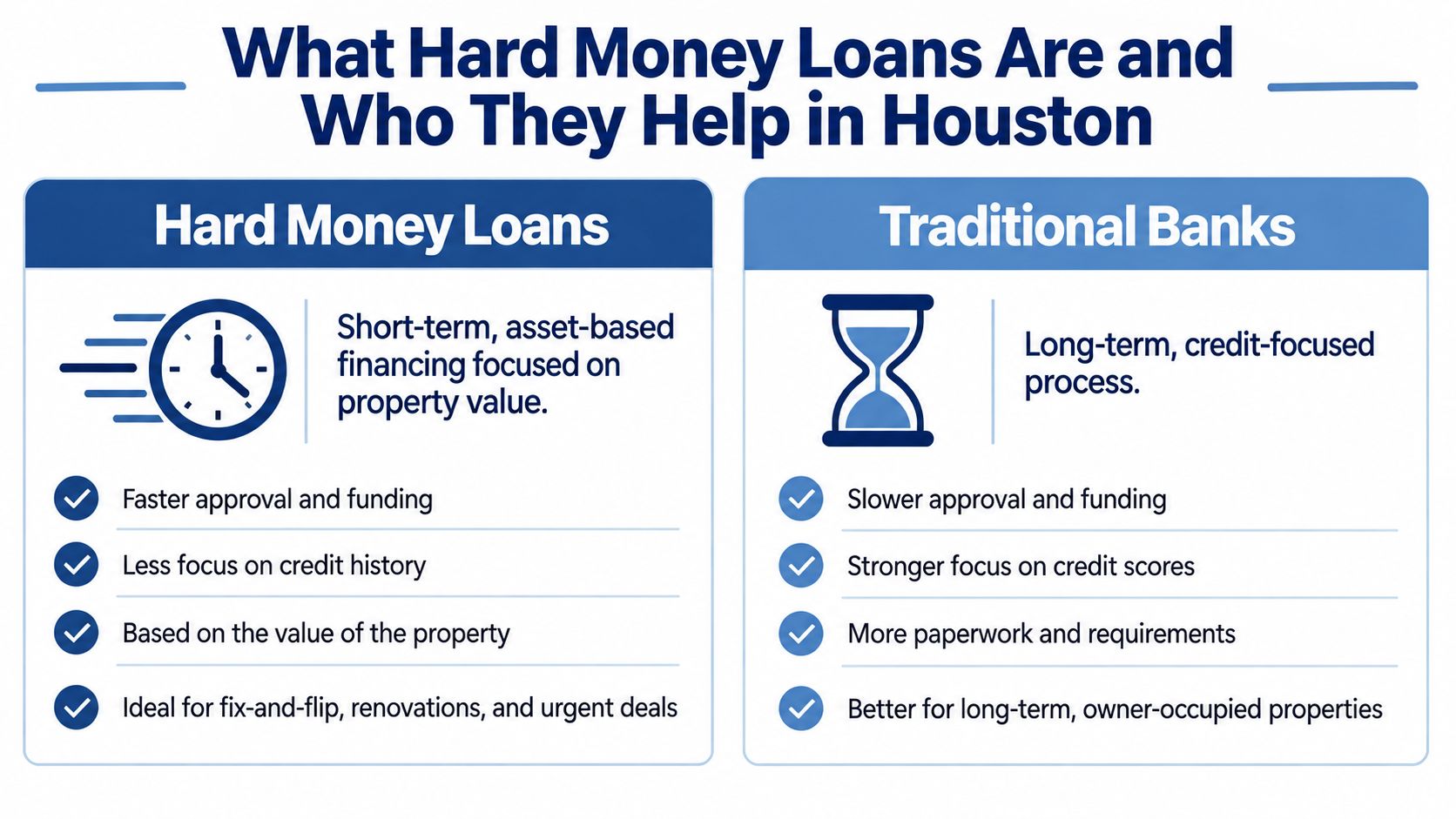
Hard money versus conventional financing
| Factor | Hard Money | Conventional |
|---|---|---|
| Primary focus | Property value, project plan, equity, and exit | Borrower credit, income, debt obligations, and property eligibility |
| Typical use | Acquisition, renovation, bridge financing, and distressed assets | Long-term ownership of financeable properties |
| Speed and flexibility | May fit a compressed closing schedule or unusual property condition | More structured process with stricter documentation |
| Cost profile | Terms vary and may carry higher financing costs | Often designed for longer ownership and lower ongoing cost |
| Best fit | A time-sensitive project with a defined sale or refinance | A stable property and borrower who can wait for standard underwriting |
Home flippers may use hard money to acquire and renovate a property before resale. Real estate renovators can use it when repairs prevent a property from qualifying for ordinary financing. Builders and developers may seek asset-based funding for a defined phase, while wholesalers may need a reliable buyer who can close on a distressed contract. Multifamily investors and other real estate entrepreneurs may consider it when a property needs repositioning before it can support longer-term financing.
Quick Lending serves Houston-area investors across these use cases, including home flippers, renovators, builders, wholesalers, multifamily investors, and entrepreneurs seeking asset-based financing. Investors can also review Quick Lending's real estate investing resources before comparing a short-term loan with a conventional, rental, or private financing option.
Practical rule: Hard money should solve a timing or property-eligibility problem. It shouldn't be the default choice for a property that already qualifies for affordable long-term financing and doesn't have a deadline problem.
How Houston Hard Money Underwriting Works Step by Step
A lender's review should follow the project rather than rely on a single projected after-repair value. Federal banking guidance calls for attention to repayment capacity, collateral, borrower creditworthiness, invested equity, secondary repayment sources, maximum borrowing against the property, feasibility, sensitivity analysis, and hard-equity requirements. Those principles are useful for private real estate borrowers too, even when a private lender's terms differ from bank standards. See the Federal Reserve's interagency real estate lending guidance for the broader underwriting framework.
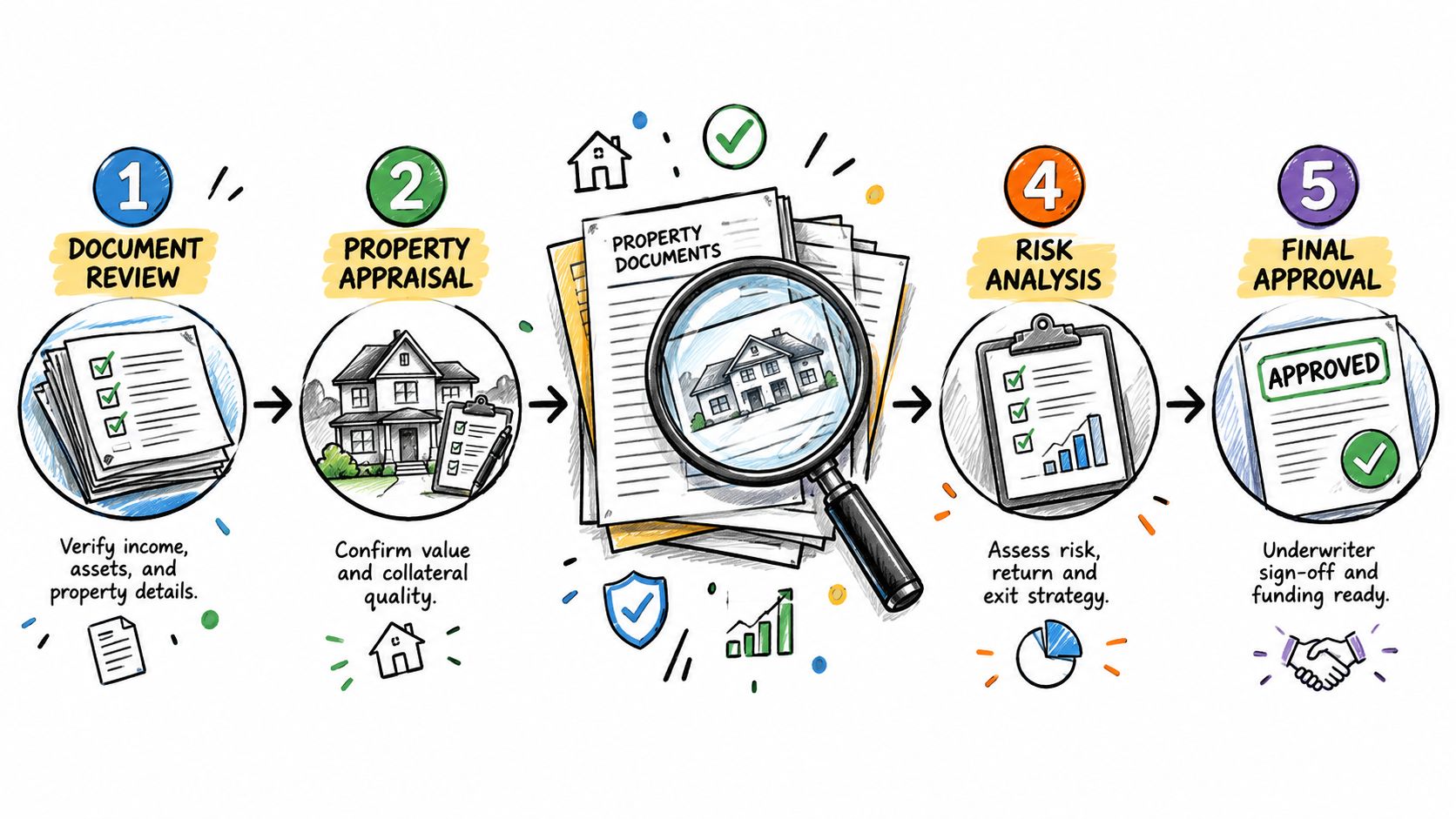
Five questions the lender must answer
Who is the borrower? The review should cover experience, available liquidity, existing credit obligations, guarantees, and the investor's ability to contribute cash when the budget changes. A first project isn't automatically disqualified, but limited experience makes the scope, contractor plan, reserves, and oversight more important.
What is the property worth today? Current as-is value should be supported by relevant comparable sales and, where required, an independent appraisal. A projected resale value isn't a substitute for understanding the collateral before construction begins. Houston values can vary sharply by neighborhood, flood exposure, street condition, school boundary, property type, and buyer demand.
What exactly will the work cost? A credible scope includes labor, materials, permits, professional services, utilities, insurance, taxes, financing charges, and carrying costs. Contractor estimates should be specific enough to connect each draw to a completed milestone. A budget that only lists visible construction work is incomplete.
How much debt can the project withstand? Calculate loan-to-cost, or LTC, against the full project basis. Calculate loan-to-value against current value and loan-to-after-repair-value, or LTARV, against a conservative completed value. Each figure should be tested under a base case and a downside case.
What repays the loan? The exit may be a sale, refinance, or rental stabilization. The timeline needs to account for construction, inspections, marketing, appraisal, title work, underwriting, and closing. A borrower should identify a second exit before the first one fails, not after the maturity date is close.
The lender may also review title, insurance, permits, contractor licensing, and lien waivers before releasing renovation funds. Draw inspections tied to completed milestones help prevent the loan balance from advancing faster than the work.
Calculating Your Houston Fix-and-Flip Project Basis
The purchase price is only the starting point for a Houston flip. Total project basis equals the purchase price, verified renovation budget, closing costs, projected carrying costs, and lender fees. Measuring exposure from the acquisition price alone understates the capital required and can leave the project short of cash before resale.
Build the worksheet around confirmed costs and clearly labeled assumptions. Closing costs may include title and settlement charges. Carrying costs can include interest, insurance, taxes, utilities, maintenance, and the expense of holding the property through construction and resale. Show when each cost becomes due. A project can look profitable in total and still run out of cash during the work.
| Line Item | Include | Typical Houston Range |
|---|---|---|
| Purchase price | Contract price and acquisition-related charges | Project-specific, not assumed |
| Renovation budget | Labor, materials, permits, inspections, and professional fees | Project-specific, supported by bids |
| Closing costs | Title, settlement, recording, and transaction charges | Confirm with the closing professionals |
| Carrying costs | Interest, insurance, taxes, utilities, and maintenance | Calculate monthly and by expected hold period |
| Lender fees | All disclosed financing charges and draw-related costs | Confirm in the proposed loan terms |
| Contingency | Reserve for scope changes and delays | Use a documented reserve, not an unsupported estimate |
Loan-to-cost and loan-to-value calculations
The core formulas are simple:
- LTC = total loan commitment ÷ total project basis
- LTARV = total loan commitment ÷ conservative completed value
- Gross project spread = resale price minus acquisition price, before expenses
The approval amount matters less than whether the project survives a weaker sale and a longer completion timeline. Test the base case first, then reduce the resale assumption and extend the hold period by several months. Include the resulting interest, insurance, taxes, utilities, maintenance, and other carrying costs rather than treating them as minor adjustments.
Fannie Mae's renovation guidance describes agency structures where financed renovation costs generally cannot exceed 75% of the relevant purchase-price-plus-renovation or as-completed-value measure, while postponed work may require an escrow equal to 120% of estimated completion cost, as described in Fannie Mae's renovation guidance. Those limits do not govern private hard-money loans, but they show why a thin budget or inflated ARV deserves closer review.
Houston comparables need more than a similar sale price. An investor might use recent sales from a renovated pocket of a neighborhood to support an ARV for a property several streets away, even though drainage, access, street condition, or buyer appeal differs. That comparable may be too optimistic. Another investor may leave out permits, utility activation, insurance, or interest while assuming every renovation dollar adds equal resale value. Both approaches create false confidence.
Underwriting principle: The highest approval amount isn't necessarily the strongest loan. The stronger structure limits debt relative to the risk of finishing, holding, and selling the property.
ATTOM's Q2 2025 home flipping report found that the typical flipped home sold for $325,000 after a $259,700 purchase, producing a $65,300 gross spread and a 25.1% return before expenses; the report also recorded a median 165-day period from purchase to resale and a 37% typical margin for homes purchased between $100,000 and $200,000, as reported in ATTOM's Q2 2025 home flipping report. The return was the lowest quarterly level ATTOM recorded since the second quarter of 2008. These national figures provide context, not a guarantee for any Houston property.
When Hard Money Makes Sense for Houston Investors
Hard money makes sense when the cost of waiting is greater than the cost of short-term financing, and when the project has enough margin to handle execution risk. It doesn't make sense just because an investor wants a quick answer or doesn't want to assemble conventional documentation.
A useful decision starts with the transaction deadline. An auction, a short option period, a distressed seller, or a property that needs immediate repairs may create a real timing problem. A conventional loan could be financially attractive but unusable if the seller won't extend, the auction closes before underwriting finishes, or the property condition prevents approval. Texas tax-foreclosure sales also follow statutory timing rules. Unless an authorized online auction applies, a real-property sale generally occurs between 10 a.m. and 4 p.m. on the first Tuesday of the month, with a first-Wednesday exception when that Tuesday is January 1 or July 4. The sale method, title status, redemption rights, and county procedures all need review, as explained in Texas Tax Code Section 34.01.
Compare the cost of borrowing with the cost of waiting
The hidden cost of waiting may include:
- Lost deposits: Contract funds can be at risk if the investor can't close.
- Extension fees: A seller may demand additional consideration to keep the agreement alive.
- Renegotiation risk: A seller may accept another offer or change terms.
- Carrying costs: Delayed acquisition or construction can shift the entire project schedule.
- Lost opportunity: Another investor may secure the property or the contractor slot.
A bridge loan can be rational when the property needs to be acquired now and refinanced after stabilization. A DSCR or other long-term rental product may be more appropriate once the property produces reliable income. Conventional financing may be the better choice when the property is already eligible, the borrower can meet the process requirements, and the closing date allows sufficient time.
The Federal Reserve reported that lending standards for construction and land development, nonfarm commercial, and multifamily loans were broadly unchanged in early 2026, while demand and access still vary by borrower size and property type. That supports a simple conclusion: financing availability isn't uniform, so the investor should obtain an actual comparison rather than assume either a bank or a private lender will approve the project. The Federal Reserve lending survey provides the relevant market context.
Fast approval isn't automatically a bargain. The right question is whether the financing protects a viable transaction that would otherwise be lost.
Stress-Testing Your Houston Renovation Exit Strategy
A projected ARV is only one version of the deal. A responsible stress test asks what happens if the contractor misses a milestone, the appraisal comes in below expectations, the buyer pool absorbs the finished property slowly, or refinancing terms change before stabilization.
Short-term bridge and rehabilitation financing has been quoted around 9.5% to 12.75%, depending on loan-to-value ratios, asset quality, and market conditions, according to current construction and renovation financing commentary. Actual Quick Lending terms may differ by borrower, property, and project and must be confirmed during review. At that cost level, even a modest delay can consume an interest reserve and create pressure to extend, refinance, or sell before the original plan is ready.
Four tests before accepting the loan
Construction delays: Model timeline extensions caused by permits, inspections, material availability, contractor scheduling, weather, or unexpected site conditions. The schedule should identify the point at which the loan needs an extension and the maximum additional cost the project can absorb.
Refinance risk: A refinance depends on value, condition, income, title, lender standards, and market conditions at the future closing date. A borrower shouldn't treat refinancing as automatic. The project should also be underwritten for sale, even if holding is the preferred outcome.
Cost overruns: Maintain a written budget with a contingency reserve. For two- to four-unit projects, a 10% contingency reserve is a useful benchmark, while certain improvement-escrow structures may permit reserves up to 20%, according to the federal guidance cited earlier. These are risk-management benchmarks, not universal private-loan requirements.
Exit timing: Set a concrete deadline for listing, sale, refinance, or rental stabilization. Define the decision point for reducing the price, changing the scope, adding capital, or selling below the original ARV rather than allowing interest to accumulate without a plan.
Draws should follow inspections and completed milestones. The borrower should confirm the extension policy, reserve requirements, payment structure, title conditions, insurance obligations, permit status, and lien-waiver process before closing.
Frequently asked questions
Are hard money loans only for home flippers?
No. They may support residential renovations, distressed acquisitions, bridge transactions, small development projects, rental stabilization, and other investment-property strategies. The project still needs a defensible value, a workable budget, and a credible repayment plan.
Is a high credit score required?
Credit is one part of the review, but asset-based underwriting places substantial emphasis on collateral, liquidity, experience, invested equity, and the exit strategy. Requirements vary by lender and project, so borrowers should ask what information will be reviewed before assuming that credit alone decides the outcome.
Can hard money finance a rental property?
It may finance acquisition or improvements before a property is ready for long-term rental financing. A borrower should underwrite the future rental income, stabilization timeline, refinance assumptions, and a sale alternative rather than rely on a single projected exit.
Does a conventional mortgage always require more closing time?
Most covered residential mortgage transactions require the borrower to receive a Closing Disclosure at least three business days before closing. The CFPB explains that a new waiting period generally applies when the annual percentage rate becomes inaccurate, the loan product changes, or a prepayment penalty is added. Investment-purpose financing may follow a different disclosure regime, so the lender and closing professionals should confirm the applicable rules early. The CFPB Closing Disclosure guidance describes the distinction.
A Houston investor considering hard money loans near me should compare the full project basis, the cost of waiting, the available liquidity, and at least two exits. Quick Lending can review a proposed acquisition and discuss whether short-term financing may fit the property and timeline, subject to project review and approval.
Quicklending LLC offers short-term hard money, purchase-and-rehab, bridge, acquisition, and transitional financing for Houston-area real estate investors managing time-sensitive purchases or renovation periods. Visit Quicklending LLC to explore financing options and discuss the property, budget, deadline, and planned exit with the lending team.