

Conventional agency guidelines generally require about 15% down for a one-unit investment property and about 25% down for a two- to four-unit property. Hard money and bridge financing may use different leverage trade-offs, especially when a property, borrower, or closing timeline falls outside conventional underwriting.
A Houston investor may be looking at a dated rental, a non-warrantable condo, or a property with a closing deadline that leaves little room for a traditional loan process. The headline percentage matters, but it isn't the whole cash requirement. The key question is how much equity the lender expects, how the property is valued, what condition it's in, and whether the borrower can carry the project until the exit.
Table of Contents
- The Quick Answer on Investment Property Down Payments
- What Loan-to-Value Means for Your Down Payment
- Comparing Conventional, Portfolio, and Hard Money Loans
- Calculating the Real Cash Needed at Closing
- How Down Payment Plans Change by Deal Type
- Common Misconceptions About Investment Down Payments
- How Quick Lending May Help With Your Down Payment Plan
The Quick Answer on Investment Property Down Payments
For a conventional, non-owner-occupied purchase, 15% is the agency-level benchmark for an eligible one-unit investment property. That means a $400,000 property could require a $60,000 purchase-price contribution before closing costs, reserves, lender fees, prepaid taxes and insurance, or renovation funds, based on an 85% maximum LTV example described in the investment-property financing guidance.
A two- to four-unit investment property generally requires more equity. Freddie Mac's published maximum-LTV table lists 85% for a one-unit investment property and 75% for a two- to four-unit property, which implies approximately 15% down and 25% down, respectively, when the borrower and property satisfy the applicable rules. Those agency-level figures are summarized in Freddie Mac's investment-property mortgage guidance.
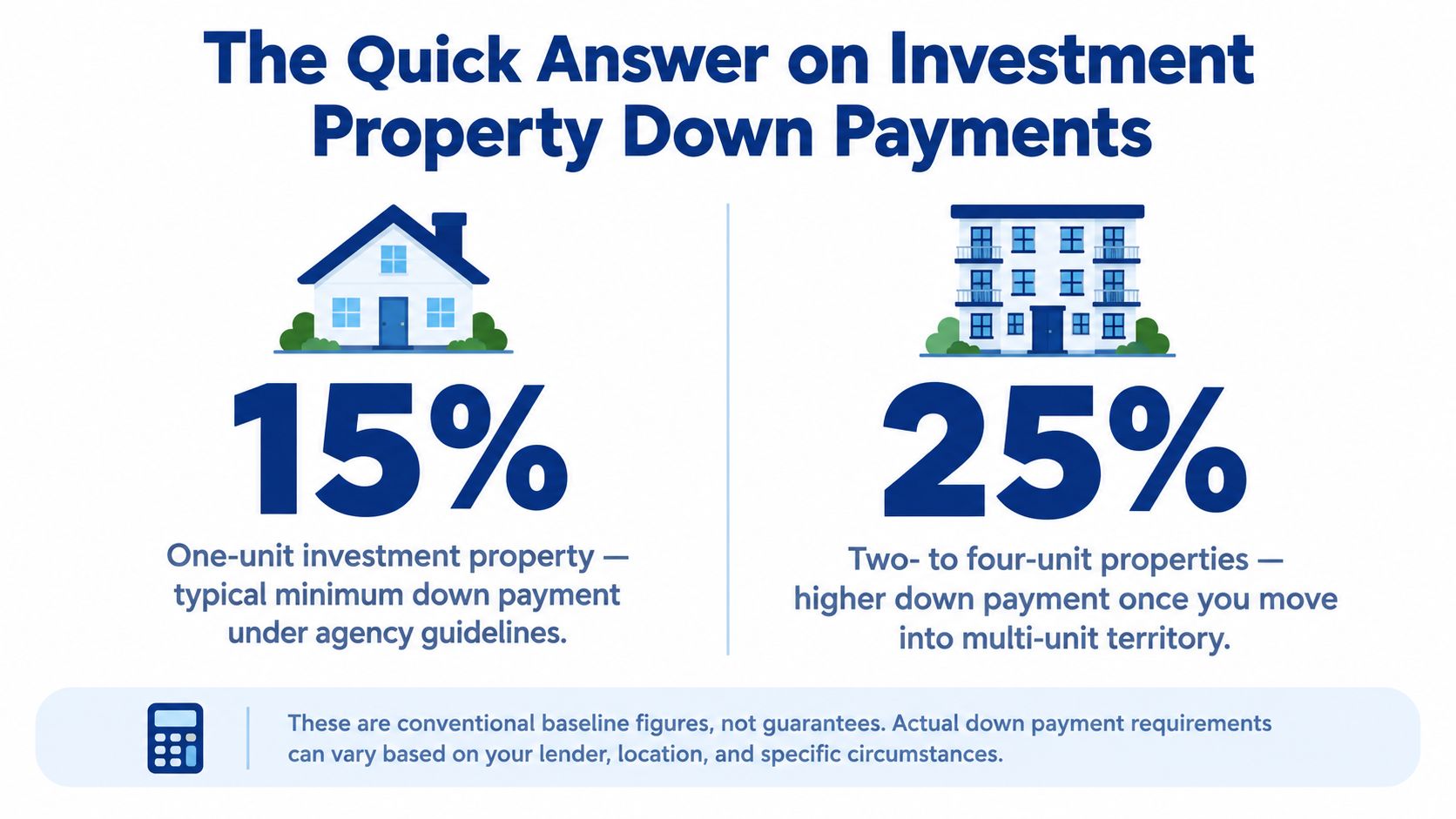
Those are minimum financing benchmarks, not promises. Credit profile, debt-to-income ratio, reserves, loan limits, property condition, appraisal value, and lender overlays can push the required contribution higher. Owner-occupied programs with lower down-payment structures don't automatically apply to a property purchased strictly as a rental or investment.
Start with the unit count
Unit count is one of the first questions a lender asks because it changes the underwriting risk. A single rental home is generally simpler to operate and analyze than a property with several units, where vacancy, repairs, tenant turnover, and operating complexity affect the lender's exposure.
A $400,000 one-unit purchase at 85% LTV produces a $340,000 loan and $60,000 toward the purchase price. A qualifying $400,000 two- to four-unit purchase at 75% LTV requires $100,000 toward the purchase price, a difference of $40,000 before other transaction expenses.
Know when the conventional box doesn't fit
Conventional financing can work well for a stabilized rental with acceptable condition, documented income, and enough liquidity. It becomes less useful when the property needs substantial repairs, the borrower has complex income, the appraisal is difficult, or the closing window is too tight.
Hard money and bridge loans may address those gaps by focusing more heavily on the asset, the project plan, and the exit strategy. That flexibility comes with its own pricing and trade-offs. A borrower shouldn't compare only down-payment percentages. The correct comparison includes total cash required, financing cost, repair funding, carrying expenses, and the time needed to refinance or sell.
What Loan-to-Value Means for Your Down Payment
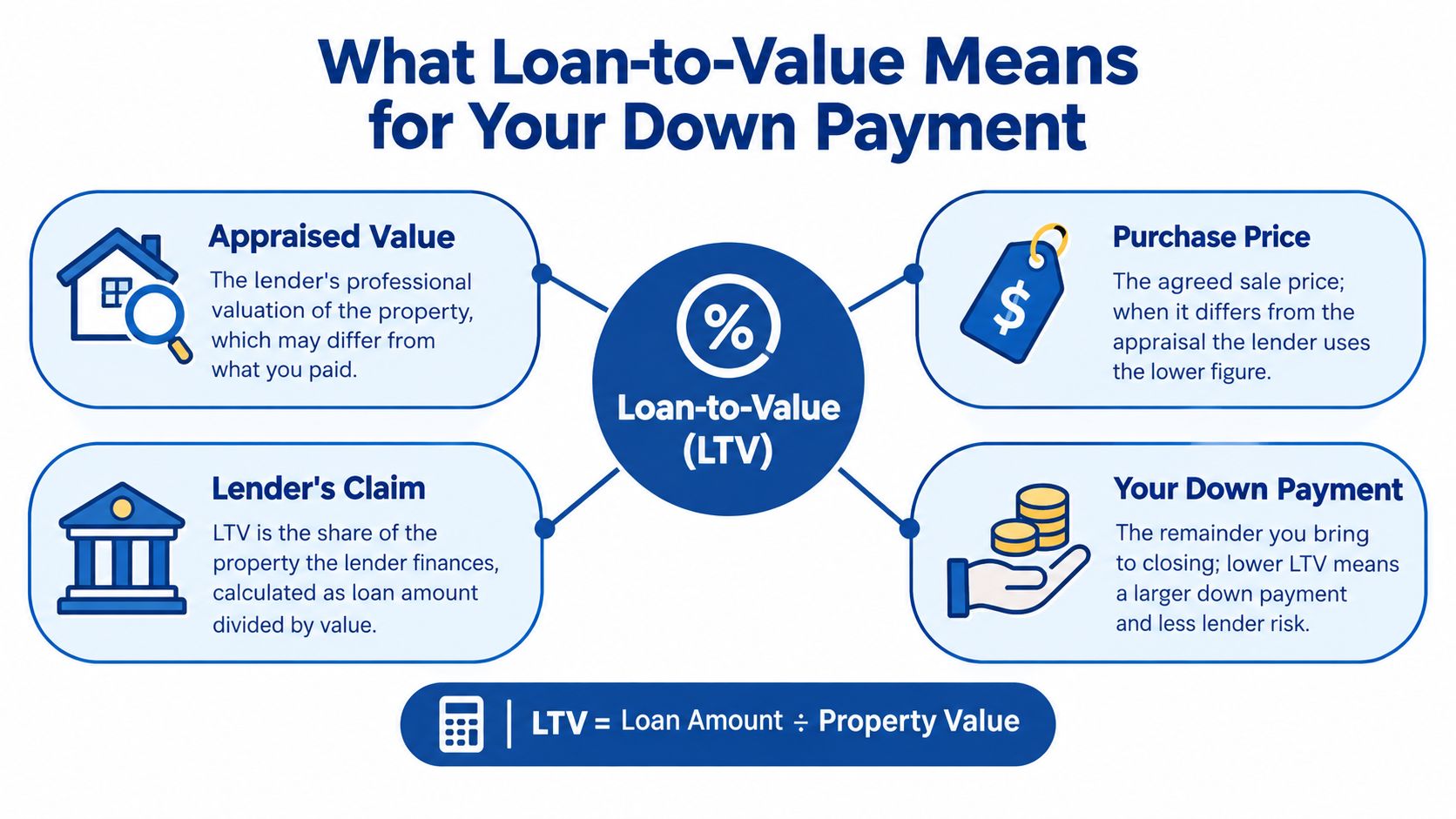
Loan-to-value, or LTV, measures the loan amount as a share of the lender's eligible property value. The calculation isn't based automatically on the contract price. For many conventional transactions, the relevant value is constrained by the lower of the purchase price or appraised value.
That distinction can change the equity check quickly. If a $400,000 contract appraises at $380,000, an 85% LTV calculation supports a $323,000 loan rather than a $340,000 loan. The buyer may then need $77,000 toward the purchase price before closing costs and other cash requirements, as explained in the conventional investment-property loan overview.
The $300,000 example
A $300,000 acquisition makes the math easy to see:
| LTV | Loan amount | Purchase-price contribution |
|---|---|---|
| 75% | $225,000 | $75,000 |
| 80% | $240,000 | $60,000 |
| 70% | $210,000 | $90,000 |
The 75% example reflects the two- to four-unit conventional purchase scenario described in the cited agency-level guidance. The 80% and 70% rows illustrate how the equity check changes when a lender uses a different risk ratio. They aren't universal offers or approval standards.
Practical rule: The advertised LTV is not the investor's final cash number. The final number comes from the lender's eligible value, approved loan amount, and every additional dollar required to close and carry the property.
A lower LTV means more equity and less borrowed money. That can reduce the loan balance and monthly debt service, but it also ties up more capital. A higher LTV preserves cash for repairs or other acquisitions, but lenders may offset that exposure through pricing, fees, reserve requirements, or tighter project review.
The calculation also explains why a low purchase price isn't enough by itself. A property can look affordable until the appraisal comes in below contract, the lender reduces the loan amount, or the borrower discovers that repair funds must come from separate liquidity. Investors should calculate the equity requirement from the lender's valuation and then add the rest of the transaction budget.
Comparing Conventional, Portfolio, and Hard Money Loans
The right loan depends on the deal, not on a universal down-payment rule. A stabilized rental with clean documentation belongs in a different financing category from a distressed Houston property that needs work before a conventional lender will consider it.
The following comparison keeps the categories practical. Exact terms vary by lender, borrower, property, and project.
| Loan Type | Typical Down Payment | Approx. Close Time | Condition Tolerance | Documentation | Best Fit For |
|---|---|---|---|---|---|
| Conventional | Agency baseline varies by unit count, with one-unit and two- to four-unit properties treated differently | Traditional closing process | Lower tolerance for unresolved condition issues | Detailed income, asset, property, and reserve documentation | Stabilized rentals that fit agency rules |
| Portfolio | Lender-specific equity requirement | Varies by institution and file | May be more adaptable than agency underwriting | Customized review of borrower and property | Borrowers or properties that fall outside standard agency criteria |
| Hard money | Lender- and project-specific equity contribution | Built for time-sensitive acquisitions, subject to review | Often structured for distressed or renovation properties | Asset, scope of work, borrower, and exit documentation | Fix-and-flip, bridge, and non-bankable acquisitions |
| Bridge | Terms depend on the property, transition plan, and exit | Designed for a defined transition period | May accommodate a property before stabilization | Property and exit-focused underwriting | Purchases that need time before refinance or sale |
Conventional financing
Conventional financing usually offers the clearest agency framework, but clarity doesn't mean every property qualifies. The lender may review income, debt obligations, assets, reserves, appraisal, title, insurance, property condition, and rental documentation.
Rental income can help support qualification, but lenders don't necessarily count every projected rent dollar. Under the cited underwriting treatment, 75% of gross rental income may be counted, while the remaining 25% acts as an allowance for vacancy, repairs, and management, subject to documentation and applicable rules. A property expected to generate $2,000 per month in gross rent could contribute approximately $1,500 toward qualifying income rather than the full amount, as described in the rental-income underwriting explanation.
Portfolio lending
A portfolio lender keeps the loan in its own portfolio rather than relying entirely on a standardized secondary-market structure. That can create room for a customized review, especially when the borrower has a strong asset, a nonstandard income profile, or a property that doesn't fit a conventional template.
Flexibility doesn't eliminate underwriting. The lender still needs a defensible valuation, a repayment plan, and confidence that the borrower can manage the property or execute the exit.
Hard money and bridge financing
Hard money is generally more asset-focused and short term. The lender may place greater weight on property value, condition, project scope, borrower experience, and the planned sale or refinance than on a conventional income profile.
That structure can help with a distressed purchase, a tight option period, or a renovation that prevents immediate bank financing. It also means the borrower must evaluate the entire project budget. A smaller equity contribution may come with higher financing costs or greater repayment pressure, so borrowed funds only help when the renovation and exit assumptions are credible.
Calculating the Real Cash Needed at Closing
The down payment is only one line on a Houston investor's closing statement. A workable plan usually has four separate cash buckets:
- Purchase-price equity, the portion of the acquisition not covered by the loan.
- Closing costs and prepaid items, including transaction charges, lender fees, and property-related prepaids.
- Liquidity reserves, which protect the borrower if rent, construction, or the exit takes longer than expected.
- Rehab and carrying funds, covering improvements, utilities, taxes, insurance, interest, and other project expenses.
On a $300,000 purchase at 75% LTV, the loan is $225,000 and the purchase-price contribution is $75,000. That $75,000 isn't a complete cash-to-close figure. It excludes the other buckets, and a lender may also require documentation showing that those funds are available and traceable.
| Cash Component | Conforming Rental, 75% LTV | Hard Money Fix-and-Flip, 70% LTC |
|---|---|---|
| Purchase-price or project equity | $75,000 purchase-price contribution | Varies by approved structure |
| Closing costs and prepaids | Added separately | Added separately unless included in approved financing |
| Reserves | Reviewed under the applicable loan program | Reviewed against project and repayment risk |
| Rehab budget | Usually planned separately when the property needs work | May be addressed through a purchase-and-rehab structure |
| Total liquid cash required | More than the purchase-price contribution | Depends on acquisition, improvements, and exit terms |
The $75,000 calculation follows the agency-level two- to four-unit example described in the applicable conventional loan guidance. The hard-money column intentionally avoids presenting a universal term. Hard money lenders structure transactions differently, and an approved loan may be based on purchase price, project cost, value, or another agreed framework.
Why lenders ask for more than the down payment
Reserves address the period when the property doesn't perform as planned. A tenant may leave, a contractor may uncover an issue, or an appraisal may delay a refinance. The lender wants evidence that the borrower can continue making payments and funding obligations without depending on immediate rent or a quick sale.
Rehab and carry budgets serve a different purpose. Reserves protect the repayment plan, while project funds make the property usable, leasable, or sellable. Combining the two into one headline percentage creates a weak budget.
A borrower with enough money to close but no money to finish the property still has an underfunded deal.
Asset documentation matters, too. Vested stocks, government bonds, and mutual funds may be acceptable for the down payment, closing costs, and reserves when ownership and value are verified. Fannie Mae's cited guidance also addresses documentation after liquidation and limits interested-party contributions on investment properties to 2% of property value, as detailed in the asset and contribution guidance.
How Down Payment Plans Change by Deal Type
A long-term landlord and a fix-and-flip investor may use the same phrase, “down payment,” while solving completely different financing problems.
The conforming rental buyer
Consider a landlord purchasing a conforming two-unit rental in a stable Houston submarket. The property has acceptable condition, the appraisal supports the contract, leases or market-rent documentation are available, and the borrower has savings for the equity contribution and reserves.
The lender's analysis centers on documented borrower income, allowable rental income, debt obligations, property value, and liquidity. The landlord's plan should separate the purchase contribution from post-closing reserves and any repairs needed before the units are fully occupied. A lower loan balance may also make the rental's qualifying cash flow easier to support.
The exit is usually operational rather than immediate. The owner expects to rent the units, manage vacancy and maintenance, and hold the property while the debt remains in place. That makes liquidity and stable carrying capacity more important than reaching the smallest possible initial contribution.
The tight-option flipper
Now consider a flipper buying a dated Houston property under a short option deadline. The home may have condition issues that prevent conventional financing, and the borrower may need to close before a traditional lender can complete its full review.
A hard money or bridge structure may focus on the asset, the purchase contract, the repair scope, the after-repair plan, and the sale or refinance strategy. The equity calculation may be tied to the approved project structure rather than a simple conventional purchase formula. If the lender doesn't finance the full renovation budget, the borrower must bring those funds separately.
The flipper's liquidity timing is different from the landlord's. Cash must cover acquisition, construction gaps, interest, utilities, insurance, and any delay between completion and sale. The exit must be specific enough for the lender to understand how repayment will occur.
Deal test: The down payment is reasonable only when the borrower can fund the project through the exit, not merely through the closing date.
Common Misconceptions About Investment Down Payments
The 20% rule is universal
It isn't. Conventional agency guidance distinguishes between one-unit and two- to four-unit investment properties. The cited frameworks point to an agency-level 15% minimum for an eligible one-unit property and approximately 25% for a qualifying two- to four-unit property, before other cash requirements.
Nonconforming loans use different methods to price risk. A lender may accept a different debt structure because the asset, project, or exit supports it, but that doesn't make the financing cheaper or automatically safer.
Family money always solves the equity requirement
Investors shouldn't assume that informal funds will be accepted without review. The source of funds, ownership, account history, transfer records, and lender rules can affect approval and documentation.
Verified assets may be usable in some circumstances, but the borrower should preserve statements and transaction records. Interested-party credits also have limits. For investment properties, the cited guidance caps those contributions at 2% of property value, so seller credits shouldn't be treated as a guaranteed substitute for the borrower's required equity.
The lowest down payment is always the best choice
A smaller initial contribution preserves cash, but it can increase debt exposure and payment exposure. It may also leave less room for appraisal gaps, repairs, vacancy, or a delayed exit.
A larger contribution can reduce the loan balance and improve the project's liquidity profile, but tying up too much capital can prevent the borrower from completing the work or pursuing the next acquisition. The better question is not “What is the lowest down payment?” It is “What equity structure leaves enough capital to finish and repay the loan?”
Investors should also avoid treating projected rent as fully available mortgage support. As described earlier, underwriting may count only an adjusted portion of gross rent, subject to documentation. The qualification number and the property's real operating income aren't necessarily the same.
How Quick Lending May Help With Your Down Payment Plan
Quick Lending serves Houston-area investors who need to evaluate a property that doesn't fit a standard bank process. Its hard money, bridge, purchase-and-rehab, acquisition, and transitional financing programs are designed for situations involving repairs, repositioning, tight closing windows, or a defined path toward sale or long-term refinancing.
The process starts with the property details. An investor can provide the property address, purchase contract, scope of work, estimated value after improvements, and proposed exit. Quick Lending then reviews the asset and project to determine whether the transaction fits its lending parameters, including the required equity contribution and applicable terms.
That approach is useful when the conventional down-payment formula doesn't answer the problem. A distressed property may need funding before it can qualify for permanent financing. A borrower may have a strong project but insufficient agency-required reserves. A contract may have a closing deadline that doesn't accommodate a conventional process. In each situation, the lender still needs a credible valuation, workable numbers, and a repayment plan.
Quick Lending's Fast Available Funds positioning reflects a practical focus on responsive intake and funding coordination for time-sensitive investment transactions. It isn't a guarantee of approval, pricing, or closing speed. Terms depend on the property, borrower, project scope, documentation, and review.
The exit needs attention before the loan closes. A flipper may plan to sell after renovation. A landlord may stabilize the property and pursue long-term financing. A builder or developer may repay through a sale or another defined capital event. The lender needs to understand that path because the down payment is only one part of repayment risk.
Investors can review practical financing topics on the Quick Lending investment-property blog and prepare the property address, contract, repair budget, valuation support, available cash, and exit plan before requesting a quote.
Frequently asked questions
How much down payment does a one-unit investment property require?
An eligible one-unit conventional investment property generally has an agency-level minimum of approximately 15% down, based on an 85% maximum LTV. The final requirement may be higher after appraisal, credit, reserve, property, and lender review.
How much down payment does a two- to four-unit investment property require?
A qualifying two- to four-unit conventional investment property generally requires approximately 25% down, based on a 75% maximum LTV. The purchase contribution is separate from closing costs, reserves, repairs, and prepaid items.
Can rental income help an investor qualify?
It may. Under the cited conventional underwriting treatment, lenders generally count 75% of gross rental income, with documentation such as leases, market-rent evidence, appraisal information, or tax records subject to the applicable rules.
Can investment-property financing use stocks or mutual funds for cash requirements?
Eligible vested assets such as stocks, government bonds, and mutual funds may be acceptable for down payment, closing costs, and reserves when the lender can verify ownership and value. Account statements, transaction histories, and liquidation records should be preserved.
When should an investor consider hard money or bridge financing?
Hard money or bridge financing may fit a property with significant condition issues, a tight closing window, complex borrower income, or a transition plan involving renovation and later sale or refinancing. The borrower should compare total financing cost, required equity, repair funding, carrying expenses, and exit risk rather than focusing only on the down-payment percentage.
Quicklending LLC offers short-term hard money, bridge, purchase-and-rehab, and transitional financing for qualified Houston-area investment-property projects, subject to review and approval. Investors can visit Quicklending LLC to request a quote or discuss the cash requirement for an upcoming acquisition.