

A first-time flipper often starts with a promising listing, a contractor's rough estimate, and a resale price that appears to leave plenty of room. The mistake comes when the purchase price is subtracted from the projected sale price and the difference is treated as profit. A gross resale spread is only the starting point.
Fix and flip loans for beginners can provide short-term capital for purchasing and improving an investment property, but the borrower still has to cover the full project economics. Interest, points, inspections, closing charges, permits, insurance, utilities, taxes, contractor costs, selling expenses, and schedule delays can consume a spread that looked comfortable on paper.
Table of Contents
- Understanding Fix and Flip Loans for Beginners
- Why Flip Margins Are Tighter Than Headline Returns Suggest
- How to Underwrite a Fix-and-Flip Project Before You Apply
- Choosing Renovation Scope That Recovers Its Cost
- Managing Draws, Contingencies, and Exit-Strategy Risk
- How Quick Lending May Support Beginner Fix-and-Flip Projects
- Frequently Asked Questions About Fix and Flip Loans for Beginners
Understanding Fix and Flip Loans for Beginners
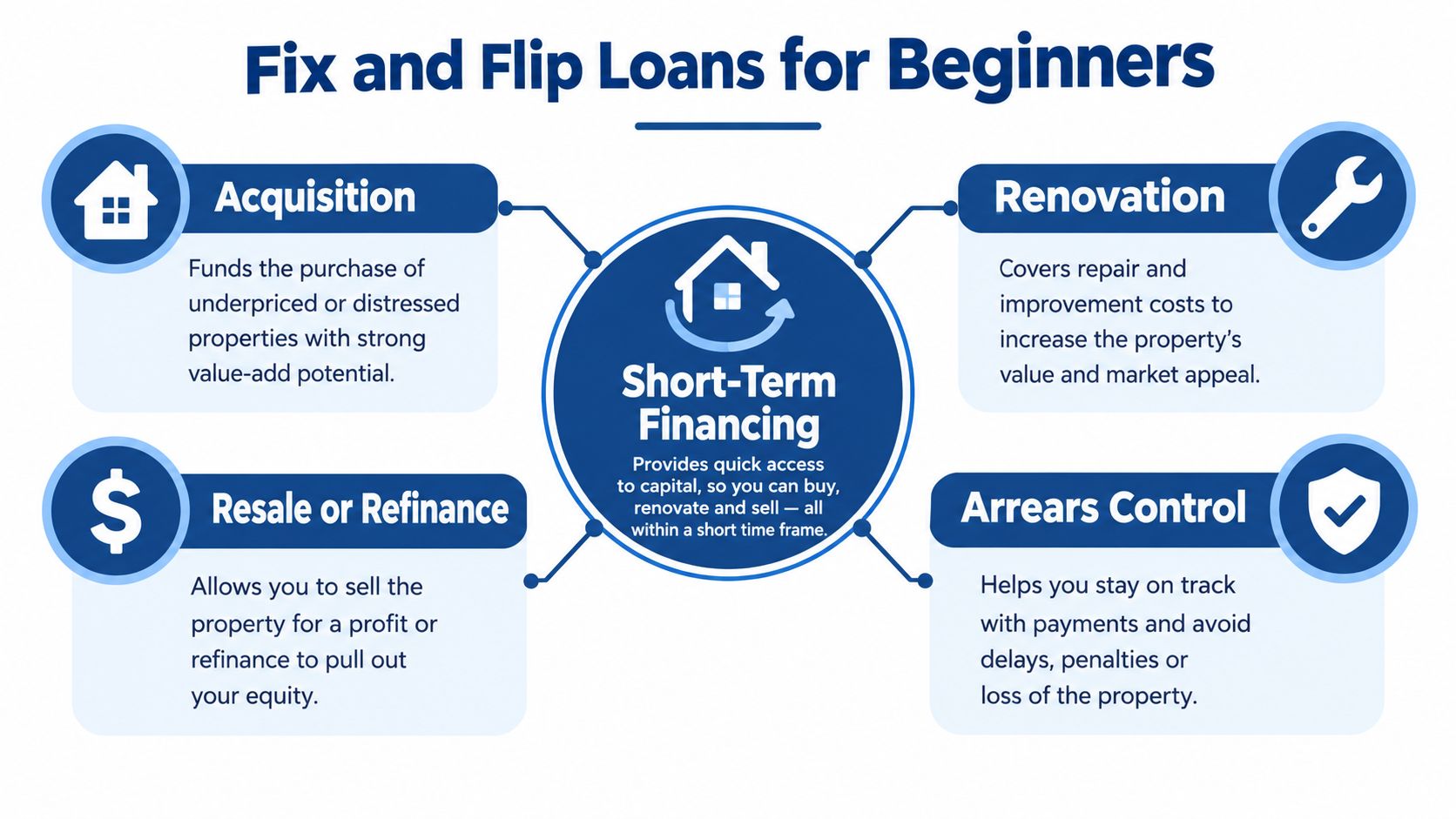
A fix-and-flip loan is short-term financing used to acquire a property, fund approved renovations, and repay the lender through a sale or refinance. Unlike a conventional mortgage, it's generally structured around the property, the renovation plan, the borrower's capacity, and the proposed exit. That can make the process more flexible for distressed or transitional properties, although terms vary by loan and project and remain subject to lender review and approval.
The central beginner lesson is simple: resale spread isn't project profit. ATTOM reported that in the first quarter of 2025, the typical U.S. flipped home was purchased for approximately $260,000 and resold for $325,000, creating about $65,000 in gross profit and a 25% gross ROI before expenses. That calculation excludes financing, origination points, appraisal and inspection fees, title and closing charges, property taxes, insurance, utilities, contractor costs, permits, agent commissions, and taxes on the gain. See the ATTOM first-quarter 2025 home flipping report for the reported methodology and market results.
If acquisition and renovation costs total $300,000, that same $65,000 spread represents about 21.7% of invested project costs before financing and selling expenses. A useful underwriting file therefore calculates the entire capital stack, not just purchase price and resale value.
Practical rule: A lender's approval doesn't turn a thin deal into a strong one. The borrower still owns the overrun, delay, and resale risk.
The project lifecycle starts with a credible loan package, continues through controlled renovation draws, and ends with a defined sale or refinance. Treating each stage as a cash-flow decision helps a beginner avoid committing to a project that depends on everything going exactly right.
Why Flip Margins Are Tighter Than Headline Returns Suggest
Headline ROI can hide how sensitive a flip is to time and cost. ATTOM reported that the typical U.S. flip in the second quarter of 2025 generated approximately $65,300 in gross profit on a $259,700 purchase and a $325,000 resale, equal to a 25.1% gross ROI before expenses. That was the lowest quarterly margin recorded by ATTOM since the second quarter of 2008, while gross profit was 13.6% below the same quarter of the prior year. The ATTOM second-quarter 2025 report provides the market context.
The longer comparison is even more useful for a beginner. Reported coverage of ATTOM's data placed typical gross ROI at 62.9% in 2012, compared with 25.1% in the second quarter of 2025. Older return assumptions can therefore overstate the safety margin available to a current borrower.
Where the margin disappears
Interest accrues while contractors work, even when the property produces no income. Material prices, labor availability, permit delays, and hidden conditions can push the renovation beyond its original scope. A sale that takes longer than expected adds carrying costs and may require a price reduction, while a refinance can become harder if the completed value or borrower's financial position changes.
ATTOM's year-end 2025 data reported a typical gross spread of $65,981 and a 25.5% gross ROI, but the average property took 163 days from purchase to resale. Those figures exclude financing, rehabilitation, holding, selling, and tax costs. The ATTOM 2025 year-end home flipping report is a useful reminder that even a completed sale may involve a substantial holding period.
A conservative borrower treats a fix-and-flip loan as high-sensitivity capital, not guaranteed income. The underwriting must survive interest during construction, a realistic sale period, a construction overrun, and a resale value below the target.
How to Underwrite a Fix-and-Flip Project Before You Apply
A loan-ready project begins with a defensible valuation and ends with a repayment plan. Experienced borrowers don't approve a deal because the property is cheap. They approve it because the completed project still works after realistic costs and downside assumptions are included.
Use a five-step underwriting sequence
Establish the after-repair value. Review several comparable renovated sales in the target neighborhood. The selected properties should resemble the subject in location, size, condition, layout, and buyer appeal. A projected resale price should reflect what buyers have paid for finished homes, not what an ambitious renovation might theoretically create.
Build the renovation budget from bids. Obtain itemized contractor proposals rather than relying on a rough per-room estimate. Separate structural work, systems, finishes, permits, appliances, and cleanup. Add a contingency reserve based on the property's condition and the uncertainty of the scope.
Calculate total project basis. Include the purchase price, financing charges, points, closing costs, renovation work, insurance, taxes, utilities, and expected selling expenses. The total basis is the amount the project must recover before it produces a meaningful return.
Model a realistic exit timeline. The sale period should include construction, inspections, listing preparation, buyer negotiations, closing, and possible delays. A refinance scenario should account for completed value, lender requirements, and the time needed to stabilize the property.
Require a target risk margin. Projected proceeds should exceed total basis by enough to justify the execution risk. If the deal only works at the highest resale estimate and the lowest construction cost, it isn't ready for approval.
Stress-test the package
The national 2025 data cited above shows that a flip can remain tied up for several months. That makes a month-by-month cash-flow schedule essential. At minimum, test a delayed-sale scenario and a construction-overrun scenario.
The schedule should show when loan proceeds arrive, when contractors need payment, when interest and carrying costs accrue, and how much liquid cash remains if a draw is delayed. A borrower should also identify the maximum purchase price that works after subtracting renovation costs, transaction expenses, reserves, and the desired risk margin.
Choosing Renovation Scope That Recovers Its Cost
The most common renovation error is not necessarily spending too little. It's spending on improvements that buyers in the target neighborhood won't value enough to repay the cost.
The 2025 NAR/NARI Remodeling Impact data estimates different resale recovery by project type. A new steel front door recovered 100% of estimated cost, while a closet renovation recovered 83%, a fiberglass front door 80%, vinyl windows 74%, a complete kitchen renovation 60%, and a bathroom renovation 50%. These are national estimates, not guaranteed Houston outcomes, and they compare estimated resale value with estimated project cost rather than overall investment return. The 2025 Remodeling Impact Report explains the comparison.
| Renovation Type | Estimated Resale Recovery |
|---|---|
| New steel front door | 100% |
| Closet renovation | 83% |
| Fiberglass front door | 80% |
| Vinyl windows | 74% |
| Complete kitchen renovation | 60% |
| Bathroom renovation | 50% |
Rank scope before authorizing work
A practical scope review considers four questions:
- Buyer relevance: Does the work address a visible deficiency or a feature buyers expect in comparable homes?
- Permit and inspection risk: Could the improvement require approvals, inspections, engineering, or utility changes?
- Schedule impact: Will the work delay other trades, listing preparation, or final inspections?
- Local recovery: Do nearby renovated comparables support the planned finish level and resale price?
Essential systems come first. Roof, foundation, plumbing, electrical, drainage, heating, cooling, and safety issues can affect habitability, inspections, insurance, and buyer confidence. Cosmetic choices should then match the neighborhood rather than exceed it.
A larger kitchen or bathroom isn't automatically a better investment. If the finished property would be more expensive than competing homes, the extra scope may reduce liquidity instead of increasing demand. Contractor bids should be compared with local comparable properties before the borrower commits loan proceeds.
Managing Draws, Contingencies, and Exit-Strategy Risk
A renovation loan isn't usually an unrestricted pool of cash. Many lenders control rehab proceeds through draws released after work reaches agreed milestones and an inspection confirms progress. The borrower may need to pay for labor or materials before reimbursement, depending on the loan structure.
Before closing, the borrower should understand whether draws require inspections, lien waivers, updated title work, invoices, photographs, or other evidence of completion. The loan agreement should also clarify retainage, change orders, draw timing, and whether interest accrues on undrawn funds or the full committed amount.
Budget uncertainty creates liquidity risk
Industry survey data indicated average renovation costs of about $72,000 in the first quarter of 2025 and roughly $75,000 in the fourth quarter of 2025, with approximately 61% of flippers spending between $31,000 and $90,000. These figures show why a small cosmetic-budget assumption can be misleading, while averages still conceal major differences between properties. The John Burns Research and Consulting Q1 2025 fix-and-flip market update contains the referenced survey data.
If a contractor discovers structural damage or a bid exceeds the approved scope, the lender may not automatically increase the loan. The borrower could face a capital call, meaning additional personal or partner funds are needed before work continues. That cash requirement should be planned before closing, not discovered after demolition starts.

Test three exits
A file models:
- Sale at the target price, after realistic marketing and closing costs.
- Sale after a price reduction, with additional interest and carrying costs.
- Refinance after a delay, including the possibility that the completed value, qualification, or loan terms differ from expectations.
Mortgage rates remained high in 2025, and flipped homes sold during July through September reportedly averaged an 8.3% discount from their maximum listing price. That market condition makes a price-reduction scenario more than a theoretical exercise, as discussed in this hard-money and private-money lending analysis.
A lender evaluates collateral, borrower capacity, and the proposed exit. The investor still carries the risk of overruns, delays, and market time.
How Quick Lending May Support Beginner Fix-and-Flip Projects
Quick Lending, LLC serves Houston-area investors pursuing residential flips, renovations, construction, development, wholesaling, and multifamily opportunities. Its short-term hard-money programs are designed for investment-property acquisitions, approved renovation work, bridge situations, and transitional projects where a defined sale or refinance is part of the plan.
For a beginner, the practical value of a responsive lender is clarity around the project package. A loan officer can review the acquisition, scope of work, valuation support, borrower liquidity, draw expectations, and exit strategy before the borrower commits to a closing. That process doesn't replace the borrower's underwriting, but it can expose missing information early.
The Houston focus may also help borrowers working through local appraisal questions, contractor coordination, permitting, insurance, flood exposure, title work, and neighborhood-level resale considerations. Quick Lending emphasizes Fast Available Funds, an intake, clear communication, and responsiveness during underwriting and closing, without implying guaranteed approval, pricing, or funding.
Borrowers comparing lenders should ask practical questions about draw inspections, required documentation, change orders, extensions, payoff procedures, and total project liquidity. A useful overview of related capital structures is available in Quick Lending's capital markets real estate article.
Terms vary by loan and project, and final approval is subject to review. Qualified borrowers can request a quote or discuss how a proposed Houston project may fit an available financing structure.
Frequently Asked Questions About Fix and Flip Loans for Beginners
What happens if a flip takes longer than expected?
The loan continues accruing interest and carrying costs until repayment. Depending on the agreement, an extension may involve additional fees, revised terms, or further underwriting. If the property isn't ready for sale or refinance before maturity, the borrower may need more liquidity or could face pressure to sell under unfavorable conditions.
How does hard-money financing differ from a conventional renovation loan?
Hard-money and bridge loans commonly emphasize the property, the completed value, the renovation plan, borrower capacity, and the proposed exit. Conventional renovation programs apply more standardized eligibility and appraisal rules. For example, Fannie Mae's HomeStyle Renovation mortgage permits financing for an eligible one-unit investment property, with purchase renovation costs generally capped at 75% of the lesser of purchase price plus renovation costs or the as-completed appraised value. Its HomeStyle Renovation eligibility guidance also illustrates why projected resale value must be supported by an appraisal.
Does a beginner need personal capital upfront?
Usually, a borrower needs liquidity beyond the loan proceeds. That may include the down payment or equity contribution, interest, taxes, insurance, utilities, inspections, draw timing gaps, contractor deposits, and contingency funds. A lender financing most acquisition and renovation costs doesn't necessarily fund every expense on the day it occurs.
Borrowers should review loan documents with appropriate legal, tax, and financial professionals before relying on a structure for a specific project. Educational guidance can't replace advice matched to the property, entity, transaction, and borrower.
Additional educational material is available through the Quick Lending blog, and qualified investors can speak with the Quick Lending team about a proposed project.
Quick Lending, LLC provides short-term hard-money financing for Houston-area investment-property acquisitions, renovation projects, bridge needs, and defined sale or refinance exits. Visit Quicklending LLC to explore financing options and discuss the property, budget, draw plan, and exit strategy with the lending team.