

The borrower who loses the deal is usually not the one with the weakest property. It's the one whose paperwork never reached lender-ready. A seller wants proof of funds, the clock is moving, the house needs work, and a bank keeps asking for more documentation while the opportunity slips away. That gap is where hard money lending fits, especially for Houston investors who need a short-term, asset-based solution that can keep a purchase moving.
Table of Contents
- Why Houston Investors Turn to Hard Money
- Building a Lender-Ready Package
- Understanding the True Cost of Short-Term Financing
- Modeling Your Exit Strategy
- How Quick Lending Supports Houston Investors
- Hard Money vs Conventional Financing for Investors
- Next Steps for Your Houston Investment Project
Why Houston Investors Turn to Hard Money
A common Houston scene starts the same way. An investor has a distressed house under contract, the inspection reveals repairs, and the bank timeline stretches past the option period. By the time the file is clean enough for standard underwriting, the deal's gone.
Hard money exists for that gap. It's best understood as secured, short-term real estate financing built around the property and the exit plan, not as a standard consumer mortgage process. The Federal Reserve's July 2024 Senior Loan Officer Opinion Survey reported that banks tightened standards across major commercial-real-estate categories in the second quarter of 2024 and also reported weaker demand across those categories, which helps explain why alternative capital matters when property condition or timing doesn't fit bank boxes. Federal Reserve Senior Loan Officer Opinion Survey
What that means in practice
For investors buying distressed, vacant, or renovation-dependent houses, the lender usually wants to see that the project itself makes sense. That means the purchase contract, property address, repair scope, budget, expected after-repair value, a realistic sale or refinance plan, and proof that the borrower can cover costs the loan doesn't fund. The lender then looks at the collateral and the exit strategy alongside experience and liquidity.
Practical rule: a strong hard-money file doesn't start with credit score, it starts with a financeable deal.
That's why Quick Lending, a Houston-area hard money lender, fits the market conversation naturally. The local angle matters when the file needs quick review, the property needs repairs, and the transaction can't wait on slow conventional underwriting. For Houston investors, the central question is whether the project can be financed cleanly enough to close before the opportunity disappears.
Building a Lender-Ready Package
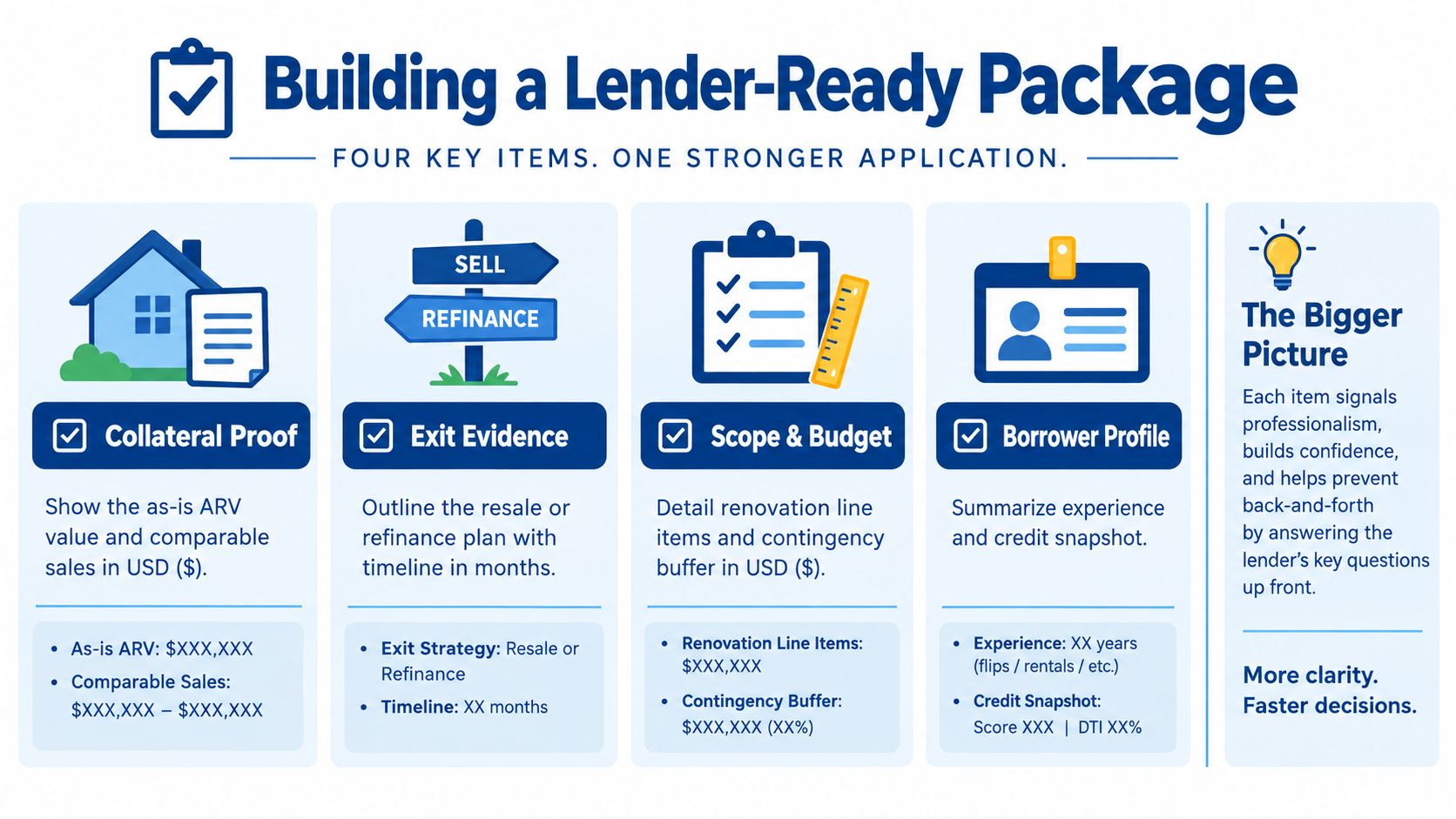
A lender-ready package is really a credibility package. It shows that the borrower understands the property, the numbers, and the way the loan gets repaid. The fastest files are rarely the flashiest ones, they're the ones that answer the lender's questions before the lender has to ask them.
The core method is simple: build the request around collateral and exit, not personal credit alone. That means gathering verifiable value evidence, a real repair budget, and a defined timetable for sale or refinance. Federal interagency guidance also points to a practical submission sequence, confirm lender eligibility, obtain a preliminary term sheet, assemble title and financial documents, validate the scope and budget, order valuation and title work, negotiate draw procedures, and close only after confirming the payoff source. Federal interagency guidance on real-estate lending policies
Documents that reduce delays
A practical file usually includes the purchase contract, property photos, contractor bids, itemized repair budget, comparable sales or rent evidence, recent bank statements, entity and ownership information, identification, and a dated exit timetable. Fannie Mae's guidance on financed properties also shows the broader underwriting logic, borrowers still need enough assets to close after reserves, which is why a sources-and-uses schedule helps lenders see the full picture. Fannie Mae multiple financed properties guidance
What slows files down
The most common mistakes are easy to avoid. Optimistic comparable sales distort the after-repair value. Missing permitting or utility costs understates the budget. Assuming the lender will fund every overrun creates a gap the borrower has to cover later. When a file is structured correctly, the conversation shifts from “Can this close?” to “How should this close?”
Bottom line: the better the package, the fewer the revisions.
That's exactly the kind of discipline Houston lenders respond to. A borrower who brings a complete package usually gets a cleaner review, clearer expectations, and fewer back-and-forth questions before terms are discussed.
Understanding the True Cost of Short-Term Financing
Most borrowers start with the note rate. That's only part of the bill. A short-term hard-money loan can look reasonable on paper and still become expensive once points, extension fees, minimum-interest clauses, servicing charges, and delays are added in.
The structure matters because time changes the economics. Two points on a 12-month loan add roughly two percentage points to the stated rate, while the same two points on a six-month loan add roughly four percentage points before other charges. A recent federal loan-record analysis of Florida short-term investor loans found a 2025 median note rate of 10.45%, with the middle half between 9.75% and 11.2%, and its examples showed that fees could push a six-month loan above an applicable 18% usury threshold. Florida short-term investor loan analysis
A simple way to think about it
A borrower isn't just paying for money. The borrower is paying for speed, flexibility, and the right to close when a bank would stall. That trade-off can make sense on the right deal, but only if the exit is realistic.
| True Cost Comparison: Points Impact by Loan Duration | ||
|---|---|---|
| Loan Term | Points Charged | Annualized Cost Impact |
| 12 months | 2 points | Roughly 2 percentage points added |
| 6 months | 2 points | Roughly 4 percentage points added |
What to read before signing
The focus shouldn't stop at the headline rate. Borrowers need to ask which fees count toward the economic cost, how extension charges work, whether there's a minimum-interest clause, and what happens if the property is repaid early or held longer than planned. A fast loan can be a smart solution when it saves a deal, but a repeated extension schedule can turn a workable project into an expensive one.
Transparent financing is easier to manage than “cheap” financing that breaks when the timeline slips.
For Houston investors, that's the true test. If the numbers only work when everything goes perfectly, the loan is probably too tight.
Modeling Your Exit Strategy
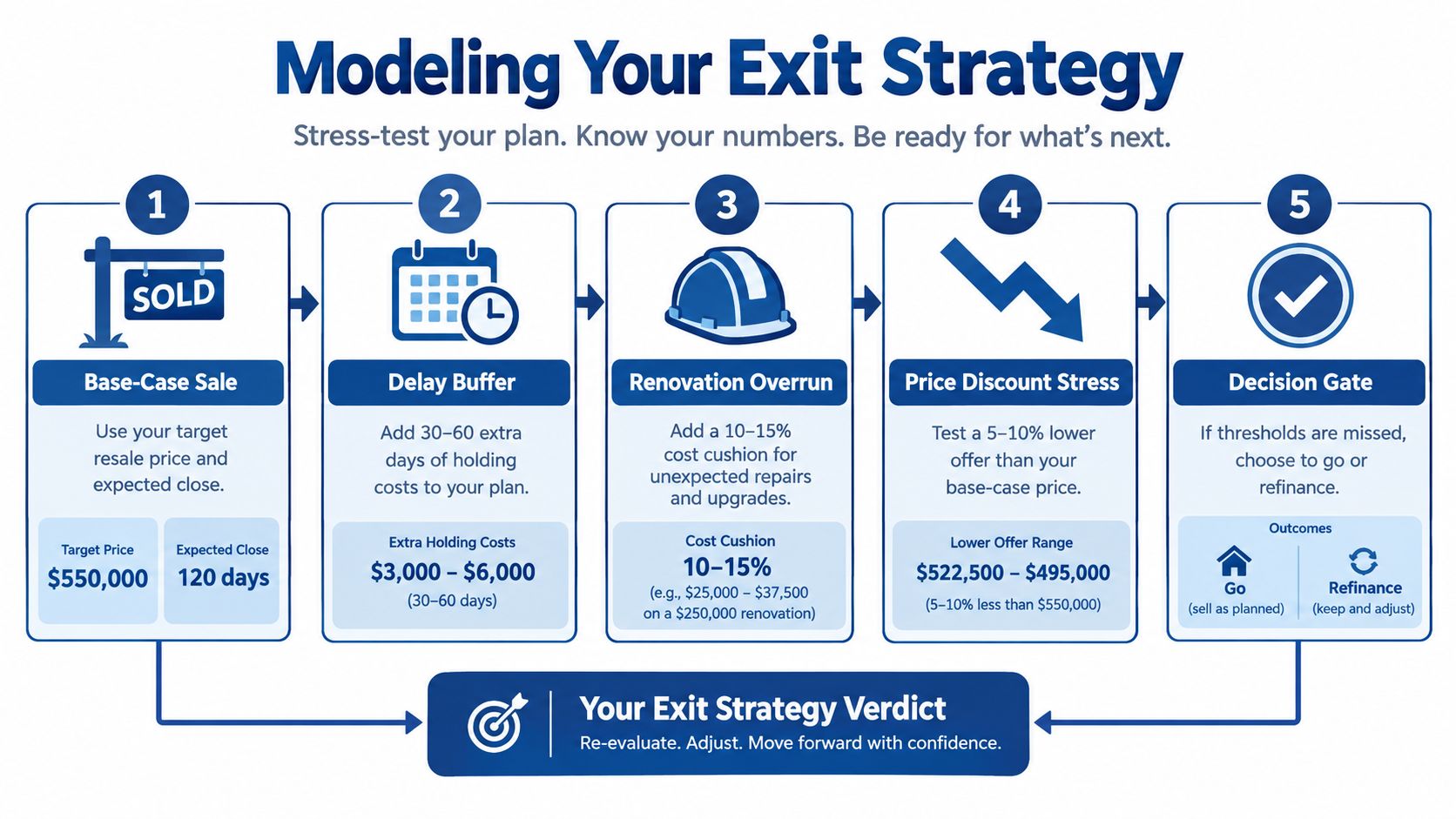
A hard-money lender wants to see repayment, not optimism. The strongest files show how the loan gets paid off if the first plan slips. That usually means testing the exit against slower sales, higher repair costs, and valuation pressure before closing.
There are two common exits. A sale exit depends on the property selling at a price that covers debt, carrying costs, and profit. A rental refinance depends on the asset producing enough income to support new debt. Those are different paths, and they need different proof.
Stress-test the deal, not just the headline number
A strong exit file usually shows a base-case sale, a delay buffer, a renovation overrun cushion, a lower-price stress case, and a clear decision gate for whether to sell or refinance. That approach matters because lenders have tightened several credit conditions, and a deal that depends on perfect execution is harder to underwrite than one that already includes a fallback.
For buy-and-hold or multifamily deals, debt-service coverage ratio, or DSCR, gives the lender a practical stress test. The OCC defines DSCR as net operating income divided by annual debt service. A Federal Reserve research paper describes minimum thresholds used in the analyzed underwriting framework as more than 1.25 for multifamily properties, 1.50 for leased properties, and 1.70 for other loans. The same paper shows that net operating income of $150,000 divided by annual debt service of $120,000 produces a 1.25 DSCR. Federal Reserve DSCR research paper
Why downside scenarios matter
Borrowers gain credibility when they present what happens if permits take longer, appraisal values come in lower, or the refinance lender says no. That doesn't weaken the file. It strengthens it, because the lender can see a real repayment path instead of a best-case story.
If the deal only works at the top of the range, the lender sees fragility, not readiness.
Houston investors who build the exit this way usually have a cleaner conversation with lenders. The file shows discipline, and discipline is what keeps a short-term loan fundable.
How Quick Lending Supports Houston Investors
A Houston deal can look ready on paper and still stall if the lender does not understand the timing behind it. Investors need more than capital. They need a lender that can read property condition, local closing pressure, and the exit plan without adding avoidable friction.

Quick Lending works with investment-property borrowers who need purchase and rehab financing, bridge financing, acquisition funding, and transitional loans for properties that need work before a refinance or sale. That matches the situations where conventional underwriting slows down, especially with distressed houses, tight option periods, auctions, and projects that need repairs before traditional financing becomes realistic.
Why that matters operationally
A clear intake process lets the lender review the file faster and ask better questions early. It also shows the borrower what is missing before the deal stalls. For investors, that can mean fewer surprises during underwriting, cleaner draw discussions, and a more direct path to funding.
Quick Lending focuses on investment properties rather than consumer home loans, so the file is evaluated around the property, the plan, and the exit. That keeps the process aligned with deal-driven transactions instead of forcing them into a consumer-mortgage format. Readers who want more background on financing structures can also review the Quick Lending blog.
Where it fits best
This type of lending works best when the borrower needs to bridge acquisition through project completion, manage renovation timing, or stabilize a property before a refinance. A strong file shows a realistic payoff event and a stress-tested exit, because that is what makes short-term borrowing fundable.
Treat this as bridge capital with a defined payoff event, and reserve long-term low-cost debt for the refinance or sale that follows.
Hard Money vs Conventional Financing for Investors
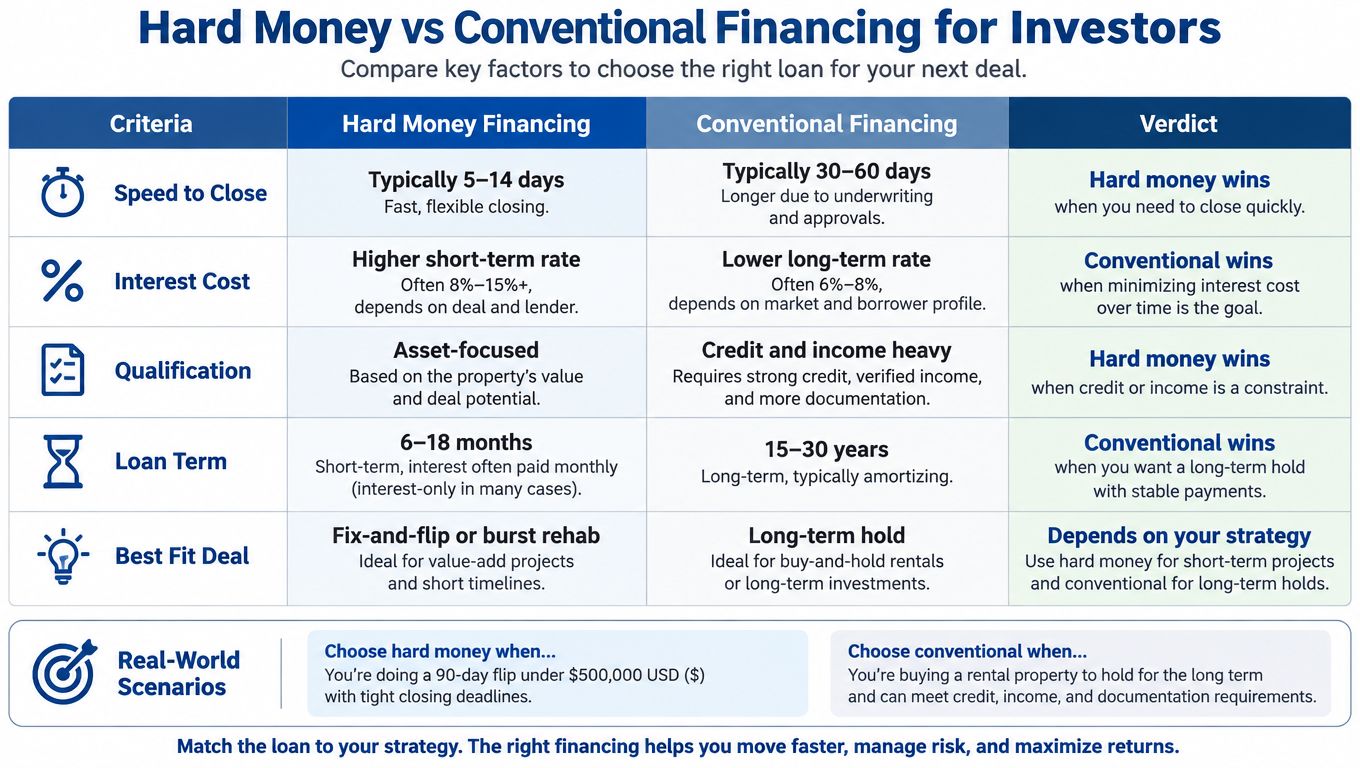
A Houston investor facing a tight closing date and a property that still needs work usually has two practical routes. Conventional financing fits cleaner assets, fuller documentation, and borrowers who can wait for a standard underwriting cycle. Hard money fits deals that live or die on speed, repairs, and a realistic resale or refinance path.
Market pressure explains why both options stay in play. The EY Real Estate Borrower Outlook Survey found that 65% of respondents viewed rising lending margins and less favorable existing-lender terms as major challenges in sourcing or refinancing debt, while 27% said lender decision-making was taking longer. That does not make conventional lending a bad fit. It does explain why investors keep short-term capital available when timing is under pressure.
Decision matrix for investors
| Criterion | Hard Money | Conventional Financing |
|---|---|---|
| Speed to close | Faster when the file is ready | Slower, but often cheaper |
| Property condition | More tolerant of distress or rehab needs | Better for ready, financeable properties |
| Documentation | More asset and exit focused | More income and paperwork heavy |
| Credit dependence | Lower emphasis relative to the deal | Stronger emphasis on borrower profile |
| Flexibility | Better for renovation and transition | Better for long-term ownership |
| Best fit | Flips, bridge deals, transitional projects | Stable holds and standard purchases |
When each option wins
Hard money wins when the borrower needs to move quickly and the property itself supports the loan. Conventional financing wins when the asset is already stabilized and the file can tolerate a slower review. A Houston investor should weigh execution risk first, then compare rates once both paths can close on the timeline.
Short-term borrowing also carries a real cost structure, not just a headline rate. Fees, points, and timing pressure can change the economics fast if the exit slips. For a closer look at how capital conditions shape that math, the Quick Lending capital markets article gives useful context. The cheapest capital still loses if it cannot close on time.
Next Steps for Your Houston Investment Project
The next move is simple. Gather the property details, repair scope, exit plan, and funding need into one clean package, then ask whether the deal fits a short-term secured loan. That single step tells the lender more than a scattered set of emails ever will.
Borrowers usually get better answers when they lead with specifics. A property address, purchase contract, valuation basis, requested loan amount, and the planned sale or refinance path give the lender a usable starting point. If the exit looks thin, that's better identified early than after the deal is already under contract.
Common questions investors ask
Does credit score still matter? Yes, but usually less than the property, the exit strategy, and the borrower's liquidity. Hard-money underwriting tends to lean more heavily on the asset and repayment path.
How fast can a hard-money loan close? That depends on the property, the file, and how quickly the documents come together. A complete package usually moves faster than a file that needs constant revision.
What documents matter most? The most useful items are the contract, repair budget, title information, photos, bank statements, comparable sales or rent support, and the exit timetable. The cleaner the package, the fewer the delays.
What if the project runs late? Delays can increase carrying costs, extension fees, and repayment pressure. That's why a backup exit matters before closing.
Can the property still qualify if it needs work? Yes, depending on the condition, the numbers, and the exit plan. Properties that need renovation are often where hard-money financing becomes most relevant.
A borrower who wants clarity should start by reviewing the basics, then compare the project against the lender's expectations. For broader educational reading, the Quick Lending blog is a useful place to start.
Quick Lending helps Houston investors compare short-term financing options for purchase, rehab, bridge, and transitional projects with a straightforward review process. If the deal needs speed, flexibility, and a clear exit plan, visit Quicklending LLC to request a quote and discuss whether the project fits this type of financing.