

ARV is the market value of the property after a defined renovation is finished, not the purchase price plus the rehab budget.
That distinction challenges a popular shortcut in real estate investing: spending more doesn't automatically make a property worth more. For Houston investors, a useful ARV analysis starts with completed sales and ends with an offer that can withstand a disappointing resale, an expanded repair scope, or a longer holding period.
Table of Contents
- What ARV Means Before You Bid
- How to Build ARV from Closed Comps
- Why Adding Rehab Cost Does Not Set ARV
- One Flip from Comps to Offer Price
- Stress-Testing ARV When Margins Are Thin
- Upgrades That Recover Cost and Those That Do Not
- Set the Offer and Review Financing
- Frequently Asked Questions About ARV
What ARV Means Before You Bid
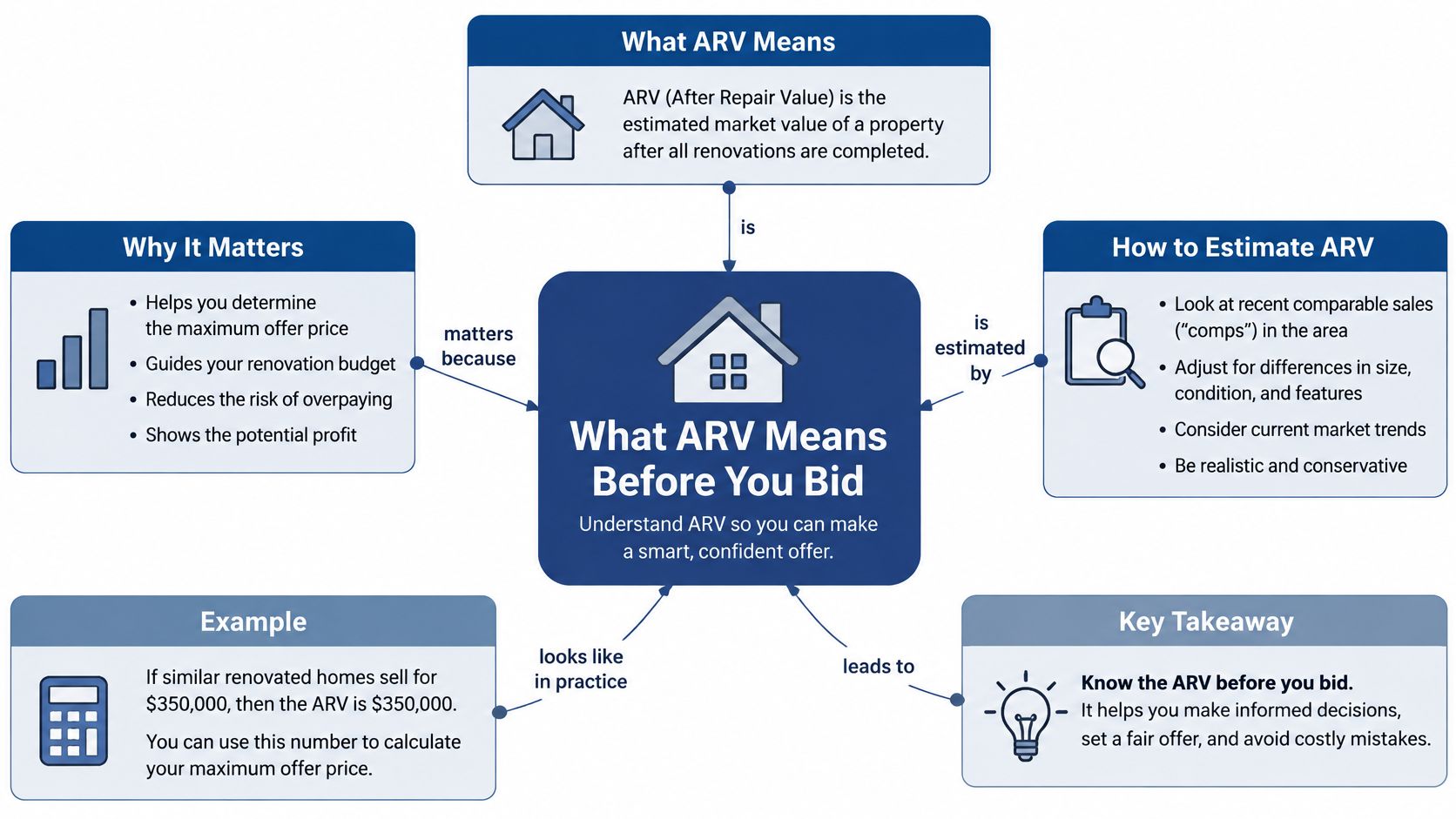
After-repair value, or ARV, estimates what a finished property could sell for after specified improvements. The HUD glossary defines its corresponding term, after improved value, as an appraiser's estimate under the hypothetical condition that planned repairs or alterations have been completed.
As-is value answers a different question: what does the property support in its current condition? Neither figure should be confused with the seller's asking price or the investor's desired exit price.
ARV is a market conclusion supported by finished sales, not a construction total.
Consider a hypothetical house worth $150,000 as-is and $400,000 finished. The first estimate describes the existing asset; the second depends on completing a particular scope and finding market support for that finished condition. The difference isn't a profit calculation.
Why both values matter
Flippers, renovators, and small multifamily buyers need to test the purchase price, repair budget, financing amount, and expected profit against a supported finished value. They also need an as-is assessment if work stops or the property must be sold unfinished.
A careful process follows this sequence:
- Define the finish: Establish exactly what the completed property will include.
- Evaluate completed sales: Reconcile relevant comparables into a base estimate.
- Test the downside: Examine whether a lower resale or higher costs would undermine the offer.
This is investing education, not an appraisal or a forecast of a particular property's sale price.
How to Build ARV from Closed Comps
A defensible ARV real estate analysis connects the planned property to homes buyers have already purchased. The investor needs evidence of the finished product, not evidence that houses nearby have sold.
A practical sequence for selecting and reconciling comps
Write the finished specification.
Record bedroom and bathroom counts, gross living area, construction quality, parking, and major systems. Describe kitchen and bath finishes concretely. A scope described only as a cosmetic renovation doesn't establish whether the subject will resemble the finished homes being used as evidence.Collect closed sales with a comparable finish.
Fannie Mae's comparable-sales guidance calls for at least three closed comparable sales, along with analysis of contract sales and listings. Match location, site, room count, finished area, style, and condition. A renovated subject generally needs renovated comparables rather than distressed houses that still require substantial work.Prefer recent, nearby evidence without forcing a match.
Proximity helps only when the homes compete for similar buyers. Review photographs, descriptions, sale dates, and property characteristics. Freddie Mac's appraisal guidance cautions against adjusting comparable-sale prices for renovation costs a buyer will incur after that transaction, because those costs weren't part of the sale's consideration.Adjust measurable differences using market support.
Location, size, quality, condition, and amenities can justify adjustments. The adjustment should reflect what buyers recognize in that market, not what a contractor charges to construct the feature. If a sale requires extensive speculative adjustments, a different comparable may provide better evidence.Reconcile the set into a base ARV.
Compare the adjusted results and give stronger weight to the most relevant sales. Record the low and high adjusted indications. A cluster of credible evidence supports a conclusion better than selecting the highest sale because it makes the deal work.
A hypothetical $250,000 purchase plus $50,000 of work produces a $300,000 cost stack, not an established ARV. Buyers must have demonstrated support for approximately that finished value in comparable properties.
What makes a comparable usable for ARV
| Check | Standard to meet | If it fails |
|---|---|---|
| Closed sales count | At least three closed sales | Don't set ARV from one best sale or listings alone |
| Condition match | Renovated or similarly finished, not unrepaired | An as-is sale doesn't prove the finished price |
| Physical similarity | Location, site, room count, living area, style, and condition | Large gaps need market-supported adjustments or a different comp |
| Adjustment basis | Differences in location, size, quality, condition, and amenities | Don't add the subject's rehab budget onto the comp price |
| Scope on paper | Beds, baths, living area, quality, parking, and major systems defined | A vague cosmetic budget can't be matched to comps |
Active listings reveal competing asking prices, but they don't prove an accepted and completed transaction. A contractor's bid describes the cost of work, not buyer willingness to pay.
Keep the comp addresses, sale dates, photographs, and adjustment notes together. That file gives an appraiser or lender something concrete to evaluate and makes unsupported assumptions easier to identify before an offer becomes a commitment.
Why Adding Rehab Cost Does Not Set ARV
Cost information can be useful, particularly for unusual properties or buildings undergoing substantial work. The cost approach estimates site value, adds the cost of constructing substitute improvements, and subtracts depreciation.
Fannie Mae's cost-approach guidance identifies properties under renovation, new construction, unique homes, and properties with functional depreciation as situations where this approach may be appropriate, but it doesn't accept appraisals relying solely on that approach as the indicator of market value.
Construction expense and buyer value are different
A contractor prices materials, labor, project conditions, and execution. A buyer compares the completed house with available alternatives. Those decisions don't necessarily produce the same number.
For example, a hypothetical $50,000 kitchen and systems scope might replace worn equipment and dated finishes while adding less than that amount to resale value. Buyers in the subdivision may already have attractive alternatives at a lower finished price.
Underwriting principle: A necessary repair can protect an exit without creating an equal increase in ARV.
Cost information belongs beside the comparable-sales analysis. It can help evaluate contractor bids, identify an unrealistic scope, or explain unusual construction, but it isn't a resale formula.
Rental income may inform a hold strategy, particularly when an investor considers refinancing instead of selling. A flip exit still depends on what a buyer will pay for the finished home.
A licensed appraiser can evaluate valuation support when a substantial offer or financing decision depends on the number. A qualified contractor should separately assess whether the proposed scope, budget, and construction schedule are workable.
One Flip from Comps to Offer Price
A three-bedroom Houston-area flip sits under contract at $210,000, with a planned two-bath layout, updated kitchen, new roof, and new HVAC. Before that price means anything, the investor needs a resale number built from closed sales.
The investor pulls renovated nearby sales, adjusts for physical differences, and reconciles the results. The adjusted indications cluster tightly, which supports a rounded working estimate instead of anchoring on the most expensive sale.
Illustrative flip from comps to first-pass spread
Every figure below is hypothetical and is neither a market quote nor a loan offer.
| Line | Figure | How it is used |
|---|---|---|
| Adjusted comp A | Illustrative $392,000 | Low end of the finished-sale set |
| Adjusted comp B | Illustrative $405,000 | High end, not automatically the ARV |
| Adjusted comp C | Illustrative $403,000 | Third closed sale in the reconciliation |
| Reconciled base ARV | Illustrative $400,000 | Working resale estimate |
| Renovation budget | Illustrative $79,000 | Cash still to spend, not value added |
| Contract price tested | Illustrative $210,000 | Price the seller wants |
| Spread before finance and sale costs | Illustrative $111,000 | ARV minus purchase minus rehab |
The $400,000 base ARV lands inside the adjusted cluster rather than at its $405,000 upper edge. Treat that cluster as a range: $392,000 is also a defensible outcome, and the $13,000 between the two ends is resale risk already sitting inside the spread. Rounding up to the top comp would hide that risk rather than remove it.
The first-pass math:
Illustrative spread: $400,000 ARV − $210,000 purchase − $79,000 rehab = $111,000 before other project expenses.
Applying a screening shortcut
The 70 percent rule offers a second check on the same deal. Seventy percent of $400,000 equals $280,000; subtracting the $79,000 rehab budget produces a maximum purchase screen of $201,000.
The $210,000 contract price runs $9,000 above that screen. Crossing a screen calls for an explicit decision, because the extra $9,000 comes directly out of the cushion that absorbs resale, scope, holding, and selling surprises.
The investor could:
- Renegotiate the acquisition: Reduce the purchase price without weakening the necessary repair scope.
- Remove unsupported upgrades: Cut optional finishes that comparable buyers haven't demonstrated a willingness to pay for.
- Accept a thinner cushion knowingly: Proceed only after evaluating the actual financing, holding, and selling expenses.
Quicklending's fix-and-flip financing guide for beginners covers how acquisition and renovation financing interact on a deal like this.
Houston due diligence can still move any line in the table. Flood exposure, foundation condition, drainage, insurance cost, and permit status can make a nearby sale a poor comparison even when the floor plan matches.
The $111,000 is a gross spread, and four separate risks draw it down before any dollar reaches the investor: the resale price can land near $392,000, the $79,000 scope can grow, interest and carrying costs accumulate each month the project runs, and commissions and closing costs come out at the sale. What remains after all four is the actual profit.
Stress-Testing ARV When Margins Are Thin
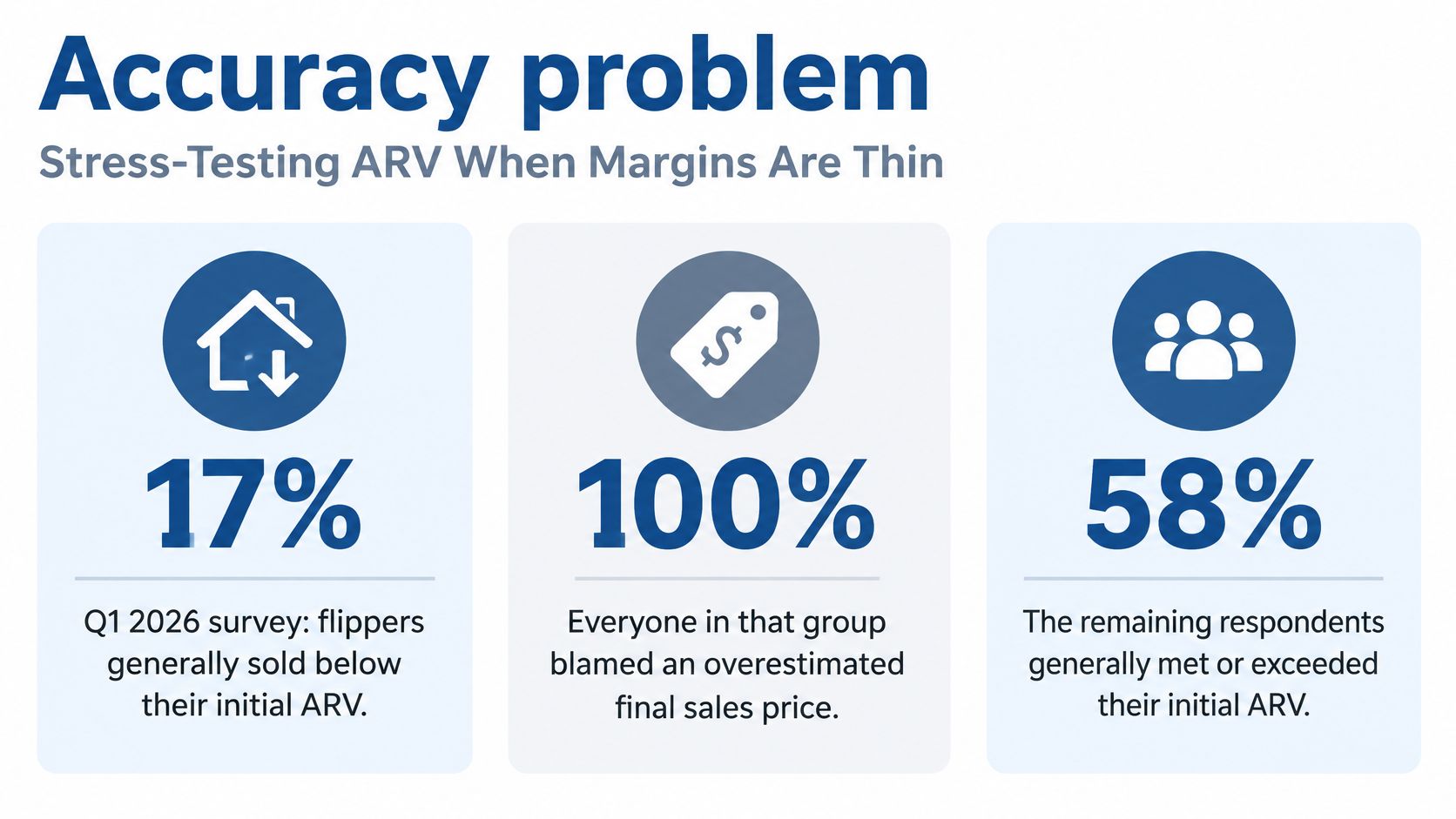
ARV accuracy becomes a practical problem when the expected cushion is small. In a Q1 2026 survey, 17 percent of flippers said projects generally sold below their initial ARV; everyone in that group attributed the shortfall to overestimating the final sale price, while 58 percent also underestimated renovation costs, according to U.S. News' guide to flipping profitability and financing.
The same guide reports that the typical 2025 flip produced a 25.5 percent gross return and $65,981 gross profit, down from 32.1 percent and $77,000 in 2024. Those figures exclude financing, carrying, selling, and unexpected-repair costs.
Offer screen under three ARV cases
The following scenarios extend the hypothetical flip. The purchase screen equals 70 percent of illustrative ARV minus illustrative rehab costs.
| Case | ARV | Rehab budget | Maximum purchase screen |
|---|---|---|---|
| Conservative | $360,000 | $79,000 | $173,000 |
| Base | $400,000 | $79,000 | $201,000 |
| Optimistic | $440,000 | $79,000 | $229,000 |
| Base ARV with overrun | $400,000 | $95,000 | $185,000 |
Across the first three rows, only resale value changes. The rehab budget stays fixed, making the effect of valuation uncertainty visible.
In the last row, the resale estimate stays at the base level while the hypothetical rehab increases to approximately $95,000, roughly 20 percent above budget. The purchase screen falls because of a scope-and-budget problem, not a comparable-sale problem.
The percentage shortcut is an optional screening habit. It isn't a lender requirement, a law, or a substitute for calculating actual project expenses.
Separate the remaining risks
A useful stress test changes assumptions independently before combining adverse outcomes:
- Resale risk: Reduce the finished sale price to reflect weaker or less relevant comps.
- Scope risk: Increase repair costs for unresolved conditions, omitted trades, or incomplete bids.
- Holding risk: Extend the schedule and recalculate insurance, property taxes, utilities, maintenance, and interest.
- Selling risk: Allow for agent commissions, buyer concessions, closing expenses, and repairs negotiated during the sale.
- Financing risk: Calculate interest and other applicable financing costs using the proposed terms and realistic duration.
A longer hold can consume cash even when the final selling price remains unchanged. A repair overrun can reduce the project's margin even when the original ARV proves accurate.
If only the optimistic case works, the investor is depending on a highly favorable sale rather than purchasing a resilient deal.
Where comps are sparse, foundation or flood questions remain unresolved, or the repair scope is preliminary, the conservative case provides a more prudent basis for the offer. If that price doesn't work for the seller, the investor can seek better evidence, renegotiate, or decline the acquisition.
Upgrades That Recover Cost and Those That Do Not
A larger renovation budget can return a smaller share of what it cost. One industry analysis of Houston flipping conditions reports that a midrange kitchen remodel recovered more than its cost, while a major kitchen remodel and a primary-suite addition recovered under half of theirs. The same review, Mortgage Research's analysis of flipping conditions, puts average renovation costs at approximately $79,000 per flip in a Q1 2026 industry survey, up from about $50,000 in early 2022.
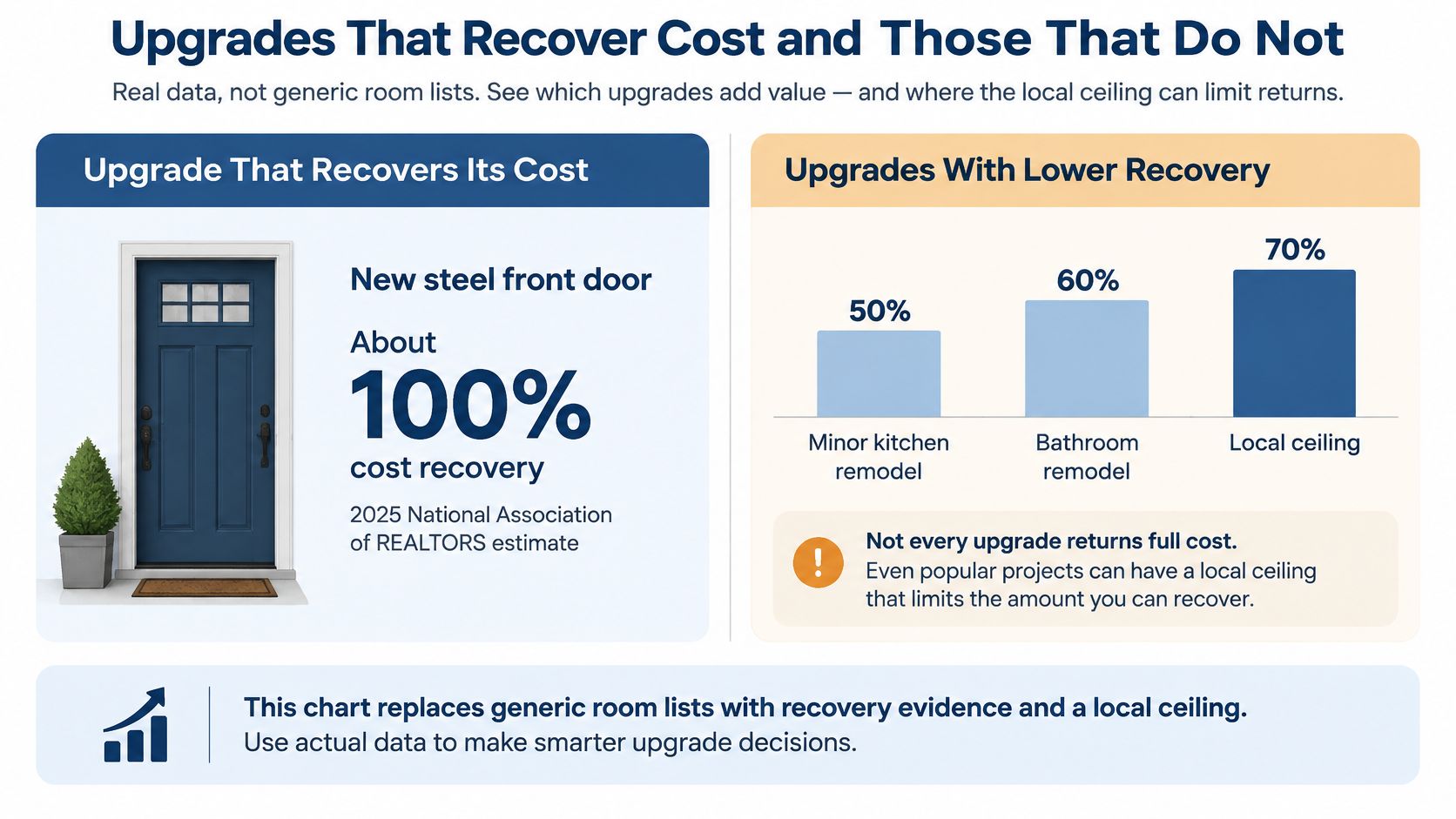
The National Association of REALTORS' 2025 remodeling report ranks smaller projects among the strongest for cost recovery, led by a new steel front door and followed by a closet renovation and a new fiberglass front door. On a hypothetical $10,000 project, the spread between the strongest and weakest of those reported rates is roughly $2,000 in recovered value. As budgets grow, the question of which line items get funded matters more than the total itself.
Reported cost recovery by project type
National estimates provide context, while Houston figures still require validation against the subject's actual resale segment.
| Project | Reported recovery | Reading for ARV |
|---|---|---|
| New steel front door | About 100 percent | Modest exterior work can recover its cost |
| Closet renovation | About 83 percent | Recovers most of a $10,000 job |
| New fiberglass front door | About 80 percent | Reported recovery is lower than steel, without proving equal project costs |
| Midrange kitchen remodel | About 106 percent in Houston data | In-range finishes can have stronger recovery |
| Major kitchen remodel | About 47 percent in Houston data | Overshooting the comp ceiling can reduce recovery |
| Primary-suite addition | About 30 percent in Houston data | Extra space still has to clear the subdivision's resale ceiling |
These are cost-recovery estimates, and they describe how much of a project's price a finished sale may absorb. The comparable-sales ceiling still caps where within the resale range the home can land, so project size, existing condition, buyer preferences, and the local finish standard continue to matter.
Separate marketable finishes from necessary repairs
Each proposed scope item should connect to a renovated comparable or a documented property need. If the finished sales don't include a luxury appliance package, custom cabinetry, or an expanded suite, the investor has no evidence those features will recover their cost. Spending above the comp ceiling belongs to scope risk: it enlarges the budget without widening the resale range.
Roof, drainage, electrical, HVAC, foundation, and code work belong in a separate category: value preservation and sale readiness. Such repairs may be necessary to sell, insure, or finance the house even without a separately measurable price premium.
Permit preparation and completion time also belong in the budget discussion. A longer project can increase carrying expenses without improving the comparable-sales evidence.
Quicklending's renovation-loan application guide offers financing-preparation context for investors organizing a proposed scope. The practical cut remains straightforward: retain work supported by finished buyers in the subdivision, and treat spending above that level as optional rather than added ARV.
Set the Offer and Review Financing
The offer price falls out of the conservative end of the ARV range. After resale risk, scope risk, holding risk, and selling risk are each priced, whatever remains is the ceiling the investor can pay. Starting from the base case and hoping for the strong outcome leaves no room for the estimate to be wrong.
The arithmetic is simple subtraction. Conservative ARV minus the rehab budget, minus holding costs, minus selling expenses, minus financing costs, minus required profit equals the maximum offer. Every dollar above that ceiling needs evidence behind it.
A lender-ready package then turns the analysis into a request:
- Maximum offer: the ceiling derived from the conservative case.
- One-page assumptions summary: the comps, finished specification, and case values behind the number.
- Financing request: the amount, structure, and draws needed to cover purchase and construction.
- Exit with a fallback: a sale or refinance plan that survives a lower outcome.
- Walk-away point: the price where the conservative case stops leaving a cushion.
A clear project supports a clearer financing discussion
A supported ARV, defined scope, and credible exit help a hard-money lender understand the transaction. They don't guarantee approval, funding, or investment profit, and the borrower should still test the proposed terms against realistic construction and exit schedules.
Quicklending LLC is a Houston-area hard money lender that has closed more than $174 million in total loans. Its Residential Loan is a short-term, interest-only loan for investors purchasing single-family homes, townhouses, condominiums, multifamily properties up to 4 units, and lot/land under an LLC or Corporation. Investors weighing transitional funding can review this overview of bridge-loan advantages and limitations. Terms vary by loan and project and are subject to review and approval.
A licensed appraiser, attorney, or tax professional should address property-specific valuation, legal, or tax questions. Once the scope and value assumptions are ready for review, the investor can request a quote and walk a loan officer through the deal.
Frequently Asked Questions About ARV
How accurate does an ARV estimate need to be?
Treat accuracy as a range with named risks. A useful estimate shows conservative, base, and optimistic resale values, then labels which assumption moves each one: resale demand, scope creep, holding time, or selling cost. The bid is disciplined when the conservative case still leaves room after realistic costs.
How should I present the three ARV cases to a lender?
Use one page that separates value support from project risk. Put the comp set behind each resale case, then list the repair budget, months to complete and resell, carrying costs, selling costs, and the exit plan. A lender can see which price is supported by closed sales, which price depends on perfect execution, and where the cushion sits if the rehab or timeline runs long.
What if my Houston submarket has few renovated sales?
Widen the search slowly and mark each sale as stronger or weaker support. Match lot size, vintage, bed and bath count, finish level, and buyer pool before reaching farther back in time or into adjacent blocks. Treat pending and active listings as context for competition. Sparse comps call for a wider range, a bigger cushion, and a lower offer.
Is the 70 percent rule enough?
It is only a first screen. Replace the shortcut with four checks: conservative resale value, complete scope, carrying period, and selling friction. If the deal needs the optimistic case to work, the price has to come down or the property should be passed.
Quicklending LLC offers Houston-area investors short-term hard money financing for acquisitions, renovations, and transition periods before sale or refinancing. Its Residential Loan is a short-term, interest-only loan for investors purchasing single-family homes, townhouses, condominiums, multifamily properties up to 4 units, and lot/land under an LLC or Corporation. Investors with a documented scope and supported ARV range can visit Quicklending LLC to request a quote, subject to review and approval.