
Construction draws are staged loan disbursements for verified installed work, not a single release of the full construction budget. With a 10% retainage assumption, part of the eligible work remains withheld rather than reaching the borrower's operating account.
A Houston investor may already have a contractor ready, lumber ordered, and utility bills arriving. An approved renovation budget doesn't necessarily provide cash for those obligations when they're due. Understanding what qualifies for a draw, what gets withheld, and what requires owner cash helps investors plan a project that can keep moving between advances.
Table of Contents
- What Construction Draws Pay for Installed Work
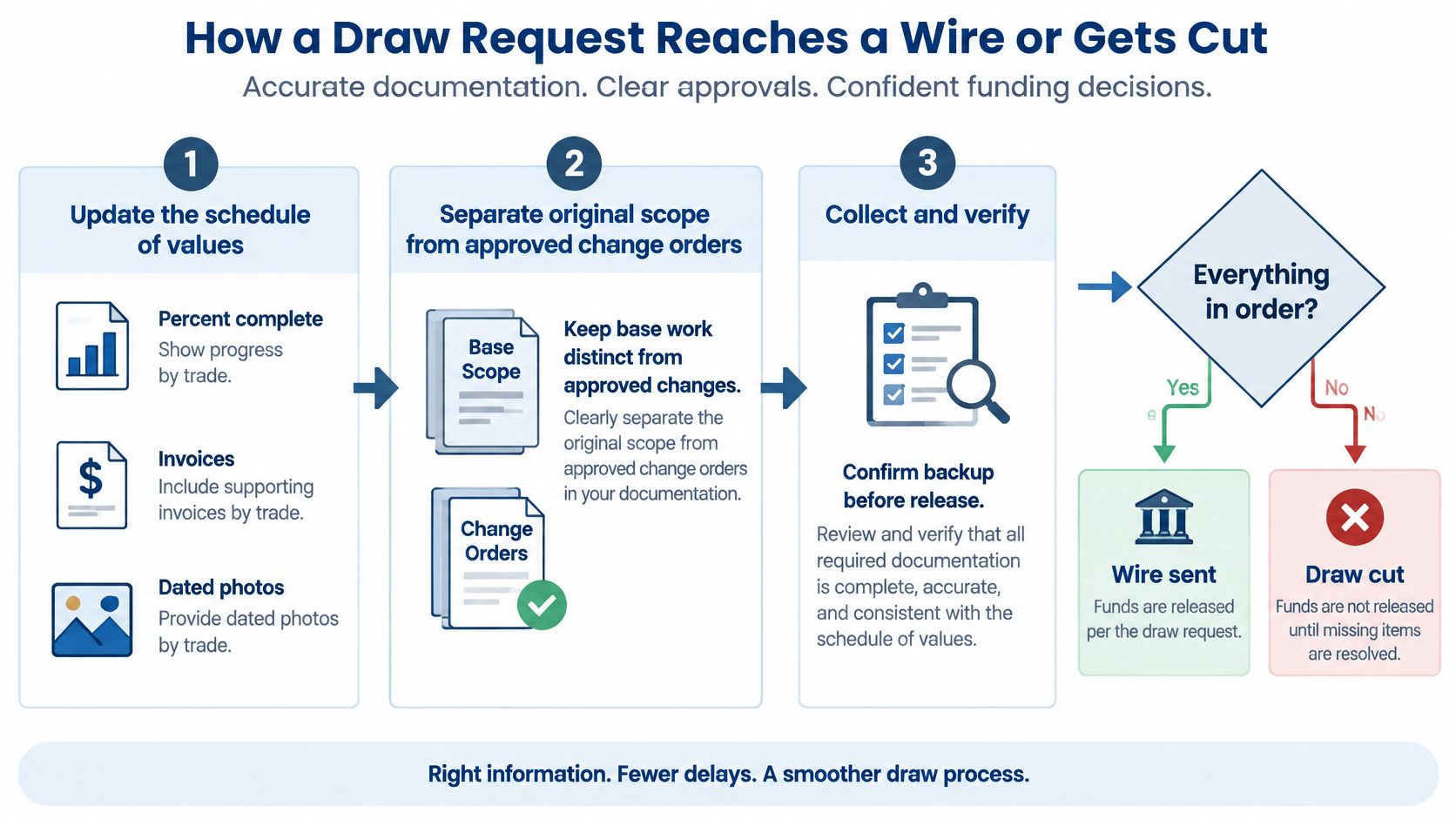
- How a Draw Request Reaches a Wire or Gets Cut
- Retainage and the Net Check on Each Draw
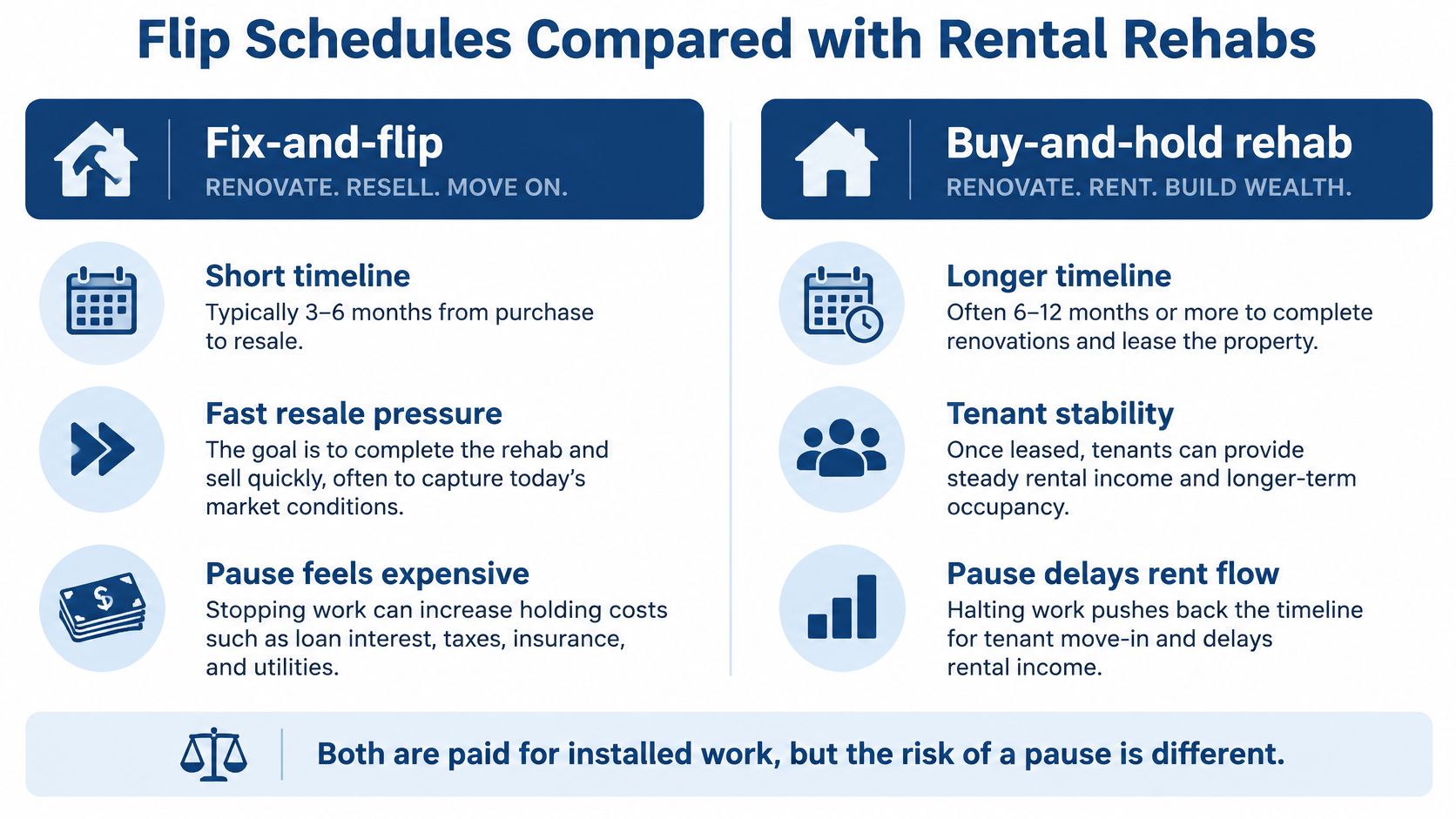
- Flip Schedules Compared with Rental Rehabs
- Texas Deadlines Tied to Unpaid Retainage
- Frequently Asked Questions About Construction Draws
- Line Up the Loan Before the First Draw
What Construction Draws Pay for Installed Work
A construction draw releases the eligible value of verified installed work, less prior amounts and applicable retainage. It doesn't release the full budget just because the borrower has signed a construction contract.
Say a Houston flipper expects the entire rehabilitation budget at closing. Instead, the first advance follows verified demolition work, while the lumber deposit still comes from the investor's reserves. That's a teaching scenario, not a description of Quick Lending's draw terms.
The distinction is work purchased versus work acceptably installed. Under HUD's Section 203(k) draw procedure, borrowers or contractors report prior draws, current requests, and rehabilitation costs by line item, with inspector adjustments where needed; construction items cannot be paid until they're acceptably installed. That program rule illustrates a useful control, but it isn't a universal private-loan agreement.
Build the calculation by trade
A schedule of values divides the construction budget into trade-level amounts that the contractor, borrower, and inspector can reconcile.
The basic calculation is:
Gross earned value = approved line budget × verified percentage complete.
Net current request = gross earned value − cumulative applicable retainage − prior net advances on that line.
Using cumulative retainage and prior net advances prevents the borrower from deducting the same holdback twice. Another valid presentation subtracts prior gross earned amounts first, then applies retainage to newly earned work. The spreadsheet must use one method consistently.
Sample draw math on a $120,000 rehab budget (illustrative)
Every budget, completion percentage, and dollar calculation below is hypothetical. The example assumes no prior advances and a teaching holdback of 10%, not a Quick Lending term, rate, or limit.
| Trade | Illustrative line budget | Verified complete | Gross earned | Retainage (10%) | Net request |
|---|---|---|---|---|---|
| Demolition | $8,000 | 100% | $8,000 | $800 | $7,200 |
| Rough framing | $24,000 | 50% | $12,000 | $1,200 | $10,800 |
| Roofing | $16,000 | 100% | $16,000 | $1,600 | $14,400 |
| MEP rough-in | $28,000 | 25% | $7,000 | $700 | $6,300 |
| Drywall | $14,000 | 0% | $0 | $0 | $0 |
| Finishes | $30,000 | 0% | $0 | $0 | $0 |
| Total | $120,000 | $43,000 | $4,300 | $38,700 |
MEP means mechanical, electrical, and plumbing. Those trades may need separate budget lines when their contractors bill and complete work independently.
Check what the percentage actually measures
Half the framing budget spent doesn't automatically mean framing is half complete. The inspector evaluates installed progress against the approved scope, not merely the contractor's purchasing activity.
A lumber delivery may support future work without supporting the current advance. Likewise, fixtures stored in a garage don't establish that bathroom finishes are complete.
The approved construction budget is therefore different from available operating cash. Every advance remains subject to the loan's eligibility rules, inspection, documentation, and lender review.
How a Draw Request Reaches a Wire or Gets Cut
Construction draws repeat throughout the project. Each request gives the lender another opportunity to compare the remaining loan funds with the work still required.
In a large-bank construction-loan sample, the Federal Deposit Insurance Corporation study found that approximately 96% received on-site inspections, with averages of 13.68 months per loan term, 12.52 draw attempts, and 8.15 inspections; the first inspection occurred an average of 3.01 months after origination, and 13% of 143,074 matched draws were denied. These sample findings show recurring monitoring, not a promised inspection schedule or denial rate for Houston borrowers.
Follow the package through review
- Update the schedule of values. Record completion by trade, attach invoices, and label dated photos with the corresponding budget line. Wide shots establish location; detail shots show the completed installation.
- Separate original scope from approved changes. A new electrical panel shouldn't disappear inside an unchanged general electrical allowance. Show the change, approval status, and budget effect.
- Collect matching lien documentation. Reconcile prior payments with the appropriate waivers and identify outstanding documentation by contractor or supplier.
- Submit the package and preserve operating cash. Payroll, utilities, materials, and loan obligations may remain payable during review. Submission isn't the same event as disbursement.
- Host the inspection and reconcile differences. If the inspector measures less progress than requested, identify the specific unfinished work rather than debating the total invoice alone.
- Review the decision and update cost to complete. A full, partial, or denied advance should lead to an updated cash forecast before another request is submitted.
Distinguish a verification hold from a paperwork hold
A verification hold means the physical progress, budget position, or remaining cost to complete doesn't support the requested release. For example, a roofing invoice may include flashing that hasn't been installed. The supported portion may be eligible while the unfinished portion remains withheld.
An administrative hold means the reviewer can't validate an otherwise supportable request from the file. Undated photos, invoices assigned to the wrong trade, missing waivers, and unapproved changes require different corrections from unfinished construction.
The borrower should request a line-specific explanation, identify the missing evidence or work, and agree on the next submission checkpoint. Rewriting the entire budget without resolving the actual discrepancy can create more confusion.
A useful escalation identifies the disputed line, the evidence needed, the person responsible, and the next review checkpoint.
Quick Lending's renovation-loan application guide provides related preparation guidance. After funding, Quick Lending's Portfolio Manager explains the draws and payoff process to the borrower. That process discussion is an opportunity to clarify responsibilities without assuming a universal review time, fee, or approval outcome.
Retainage and the Net Check on Each Draw
A contractor finishes the rough plumbing, the inspector signs off, and the draw request clears review. Then the wire arrives smaller than the invoice. The missing piece is retainage.
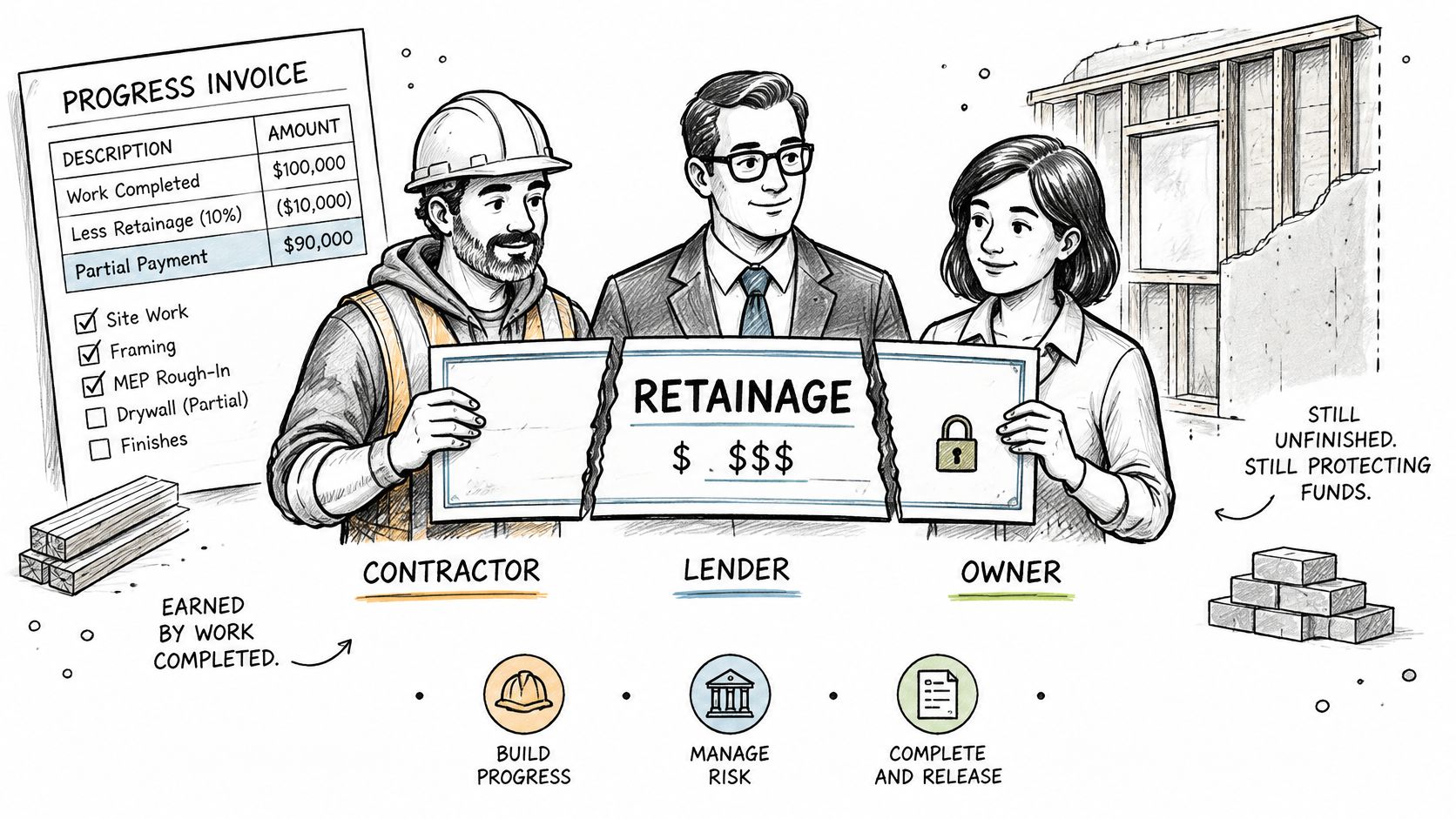
Retainage is earned value that hasn't yet been released. Each draw works like a reimbursement: the lender pays the approved cost of installed work minus the holdback percentage the contract sets. The work can qualify for payment while part of its value remains withheld under the governing agreement.
The purpose is practical: unfinished or defective work still needs a funding source. If every gross dollar has already been released when a contractor leaves, the owner may have to supply additional cash to finish the same scope. A borrower who budgets against the full invoice will come up short on every draw until the holdback is released.
HUD construction materials describe a 10% holdback under that program. For a private loan, the binding figure is the percentage written into the loan agreement and construction contract, which is why the document check matters more than any benchmark cited in the field.
Match the documents before work starts
The loan agreement, construction contract, and applicable law need a coordinated review. The borrower should confirm whether the holdback applies to labor, installed materials, or both, and whether the contractor's payment expectations match the lender's release conditions.
A HUD pre-construction agenda specifies 10% held from each monthly draw unless different treatment is approved through the construction contract's retention rider. Its program-specific structure shows why the governing documents matter more than a verbal description of the draw process.
Release conditions should identify the evidence required, including:
- Completion milestone. State whether release follows substantial completion, final completion, or another defined event.
- Punch-list closeout. Identify who confirms that incomplete or defective items have been corrected.
- Final verification. Specify inspection and completion documentation.
- Payment records. Establish the appropriate lien-waiver and payment reconciliation requirements.
- Remaining budget. Confirm that funds left available are sufficient for outstanding work.
Keep the holdback from becoming a cash-flow problem
An oversized or poorly defined holdback can strain subcontractors who still have payroll and supplier bills. A payment arrangement agreed before crews mobilize protects those relationships far better than trying to renegotiate the holdback after costs are already due.
The borrower's cash forecast should account for expenses the net wire may not cover:
- Retained amounts. Cash may be needed to satisfy contractor obligations before the lender releases the holdback.
- Early deposits. Cash goes out before the materials reach the wall.
- Permits and utilities. These obligations can arrive outside a physical-completion milestone.
- Transaction costs. Inspection or wire charges, if applicable, may reduce usable proceeds.
- Contingency. Weather, rework, or a failed inspection can require additional cash.
Retainage is a timing and contract-administration issue: the money stays earned, and the release waits on the conditions written into the agreement. A licensed attorney should review project-specific retainage obligations before the contract is signed.
Flip Schedules Compared with Rental Rehabs
Draw planning for flips and rental rehabs
| Planning point | Fix and flip | Rental rehab |
|---|---|---|
| Exit that must stay on schedule | Resale after completion | Refinance, lease-up, or both |
| Cash before visible work | Permits, deposits, and mobilization often owner-funded | Same early gap, plus make-ready before rent |
| Cost of a funding pause | Carrying costs and contractor delay on a short project | Carrying costs plus a later refinance or lease start |
| When retained funds matter most | Near listing, if holdback remains until final completion | At stabilization, if holdback is still unpaid |
| Budget item to track beside percent complete | Cost to complete versus remaining loan | Cost to complete versus cash needed until rent or refinance |
The funding control may be similar, but the investor's cash obligations differ. A flipper needs a completed property ready for sale; a landlord needs a property ready for tenants and, where planned, long-term financing.
Neither investor benefits from an unsupported release that leaves too little capital for completion. Predictable funding is a better planning target than the shortest advertised turnaround.
A flip timeline with cash needed before progress
Consider a hypothetical flip: week one involves permits and material deposits; weeks two through three involve demolition; framing and MEP rough-ins follow before drywall and finishes. This is an illustrative sequence, not a construction schedule or funding commitment.
The investor may need to pay for mobilization before enough work exists to support a meaningful request. If a hypothetical two-week hold follows, interest obligations, taxes, insurance, and utility costs don't necessarily stop. A contractor may also seek revised pricing or move a crew if payment becomes uncertain.
The forecast should show whether available owner cash can bridge those obligations without diverting money reserved for later trades. Quick Lending's explanation of short-term financing advantages offers context for evaluating financing against a defined investment timeline.
A rental timeline through stabilization
A rental rehabilitation can begin with the same permit, deposit, and mobilization gap. After construction, the landlord may still face cleaning, leasing preparation, vacancy expenses, and refinance documentation before the planned exit produces cash.
Retainage that remains unreleased near completion can overlap with those obligations. A landlord shouldn't treat expected rent or refinance proceeds as available construction cash before the relevant conditions are satisfied.
For either strategy, the planning spreadsheet needs paired entries:
- Physical milestone. Identify what the inspector can verify.
- Bill due that period. Identify who must be paid before or after that milestone.
- Funding source. Mark owner cash, an eligible advance, or another confirmed source.
- Usable proceeds. Account for applicable inspection, title, wire, or minimum-draw costs.
- Disruption reserve. Preserve cash for permitting and weather delays.
The NAHB AD&C Financing Survey recorded tightening construction lending conditions for 14 consecutive quarters through Q2 2025, as described in this construction-loan risk-management report. That historical context reinforces disciplined liquidity planning, rather than establishing current terms for a particular borrower.
Neither strategy promises a profit. The investor should review the forecast with the contractor and an appropriately licensed financial professional.
Texas Deadlines Tied to Unpaid Retainage
Retainage affects more than the size of each check. For a Houston investor, it also shapes the payment and lien record that follows the project long after the last wire. A funded draw shows that eligible work was reimbursed; it shows nothing about whether every downstream party received payment, and the lender's draw process can't resolve a subcontractor's potential rights.
Because each draw reimburses installed work minus the withheld percentage, the retained dollars are earned money sitting in limbo. The owner needs a file showing who performed the work, who was paid, what remained withheld, and which documents correspond to each payment. That record gives a Texas construction attorney what is needed to evaluate applicable notices and deadlines.
Understand the filing and notice clocks
The statute works like two timers started by different buttons, and the buttons sit on different contracts.
Under Texas Property Code Chapter 53, a residential claimant other than the original contractor generally must file a lien affidavit by the 15th day of the third month after the later of the month labor or materials were last furnished or the month specially fabricated materials normally would have been delivered. For an unpaid-retainage claim, Texas Property Code Chapter 53 sets the affidavit deadline at the 15th day of the third month after the original contract was completed, terminated, or abandoned.
The notice clock runs separately. Texas Property Code Chapter 53 requires notice of an unpaid-retainage claim to the owner or reputed owner and the original contractor by the earlier of 30 days after the claimant's contract ends or 30 days after the original contract is terminated or abandoned.
A subcontractor who finishes months before the original contract ends starts a notice clock that runs well ahead of the project's final punch list. The informal finish date on a job site is not reliable deadline tracking.
Maintain a usable payment file
The borrower should keep related records in one place rather than scattering them across text messages, contractor emails, and accounting folders:
- Draw history. Preserve submitted requests, approved amounts, and disbursement records.
- Inspection evidence. Retain reports and dated completion photos.
- Payment matching. Connect contractor and supplier payments to the relevant invoices and waivers.
- Retainage ledger. Show amounts withheld, released, and still outstanding, treating the balance like a receivable owed back to the project.
- Contract events. Keep documentation of completion, termination, abandonment, and any notices sent or received.
Waivers deserve the same care. Their effect depends on the document and the circumstances, so a signed waiver should never be read as proof that every possible claim has disappeared.
Consistent records support the next funding request and help organize the payoff when the property is sold or refinanced.
Frequently Asked Questions About Construction Draws
Are construction draws paid before the work is done?
Usually no. A draw is reimbursement for eligible work already installed and verified under the loan process, less any retainage the contract withholds. An invoice shows a bill exists; it does not prove the work is in place. Materials delivered but not yet installed often sit outside that test until they become part of the project.
Budget owner cash for the gap between paying a trade and receiving the wire. Approval of the total loan is not the same as cash available today.
Do lien waivers remove every claim?
No. Treat each waiver as a receipt for one payment and one scope. Match the party, amount, dates, and whether it is conditional before payment or unconditional after funds clear. A signed waiver does not settle a disputed notice, hidden balance, or retainage claim by itself.
Action item: log every waiver beside the invoice and draw it supports, then escalate mismatches before releasing the next check.
Can a draw cover permits or material deposits?
Plan for early permits, utility fees, design costs, and supplier deposits to need owner cash unless the signed agreement explicitly makes them reimbursable. Confirm eligibility before budgeting around a reimbursement.
Even when an item qualifies, timing can still squeeze the job: the vendor may need payment before inspection can see installed value. Keep a cash cushion for those pre-visible costs so an approved loan does not leave the crew waiting.
Does sending a draw request guarantee approval, an amount, or a closing date?
No. A request starts review; it does not set the approved amount, wire timing, payoff, or profit. Ask for specific line items, keep labor and materials separated, and do not schedule several obligations against one expected wire.
Wait for the released amount before paying it out. If retainage is withheld, the net check is the funded amount minus that holdback, so plan contractor payments from the net figure rather than the face invoice.
Line Up the Loan Before the First Draw
A rehab can be approved and still starve if the budget assumes draw money before the work is visible. A draw works like reimbursement for installed work minus retainage, so the loan has to be matched to the order of operations: what must be paid first, what can be verified later, and what remains owner cash until inspection supports release.
The objective is to make responsibilities clear enough that a change can be evaluated without rebuilding the financing plan.
Finalize the operating details
The application-ready package should establish:
- Consistent trade names. Contractor billing, budget lines, and inspection references should describe the same scope.
- Document ownership. Identify who gathers invoices, tracks waivers, and submits corrections.
- Change authority. Establish who approves scope changes before additional work begins.
- Written payment expectations. Align the contractor's billing arrangement with the retainage and release provisions.
- A defined exit. Record whether repayment depends on sale, refinance, or another reviewed strategy.
When comparing financing options, use this guide to hard money lenders to weigh process, local closing familiarity, and responsiveness.
Discuss the project before committing to a funding assumption
Quicklending's New Construction loan is a short-term loan for custom home building that can cover land, materials, and contractor labor, subject to review and approval. For a flip or rental rehab, apply the same discipline to the budget: separate items that create verifiable installed progress from items that may require cash earlier, then stress-test the gap between invoice due dates and the timing of review, inspection, and release.
Borrowers can prepare an online application or request a quote with a contractor-supported budget and clear exit plan. Submitting information does not guarantee approval, a draw schedule, a closing date, or a profit.
A licensed attorney should address contract and lien questions, the contractor should validate scope and sequencing, and a qualified tax or accounting professional should evaluate tax and accounting issues. Those reviews help the investor distinguish the loan budget from the cash required to execute the project.
Quicklending offers Houston-area real estate investors short-term financing for acquisitions, rehabilitation, and property transitions. Visit Quicklending LLC to request a quote or discuss a project budget, early cash needs, and construction-draw expectations with the team, subject to review and approval.