

You're staring at a property that needs work, a buyer who wants a fast closing, or a refinance clock that's already ticking. In that moment, the question isn't whether hard money lenders are “good” or “bad,” it's whether short-term private capital fits the deal in front of you. For Houston investors, that decision usually comes down to three things, speed, property condition, and a believable exit strategy.
Table of Contents
- What Hard Money Lenders Actually Do
- How Hard Money Differs From a Traditional Mortgage
- Typical Pricing, Terms, and Loan Structure
- Common Borrower Profiles and Use Cases
- How Hard Money Loans Are Underwritten
- Exit Risk Is the Hidden Cost of Hard Money
- When Hard Money Makes Sense and How Quick Lending Can Help
What Hard Money Lenders Actually Do
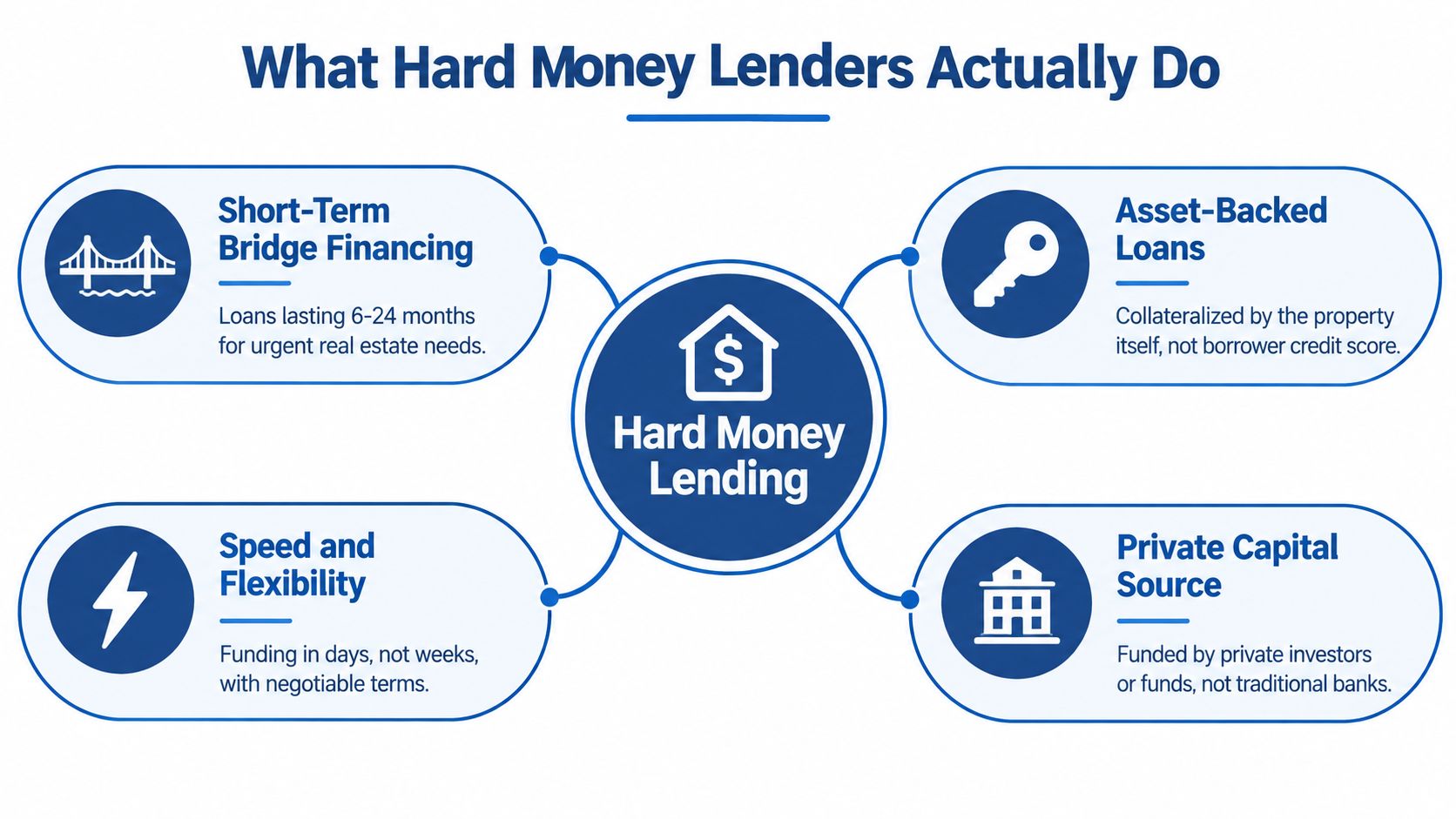
Hard money lenders provide short-term, asset-based financing for real estate transactions that don't fit neatly inside a traditional bank process. The loan is secured by the property, and the lender focuses first on the collateral and the project's exit, not just on W-2 income or a long paper trail. That's why this type of financing shows up most often in bridge deals, distressed purchases, renovations, and other investment-purpose transactions.
Why this product exists
The market uses private lending because some deals move faster than bank underwriting can reasonably handle. Banks face capital, regulatory, and documentation requirements that slow down short-duration or unconventional transactions, while private lenders can often respond with more flexibility. The trade-off is simple, borrowers usually pay for that speed with higher interest, origination fees, shorter maturities, and more default risk.
Practical rule: if the property needs repairs, the closing date is tight, or the plan is to refinance or resell soon, the lender will care less about long-term income stability and more about whether the asset can support the loan.
That's also why this product is usually a fit for investment properties, not primary residences. The loan is built around a business-purpose real estate plan, whether the borrower is flipping, repositioning, or bridging to a later refinance. For a Houston investor, that makes hard money less of a category and more of a decision tool.
How Hard Money Differs From a Traditional Mortgage
A traditional mortgage and a hard money loan can both put capital into a property, but they solve different problems. Banks are built for permanence. Hard money lenders are built for transition. That difference shows up in the paperwork, the underwriting, the timing, and the way the lender thinks about risk.
| Dimension | Hard Money Lender | Conventional Bank |
|---|---|---|
| Underwriting focus | Property collateral and exit strategy | Borrower income, debt-service metrics, and documentation |
| Timeline | Faster, often designed for urgent closings | Slower, with more process and review |
| Documentation burden | Usually lighter and more deal-specific | Usually heavier and more standardized |
| Best use case | Distressed, transitional, or repair-needed properties | Stable, long-term financing for qualified borrowers |
| Cost structure | Higher pricing in exchange for speed and flexibility | Lower pricing, but with stricter qualification standards |
The regulatory line matters
The split between business-purpose investor loans and consumer mortgages is important. Federal mortgage rules created after Dodd-Frank changed the compliance environment for some private residential transactions, but they did not end hard money lending. Instead, they made the borrower's purpose, occupancy, disclosures, and state law more important in determining which rules apply.
That's why a lender financing an investment property asks different questions than a bank underwriting an owner-occupied home. If the property is being bought to fix, rent, or resell, the file is built around the project. If it's a consumer home loan, the compliance path is different.
A lender can be very flexible and still be very disciplined. The difference is that the discipline shows up in collateral review, exit planning, and transaction structure instead of in years of tax returns.
For investors, that distinction matters because the cheapest loan on paper isn't always the right one for a property that needs work, a quick closing, or a refinance path that isn't ready yet.
Typical Pricing, Terms, and Loan Structure
A hard money quote usually has a handful of moving parts, and each one affects the cost of the deal. The headline rate gets attention, but the structure matters just as much. A borrower should look at how interest is charged, what fees apply up front, how the loan is sized, and what event will pay it off.
What to read first in a term sheet
The first item to check is the interest structure. Many hard money loans use short-term pricing that reflects speed and risk rather than long amortization. The next item is the fee stack, which can include origination charges, closing costs, and appraisal-related expenses. The final item is the repayment event, because the loan has to end somewhere, usually through a sale or refinance.
For investors, the central question is not just “what's the rate?” It's “what does the loan cost if the project stays on schedule, and what happens if it doesn't?” That's where maturity length and extension terms start to matter more than most first-time borrowers expect.
Watch the exit terms first. A slightly lower rate can be a poor bargain if the project has little room for delay and the extension language is expensive or vague.
The structure should match the project
A flip loan should not be evaluated the same way as acquisition financing for a property that will later become a rental. A renovation budget, insurance, taxes, and draw timing all affect the carrying cost. So does the payoff source, because a property that will be sold after rehab has a different risk profile than one intended for later refinancing.
Borrowers often get tripped up by comparing only the rate. That misses the full picture, especially when the project timeline is uncertain. A cleaner comparison looks at the entire loan structure, not just the annual number printed at the top of the quote.
Common Borrower Profiles and Use Cases
A Houston investor doesn't need to fit one mold to use this kind of financing. A flipper, a landlord, a builder, and a wholesaler can all end up in the same lender conversation, but for different reasons. The common thread is usually the property itself, not the borrower's job title.

Where this financing shows up
A home flipper may need to close before a seller backs out or a competing buyer shows up. A renovator may need capital to repair a property that won't qualify for standard financing yet. A builder or developer may need bridge capital to buy time while plans, permits, or construction timing come together.
A wholesale investor may use it when a buyer needs a fast close on the other side of the transaction. A multifamily investor may use short-term capital to stabilize an underperforming property before a longer-term refinance. In each case, the lender is asking a similar question, can the asset support the loan, and is there a realistic exit?
The application process is often easier to understand once the borrower sees how the pieces fit together. This renovation-loan application guide helps explain the basic flow investors usually face before funding.
The decision is property first, borrower second
That doesn't mean borrower experience never matters. It does. But hard money underwriting usually starts with the deal, then moves to the borrower's track record and exit plan. A strong property with a realistic budget and a clean payoff path can matter more than a perfect personal-finance profile.
For Houston investors, that's useful in markets where timing and condition often decide whether a property can be bought at all. The product is built for situations where the opportunity exists now, but the permanent financing story comes later.
How Hard Money Loans Are Underwritten
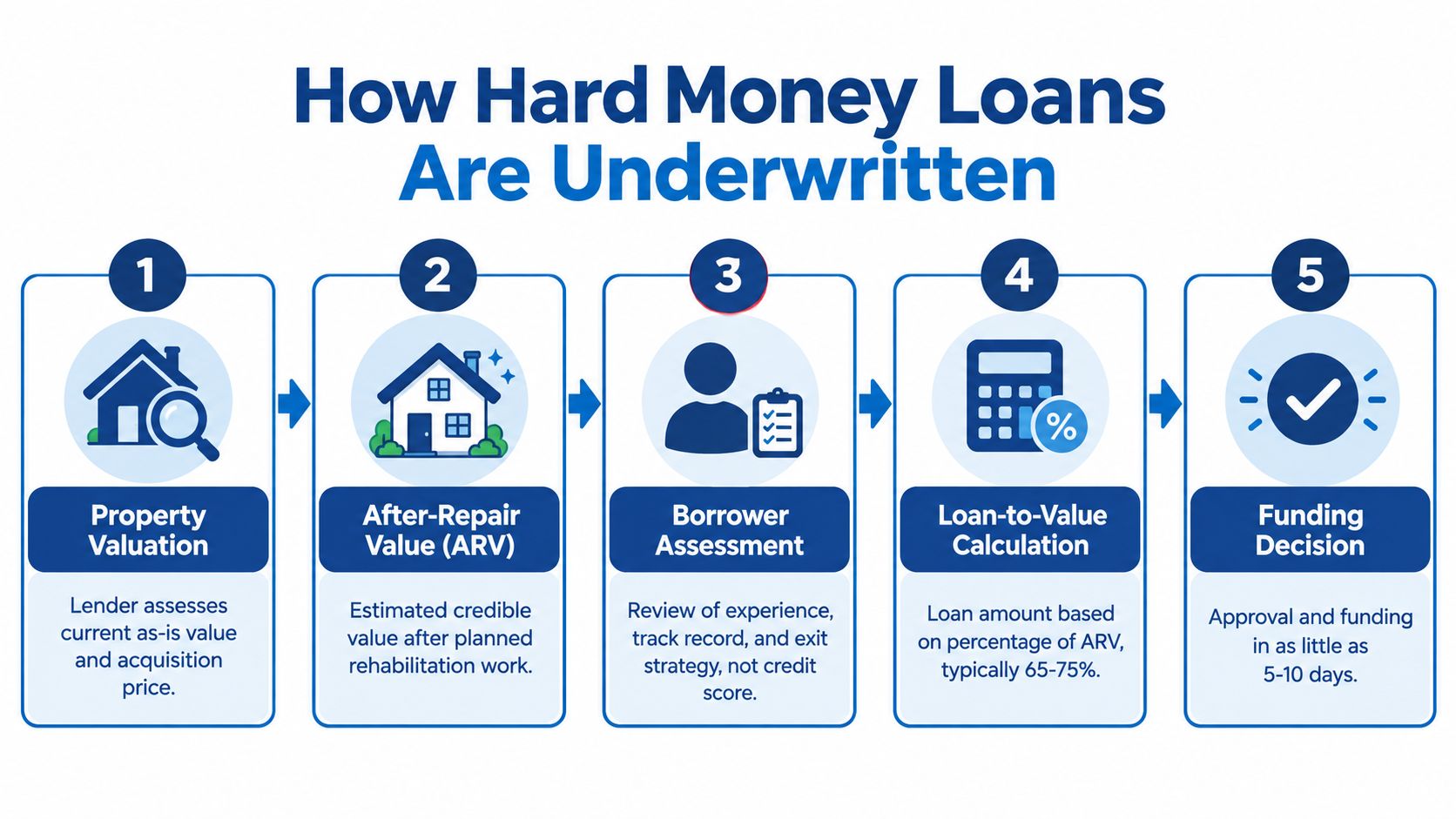
A hard money lender starts with the property and the exit. If the deal works, the borrower's profile matters more. If the deal is shaky, strong income alone usually will not fix it.
The process is easiest to see in a concrete deal. A Houston investor might buy a property for $200,000, plan a $150,000 rehab, and need the lender to judge the current value, the projected value after repairs, and the amount of equity already in the project. For a closer look at where private lending capital fits in the market, see this overview of capital markets in real estate.
The property has to make sense in three states
Lenders usually look at as-is value, acquisition basis, and after-repair value. Those three numbers show whether the deal has enough room for the loan, the rehab budget, and a reasonable resale or refinance outcome. The budget should be line-itemed, not estimated loosely, because vague repair numbers make the exit look better than it really is.
Federal supervisory guidance treats loan-to-value as the credit amount divided by the collateral value, and commercial real-estate guidance points lenders toward maximum loan amounts, valuation standards, feasibility analysis, sensitivity testing, and borrower equity requirements (Federal Reserve guidance). In private lending, that same logic shows up in plain terms: if the lender lends on a property worth $200,000 today and the borrower is funding a $150,000 rehab, the file has to show how the project still works if the sale comes in softer than planned or the refinance takes longer than expected.
Time is a credit variable
Time-to-exit changes the math. A delayed sale or refinance can add interest, taxes, insurance, utilities, and extension costs, which means the quoted rate is only part of the story. The lender wants to know how the loan behaves if the project runs late, the market cools, or the contractor schedule slips.
That is why draw controls, inspections, and budget-to-completion checks matter. They help the lender see whether the project is staying close to plan or drifting into a tighter margin. Hard money underwriting is really a check on whether the borrower can finish the project and close out the debt without relying on perfect timing.
The file should also show base, delayed, and stressed scenarios. A borrower with room in the budget and room in the timeline usually presents a stronger deal than one who needs every step to go right.
Exit Risk Is the Hidden Cost of Hard Money
A hard money loan can look inexpensive on day one and become costly if the project slips. A flip that sells on time may feel clean and predictable. A flip that lingers starts adding interest, taxes, insurance, utilities, construction carry, and sometimes extension costs that were never part of the first budget.
Investor default risk rises when debt levels are high and market conditions soften, which is why the exit deserves so much attention. The loan only stays manageable if the borrower can finish the work and close out the debt on schedule.
Stress the deal before it starts
A good review starts with a few plain questions. What if the property takes longer to resell? What if the refinance window moves? What if contractor timing pushes the project back? Those are the moments when the headline rate stops being the main issue and the carrying costs take over.
Borrowers should ask for clear extension terms, documented draw timing, and appraisal assumptions they can defend. They should also compare a loan that is flexible but expensive with one that looks cheap but leaves little room for delay. The difference often shows up in neighborhood resale liquidity, contractor scheduling, and insurance-related costs, especially in markets where property carrying costs can move faster than the original plan.
If the project only works when everything goes right, the loan is carrying more risk than the rate sheet shows.
Ask whether the deal still works when the timeline stretches and the exit gets less convenient. That is the part investors miss when they focus only on price.
When Hard Money Makes Sense and How Quick Lending Can Help
Short-term private capital makes the most sense when a property is non-bankable because of condition, the contract deadline is unusually tight, or the rehab itself will make the property eligible for permanent financing later. It can also be useful when the borrower needs a clear, structured bridge to a sale or refinance. The better choice is the one that matches the project, not the one with the lowest sticker price.
This bridge-loan overview is a useful companion for borrowers comparing temporary capital against a longer-term loan path. For investors who want a Houston-focused lender, Quick Lending works from the property and exit strategy outward, which fits renovation, acquisition, and transitional deals where timing matters.
A simple decision rule
Use short-term financing when the property needs work, the closing date is tight, or the permanent loan won't be available yet. Lean toward conventional financing when the projected cash flow already supports long-term debt and the borrower has reserves for delay. If the project can't survive a small setback, the financing choice probably needs another look.
Quick Lending can help borrowers evaluate that fit and decide whether the project belongs in a hard money structure at all. To compare options or start a conversation about a specific property, review the details and gather the project materials before moving forward.
Quicklending LLC helps Houston investors evaluate short-term property deals with financing built around the asset and the exit plan, not just the borrower profile. For renovation, bridge, acquisition, and transition scenarios, the right next step is to review the project details and see whether the math supports the loan. Visit Quicklending LLC to explore your options and request a conversation about the property.