

A Houston investor finds a small retail building that needs work, gets it under contract, and then asks a simple question: How do commercial real estate loans work when the property doesn't yet produce steady rent? The short answer is that the lender sizes the loan around the property's value and income, checks whether the plan can support the payments, and requires a clear way to repay at maturity. Understanding that sequence before applying helps an investor ask for the right amount, gather the right papers, and avoid a loan that works at purchase but fails at refinance.
Table of Contents
- How Lenders Size a Commercial Loan
- Loan Terms and How Hard Money Compares
- Documents to Gather Before You Apply
- Application to Funding in Five Stages
- Underwriting Timeline and Where Deals Stall
- Closing Coordination and Draws After Funding
- Planning the Exit Before Maturity
- Answers to Common Questions and Your Next Step
How Lenders Size a Commercial Loan
Commercial real estate loans are generally sized around the property's value and its ability to produce cash flow, not only the borrower's personal income. That distinction matters for flippers, renovators, builders, and multifamily investors because a property in transition may have value and a credible plan before it has stable rent. The lender still reviews the borrower, but the building and its income drive the loan amount.
Say a buyer wants a $750,000 loan on a building appraised at $1,000,000. The Federal Reserve supervisory example uses a $750,000 loan on a property valued at $1 million to show a 75% loan-to-value, and it also shows $120,000 in annual net operating income against $100,000 in annual debt service producing a 1.20 coverage ratio. The first number tests collateral cushion. The second tests whether rent, after operating expenses, covers the payments.
Four Measures That Set Proceeds
Core measures lenders use to size a commercial loan
| Measure | Formula | Worked example | What the lender learns |
|---|---|---|---|
| LTV | Loan amount ÷ appraised value | $750,000 ÷ $1,000,000 = 75% | How much equity cushion protects the lender |
| DSCR | Net operating income ÷ annual debt service | $120,000 ÷ $100,000 = 1.20 | Whether property income covers loan payments |
| Debt yield | Net operating income ÷ loan amount | $120,000 ÷ $750,000 = 16% | The income return the property produces against the loan |
| Loan-to-cost | Loan amount ÷ total project cost | $600,000 ÷ $800,000 = 75% | How much of the total project the loan funds |
Net operating income, or NOI, is rental income minus operating expenses such as taxes, insurance, maintenance, and management. It doesn't include the loan payment itself. That's why DSCR works as a separate test. NOI tells the lender what the property earns before debt, and DSCR tells the lender how much of that income remains as a cushion after debt service.
A property can look strong on value and weak on income, or strong on income and thin on equity. Lenders use more than one measure so one good number doesn't hide a weak one.
Hard money loans are asset-based and usually short-term, so the property's value and the exit plan often carry more weight than a long income history. That doesn't remove the income test for a rental exit. It means the lender focuses on whether the asset supports the request now and whether the sale or refinance plan supports repayment later. Investors estimating cash to close should review how much down payment an investment property may require before setting a budget. Acceptable limits vary by market, property, and lender, so no fixed threshold should be assumed for a specific deal.
Loan Terms and How Hard Money Compares
An investor signs a 12-month bridge loan, makes modest payments all year, then owes the entire principal in a single month. Four terms explain how that happens. The term is how long the loan stays open before it matures. Amortization is the schedule used to calculate each payment, and it often runs much longer than the term itself. The gap between the two leaves a balloon payment, the unpaid principal due at maturity.
An interest-only loan keeps payments covering just interest for part or all of the term, which lowers monthly costs during renovation or lease-up while leaving the principal outstanding until sale, refinance, or payoff. Recourse describes whether the lender can pursue the borrower's other assets when the property doesn't cover the debt. Many loans include a personal guarantee, and its language deserves review by a licensed attorney before signing.
Bank Loans Compared With Hard Money Loans
Bank loans and hard money loans solve different problems. Banks price the borrower's financial strength across a longer relationship, while hard money lenders price speed and the asset in front of them today. Readers comparing sources can review how hard money lenders evaluate investor deals alongside a bank term sheet.
Bank commercial loans compared with hard money loans
| Feature | Bank commercial loan | Hard money loan |
|---|---|---|
| Primary focus | Property cash flow and borrower financials | Asset value and the repayment plan |
| Typical term | Maturity of several years, with payments calculated on a much longer amortization schedule | Short-term, often around a year (Quicklending's residential loans carry a full 12-month term with no prepayment penalty) |
| Interest rate | Driven by borrower credit, property cash flow, and market benchmarks | Driven by asset value, project risk, and timeline; typically priced higher for speed and shorter terms |
| Fees | Often folded into the rate, or charged as origination plus appraisal and legal costs | Commonly quoted as points on the loan amount, plus draw or inspection charges on renovation funding |
| Closing speed | Credit committee approval can stretch the process across weeks or months | Underwriting the asset rather than a long financial history can compress the timeline; Quicklending loans can close in as little as five days |
The balloon is where term structure gets expensive. Say an investor borrows $750,000 interest-only at 10% for 12 months. The payment is $6,250 a month, $75,000 of interest over the year, and the full $750,000 comes due as one balloon at maturity. Stretching the amortization barely helps in year one: on a 30-year schedule at the same rate, payments rise to about $6,580 a month, yet the balance after 12 months still sits near $746,000 because early payments are almost all interest. The monthly payment is the easy number to compare. The balloon is the deadline the exit has to meet.
A lower monthly payment can still be the wrong loan when maturity lands before the property stabilizes. Before signing, stress-test the balloon: a refinance has to cover it even if the appraisal comes in lower, and a sale has to clear it even in a slow market. Compare the full documents, not just the rate sheet, with a licensed professional before choosing a structure.
Documents to Gather Before You Apply
Lenders verify a file in groups, and the Loan Officer confirms the exact list for each deal. Gathering the groups early prevents the most common delay, which is a package that arrives in pieces. The FDIC commercial real estate lending guidance describes underwriting that verifies borrower, guarantors, entity structure, experience, liquidity, net worth, credit history, and proposed equity contribution, then validates the property through title, zoning, environmental review, physical condition, leases, rent roll, operating statements, tax records, insurance, and an independent appraisal.
Document groups and what the lender checks
| Document group | Typical items to gather | What the lender checks |
|---|---|---|
| Borrower and entity | Entity formation papers, identification, financial statements, experience summary | Experience, liquidity, net worth, credit history |
| Property | Purchase contract, title information, insurance quote, inspection or photos | Title, physical condition, insurance coverage |
| Income and leases | Rent roll, existing leases, operating statements, tax records | Whether property income supports the debt |
| Project plan | Scope of work, contractor bids, line-item budget, draw schedule | Sources and uses, contingency reserve, timing |
| Exit plan | Sale comparables or refinance plan | A credible path to repay the loan |
What Each Group Proves
Borrower and entity papers show who owns the deal, who can sign, and whether the sponsor has liquidity for overruns. Property papers show what the lender is being asked to finance and whether title and insurance can be cleared. Income and lease papers support the NOI used in sizing, while the project plan shows whether renovation money is tied to real bids and a workable schedule.
The exit plan connects the loan to repayment through sale, refinance, or long-term cash flow. A weak submission often underwrites only the purchase price and omits renovation costs, interest carry, taxes, insurance, leasing commissions, and reserves. A stronger package shows total cost from the start.
- Gather entity papers early. Form the file before a property is under contract so names match across documents.
- Keep the rent roll current. Update tenant, rent, and lease-end dates before submitting.
- Build a sources and uses schedule. Show where every dollar comes from and where it goes, including contingency.
After the application starts, the borrower submits all paperwork in a timely manner, and the Loan Officer guides them through this documentation process. That guidance works best when the first package is organized by group rather than sent as loose attachments.
Application to Funding in Five Stages
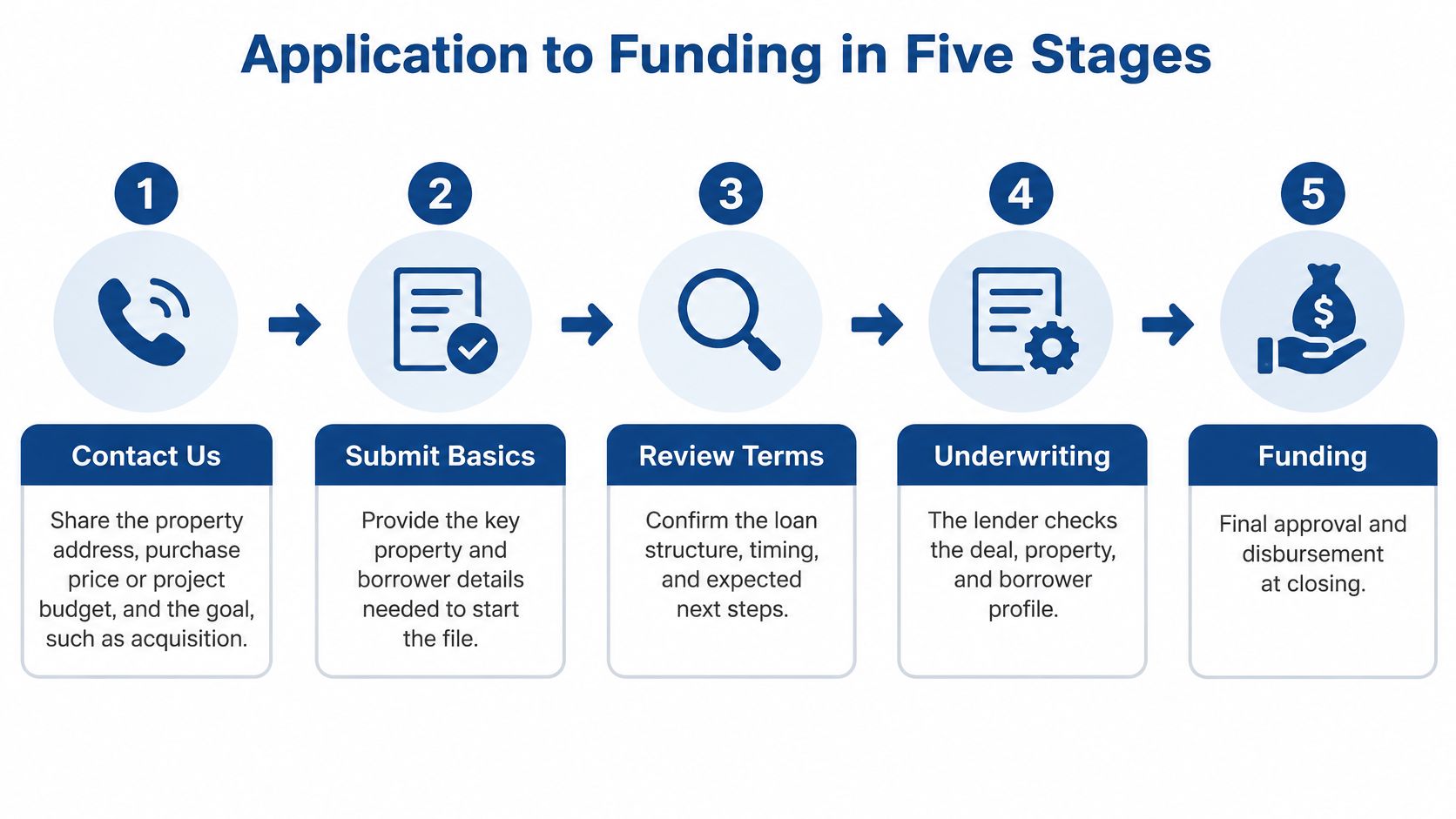
Quicklending's loan process runs in 5 steps: Contact Us, Loan Officer, Documentation, Closing Team, and Get Your Funds. It works like a relay: each stage ends in a handoff, and a fumbled pass costs more time than a slow leg. The borrower's job changes at every exchange, so knowing that job early keeps a file from stalling on missing details.
Stage 1 Contact Us
Starting takes one action: click Get a Quote and fill out the loan information, meaning the property address, the purchase price or project budget, and the goal, whether an acquisition, a renovation, or a bridge to a later sale or refinance. Send the contract timeline with that first message. Waiting for a final contractor bid before reaching out compresses every step after it, because the contract clock runs whether the lender has been contacted or not.
Stage 2 Loan Officer
A Loan Officer contacts the borrower to learn what they want to accomplish, and that call is where the structure gets chosen. An investor planning to stabilize a building and sell might hear why a bridge loan fits, while a longer hold could point toward an interest-only loan that keeps payments low during the term. State the exit plainly on this call, including whether repayment depends on a sale, new leases, or a refinance. A borrower who describes only the purchase gets quoted on half the deal.
Stage 3 Documentation
The borrower submits the paperwork in a timely manner while the Loan Officer guides each item. One borrower sent the entity documents and rent roll on day one but held the signed contract for a week over a small edit, and the file sat idle the entire time. A complete package organized by the checklist groups gives underwriting fewer reasons to pause, while documents that arrive in pieces trigger one follow-up request after another.
Stage 4 Closing Team
Once the documentation is in, the closing team takes over and drives the file to signing; that coordination work is covered in the closing section. The borrower's job shrinks to speed: answer title, insurance, and appraisal questions quickly, keep one contact available for scheduling, and expect remaining conditions to clear even after approval.
Stage 5 Get Your Funds
Funding happens at the closing table. When every earlier handoff is clean, Quicklending loans can close in as little as five days. Before signing, confirm the wire instructions, the closing figures, and any renovation money held back for draws, and ask how post-closing draws and payoff requests are handled. The payoff question matters most for borrowers planning to refinance, because learning the process at the table leaves little room to plan the exit.
Practical rule: Treat each stage as a handoff. The file moves fastest when the next person receives complete information the day the stage begins.
Underwriting Timeline and Where Deals Stall
A conditions list arrives with several items on it. Most clear within days, but one item is a third-party report, and the file sits still while that report is completed. That is the typical underwriting pattern: the loan is rarely late because a decision is pending, and more often late because one slow report sets the pace for everything behind it.
The sequence itself stays stable even when the calendar moves. Intake and borrower review check the file for completeness. Property verification covers title, appraisal, insurance, and physical condition, with third-party reports ordered as needed. The financial test confirms NOI and debt service, then checks LTV, DSCR, and the budget under lower rents or higher costs.
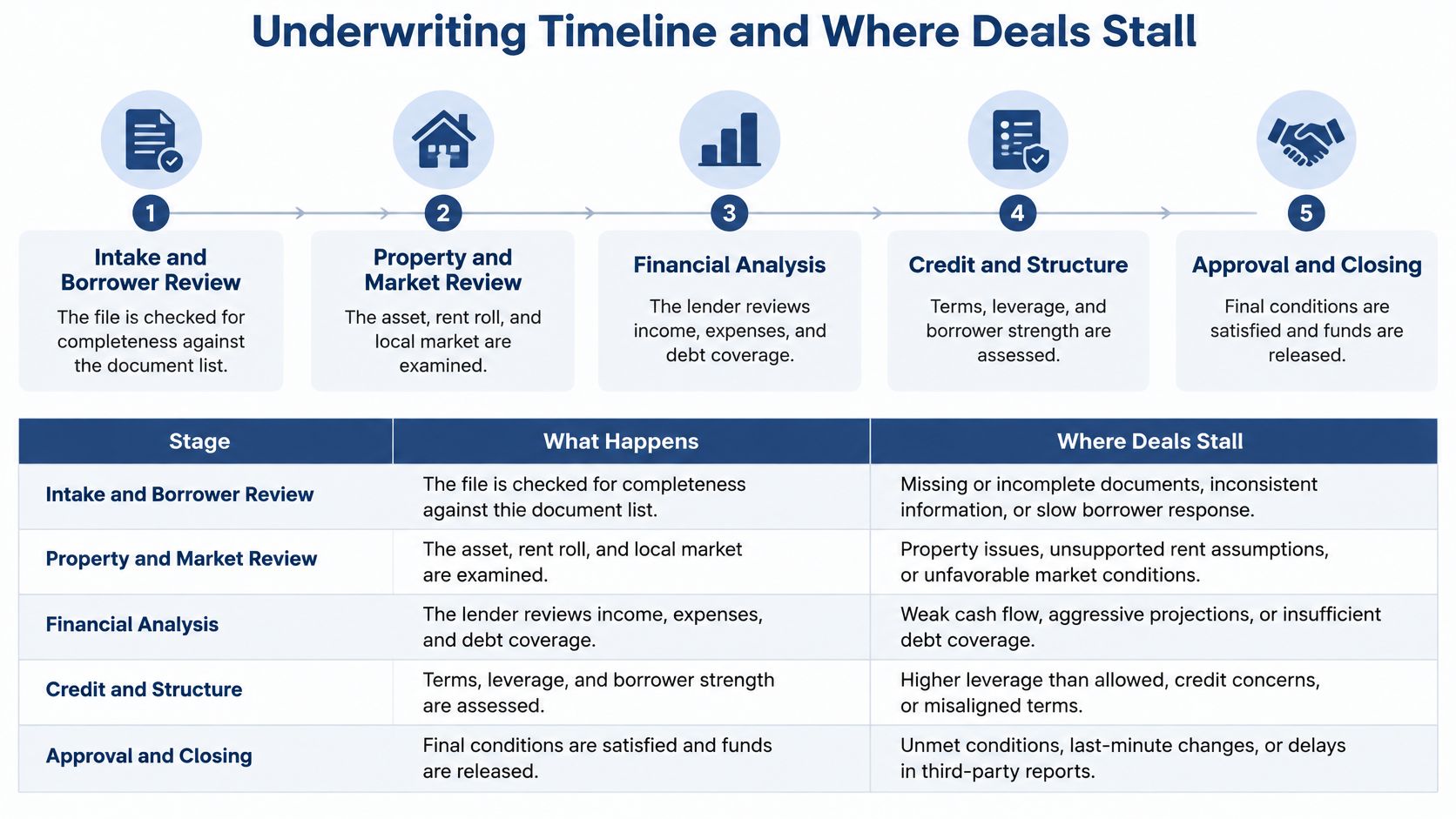
After those checks, the lender makes a credit decision, which may include conditions. Clear-to-close comes only after every condition is satisfied. No duration is promised because pace depends on the property, borrower response time, and reports such as appraisals and title searches.
Common underwriting delays and how to prevent them
| Delay | Why It Happens | How to Prevent It |
|---|---|---|
| Environmental report | The property type calls for a report that was ordered late, or the report flags a prior use that needs further review | Ask early whether the property type requires an environmental report and order it at intake |
| Appraisal scheduling or value questions | Access or comparable sales differ from expectations | Share property details and recent comparable sales early |
| Title issues | Liens, unclear ownership or vesting errors surface during title review | Order title early and resolve issues promptly |
| Thin renovation budget | Costs omit contingency, carrying costs or permitting | Build a line-item budget with reserves |
| Entity mismatch | Buyer name differs from the entity named in the purchase contract | Align entity name, contract and insurance |
Each delay has a different owner. Entity and insurance problems usually sit with the borrower, appraisal timing may depend on access and comparable sales, and title or environmental findings may require action by the seller, a contractor, or a consultant outside the borrower's control. Naming the owner early prevents a week of waiting on the wrong person.
When a conditions list arrives, ask the Loan Officer which items take longest to clear. Starting the slowest items first beats clearing the easy ones and discovering a delayed report at the end.
Closing Coordination and Draws After Funding
Between approval and funding sits a short closing window where title, insurance, and signed documents all have to land in the right order.
The usual sequence runs through five checkpoints: title review and title insurance requirements, then insurance coverage naming the lender, then the final appraisal, then clearance of any remaining conditions, and finally signed loan documents before funds move under the closing instructions. When a title hold surfaces inside that window, the fix follows a short path. Ask the title company to put the exact defect in writing, whether it is an old lien, an unreleased mortgage, or a vesting error. Confirm who must cure it, because a payoff on a seller's lien and a correction to the buyer's vesting sit with different parties. Start the payoff or release paperwork the same day, and have the title commitment reissued before closing documents are drawn.
Why Coordination Matters on Deadline Deals
A closing works like a relay: the seller, title staff, insurance agent, appraiser, and lender each carry one leg, and the deal stalls wherever a handoff is missed. One missing insurance binder can hold up signing even on an approved loan. A named coordinator lowers the risk that every party assumes someone else owns an open item.
The borrower controls two legs of that relay. Keep contact information current so requests reach the right person the first time, and send corrected documents in full rather than partial pages. Small mismatches in entity names, property addresses, or insured names can force documents to be reissued, so catching them before the signing appointment protects the closing date.
Draws After Funding
After funding, the Portfolio Manager explains the draws and payoff process to the borrower. On renovation loans, that generally means work is completed in stages, documented, and requested in draws against the approved budget. Exact draw rules are set loan by loan, so the borrower should confirm inspection, invoice, and approval requirements before work begins. A clear explanation of how construction draws are requested and released helps a borrower set up record keeping from the first day.
- Keep contractor invoices organized. Match each invoice to a budget line.
- Save dated photos. Show completed work before requesting reimbursement.
- Track the schedule weekly. Flag delays before they affect the next draw or the maturity date.
Payoff usually happens through a sale or refinance, so the draw period doubles as the first stage of exit planning. Every invoice and dated photo filed during the work becomes evidence for the next appraisal and the income review a future lender will run.
Planning the Exit Before Maturity
Maturity isn't just a payoff date. It's a deadline by which the property must support a sale, a refinance, or repayment from another source. The Federal Reserve Senior Loan Officer Opinion Survey page states that about 20% of outstanding U.S. commercial real estate loans, nearly $1 trillion, were scheduled to mature in 2025, with many borrowers not yet having refinancing secured because of tighter standards, lower property valuations, and higher interest rates.
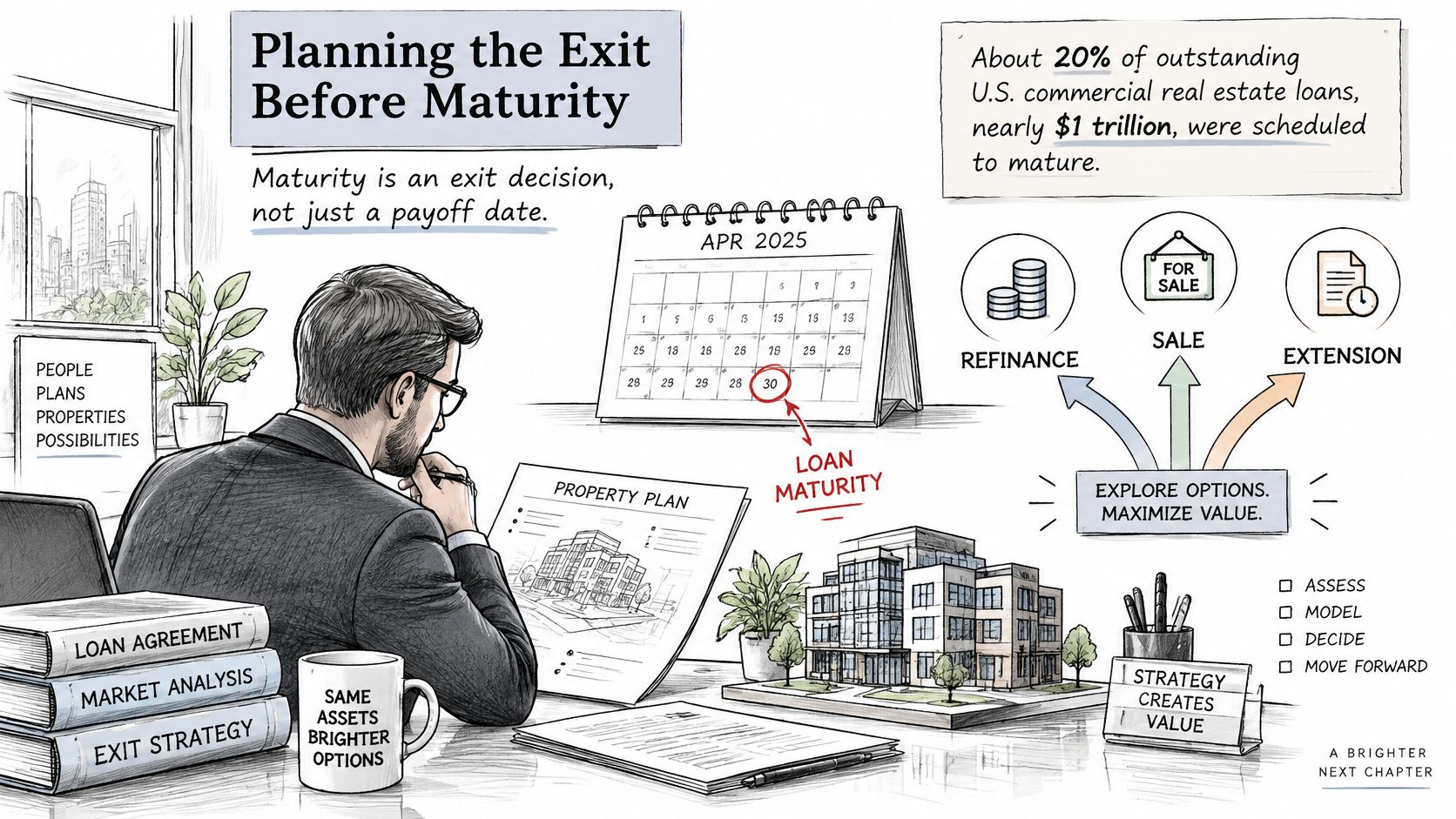
A property may pass lending tests at purchase and fall short at refinance if rents decline, operating costs rise, cap rates expand, or rates stay high. That's the gap between approval and refinanceability. The initial lender may underwrite a renovation plan, while the takeout lender underwrites actual leases, collected rent, and current expenses.
Run the Exit Stress Test Before Signing
Start with stabilized NOI, subtract realistic vacancy and repair reserves, apply a higher exit rate, and test whether the debt still works. As an illustrative example, if NOI falls 15% from $120,000 to $102,000 while annual debt service stays at $100,000, DSCR drops from 1.20 to 1.02. The property hasn't failed, but its cushion has nearly disappeared, and a refinance lender may offer lower proceeds or require a principal paydown.
- At origination. Define the exit as sale, refinance, or cash from another source, and write down the income needed for that exit.
- During the term. Collect operating statements, rent rolls, leases, and inspection records as they occur.
- Months before maturity. Start lender conversations early because review may require updated appraisals, environmental reports, and current DSCR and LTV tests.
- Keep a backup. Maintain a sale or bridge plan if the first exit slows down.
A late exit may bring extension fees, default interest, a principal paydown, a cash injection, or a forced sale, depending on the loan documents. Those outcomes aren't inevitable, but they become harder to avoid when refinancing starts at maturity. Early preparation gives the borrower time to cure a shortfall.
A short-term loan is safest when its exit has been tested before closing, not when its low carrying cost depends on a refinance that has never been stress-tested.
Answers to Common Questions and Your Next Step
Does a Quicklending Loan Guarantee Approval
No. Submitting a form starts a review, and approval comes only after the file passes it. For a commercial loan, qualification rests on three things: the property's value, the property's debt to income, and the borrower's experience. A well-documented exit plan strengthens a file, but no application guarantees funding.
Can a Loan Be Used for a Personal Home Purchase
No. Quicklending does not lend to consumers for personal loans. Its programs serve investors only: commercial bridge and interest-only loans for retail and office spaces, industrial properties, apartment complexes, and multifamily properties with five units and up, plus short-term residential loans for single-family homes, townhouses, condominiums, multifamily properties up to 4 units, and lot or land held under an LLC or Corporation.
What Happens if the Project Scope Changes Midway
Tell the Loan Officer early. A changed budget or timeline can shift the draw schedule, the remaining reserves, and the review status of the file. Early notice gives the lender room to explain available options; waiting until a draw is denied or maturity is close removes them.
Is a Rental Property Required to Qualify
The first question is not whether the property rents, but which program it fits. Unit count draws the line: five units and up falls under the commercial loan, while four units or fewer falls under the residential loan. From there, a purchase for resale, a renovation for lease-up, and a stabilized rental each raise different income and exit questions. The Loan Officer learns what the borrower wants to accomplish, then confirms which option fits that specific deal.
How to Start
Click Get a Quote and fill out the information, or reach the team during office hours of 8am to 5pm, Monday through Friday. Before submitting, have the property address, the price or budget, the renovation scope if any, and a written exit plan ready. That last item deserves real attention: a loan sized on today's income still has to survive the refinance test at maturity, so run the exit stress test before signing anything. Readers with legal, tax, or accounting questions should consult an appropriate licensed professional.
Quicklending LLC gives Houston-area investors a way to discuss short-term, asset-based financing for acquisition, renovation, bridge, and commercial projects. A borrower who has run the sizing numbers and the exit stress test, and who holds a property with a defined plan, can visit Quicklending LLC to request a quote and speak with the team about next steps.