

An LTV set at closing starts changing the day the property does. Say an investor buys a duplex for $500,000 with a $350,000 loan. The opening ratio is 70%. If the market slips and the property appraises at $450,000 mid-renovation, that same loan now measures closer to 78%. The collateral cushion shrank without the borrower drawing another dollar.
The reverse also happens. As the renovation adds value or the balance is paid down, the cushion grows back. Reading LTV as a moving number changes how investors weigh every purchase price, rehab draw, and payoff along the way.
Table of Contents
- What the Loan to Value Ratio Measures
- Why the Same House Can Have Different Caps
- How a Price Drop and a Different Denominator Change the Ratio
- Numbers to Gather Before You Apply
- Loan to Value Ratio Questions Investors Ask
- Request a Quote With Your LTV Figures
What the Loan to Value Ratio Measures
The loan to value ratio, usually shortened to LTV, measures the loan against the property value used for the calculation. It answers a narrow question: how much debt is being measured against that value?
The formula is straightforward:
LTV = (Loan amount ÷ Property value) × 100
The harder part is choosing the correct inputs. A requested acquisition loan, a fully advanced renovation loan, and a current payoff balance can produce different answers, even when they concern the same property.
Reading the loan and equity together
For the opening example, dividing the loan by the property value produces the LTV. Subtracting the loan from that value produces the implied dollar equity.
Sample loan to value ratios and equity
| Loan amount | Property value | LTV | Implied equity |
|---|---|---|---|
| $700,000 | $1,000,000 | 70% | 30% (about $300,000) |
| $300,000 | $400,000 | 75% | 25% (about $100,000) |
| $280,000 | $400,000 | 70% | 30% (about $120,000) |
| $200,000 | $400,000 | 50% | 50% (about $200,000) |
These are educational calculations, not lending limits. They show why a smaller loan against an unchanged value leaves more equity between the debt and the property's estimated worth.
That equity isn't necessarily cash available to spend. It also isn't the same as profit after a sale, because selling expenses, carrying costs, and other obligations can reduce the amount left over.
Naming the value matters
The bottom number in the formula is the denominator. In property financing, that may refer to a contract price, an appraisal-supported value, an as-is value, or a projected value after improvements.
Those labels aren't interchangeable. An as-is valuation describes the property in its present condition; a projected exit value assumes that planned improvements and the anticipated sale or refinance can be achieved.
Practical rule: Every LTV calculation should identify the loan balance, the value basis, and the point in the project being measured.
A useful spreadsheet therefore has separate fields for acquisition financing, planned advances, and the outstanding balance. The valuation column should carry an equally clear label rather than saying value.
Closing costs and a renovation budget don't automatically enter the LTV formula. They affect the ratio only to the extent that they change the loan amount or the value being used, although they still matter to the investor's cash requirement.
For an initial estimate, an investor can divide the requested loan by the value expected to be used in underwriting. The result is an educational calculation, not a loan offer, approval, or commitment to accept that valuation.
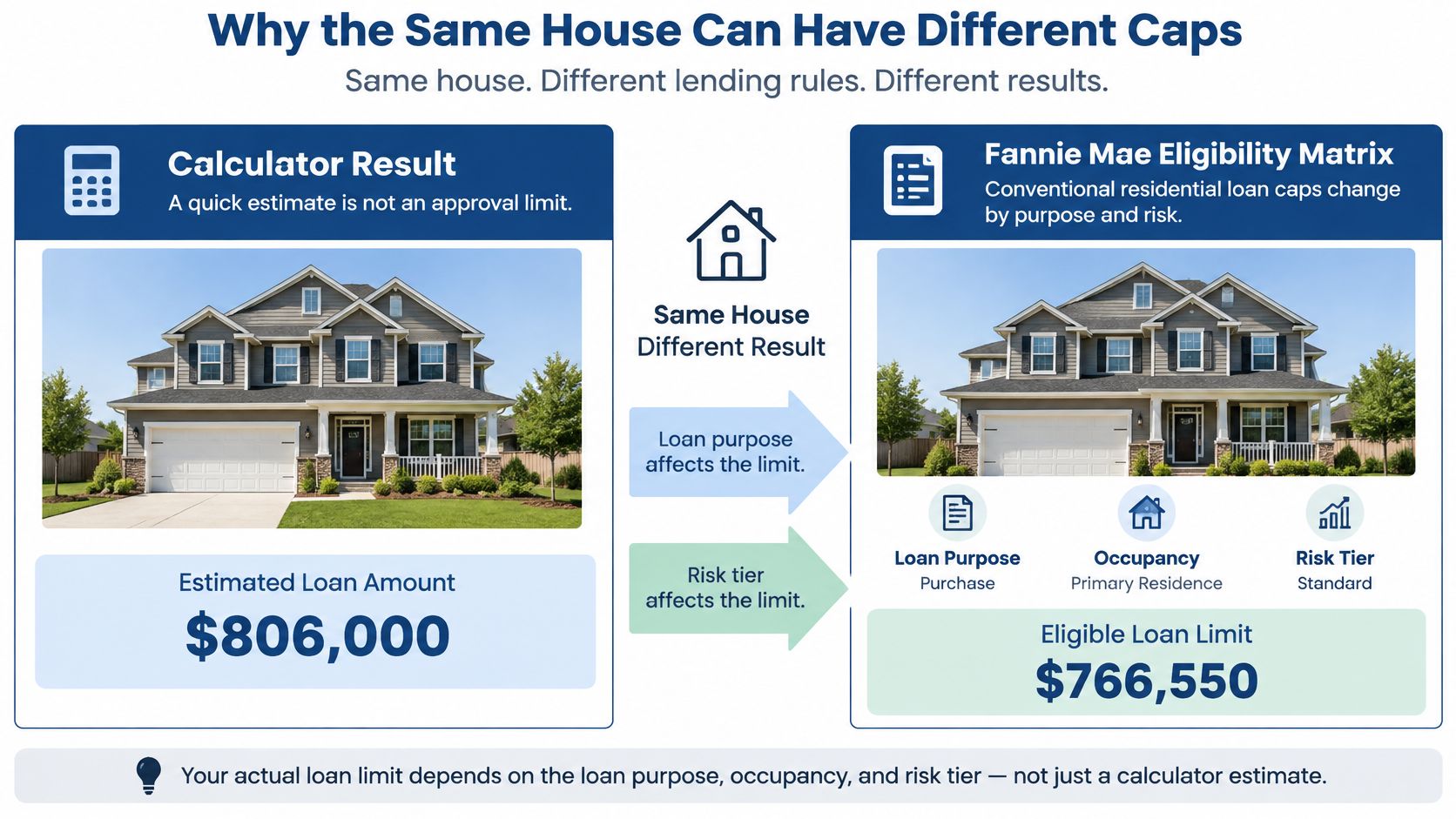
Why the Same House Can Have Different Caps
A one-unit starter home and a fourplex on the same street can carry different financing ceilings, because published limits attach to the transaction category, not the property address.
Fannie Mae's published LTV guidance and eligibility matrix permits up to 97% LTV for certain one-unit, owner-occupied fixed-rate purchases and lists different caps for the specified transactions below.
Published conventional LTV examples by situation
| Situation | Published maximum LTV | On a $1,000,000 value |
|---|---|---|
| Certain one-unit owner-occupied fixed-rate purchase | 97% | About $970,000 financed |
| Two-unit property in specified transactions | 85% | About $850,000 financed |
| Three- to four-unit property in specified transactions | 75% | About $750,000 financed |
| Cash-out refinance, one-unit principal residence | 80% | About $800,000 financed |
These are conventional reference points, not Quicklending loan terms. The dollar amounts illustrate the percentages on a common value basis; they don't establish eligibility for a particular loan amount or remove other program requirements.
Each maximum marks the thinnest equity cushion its category allows at closing. In the one-unit purchase row, the gap between property value and financing is roughly $30,000 before closing costs; the lower caps on the other rows require the borrower to keep a larger cushion from day one. Whatever the starting percentage, it describes the loan at origination rather than a ratio guaranteed to hold for the life of the project.
A calculated percentage isn't an approval ceiling
A calculator can perform the arithmetic correctly while leaving every eligibility question unanswered. It can't confirm that the loan purpose, occupancy, property type, and product requirements match the applicable category, that the property's condition is acceptable, or that the proposed repayment plan fits a lender's review. Matching a published maximum starts with matching the transaction it was written for.
Investment projects require a different conversation
An owner-occupant buying a residence and an investor purchasing a renovation project may be financing the same physical house for very different reasons. The investor's repayment plan may depend on rental income, a completed resale, or a successful refinance, so a flip needs a credible renovation scope and resale strategy while a rental acquisition needs a workable operating plan and financing path.
Quicklending's products reflect that distinction. Its Residential Loan is a short-term, interest-only loan for investors purchasing single-family homes, townhouses, condominiums, multifamily properties up to four units, and lot or land under an LLC or Corporation; its Commercial Loan includes bridge and interest-only loans for retail and office space, industrial properties, apartment complexes, and multifamily properties with five units or more. Within its closing cost calculator, the Max LTV setting offers 60%, 65%, and 70%, because the cap depends on the deal being described. For readers weighing asset-based financing, Quicklending's overview of how hard money lenders work provides context for that conversation.
Before discussing a rate, investors should accurately describe the transaction: purchase, refinance, or cash-out; intended occupancy; property condition; and unit count. Those details help a loan officer evaluate the actual project instead of responding to a percentage without context.
How a Price Drop and a Different Denominator Change the Ratio
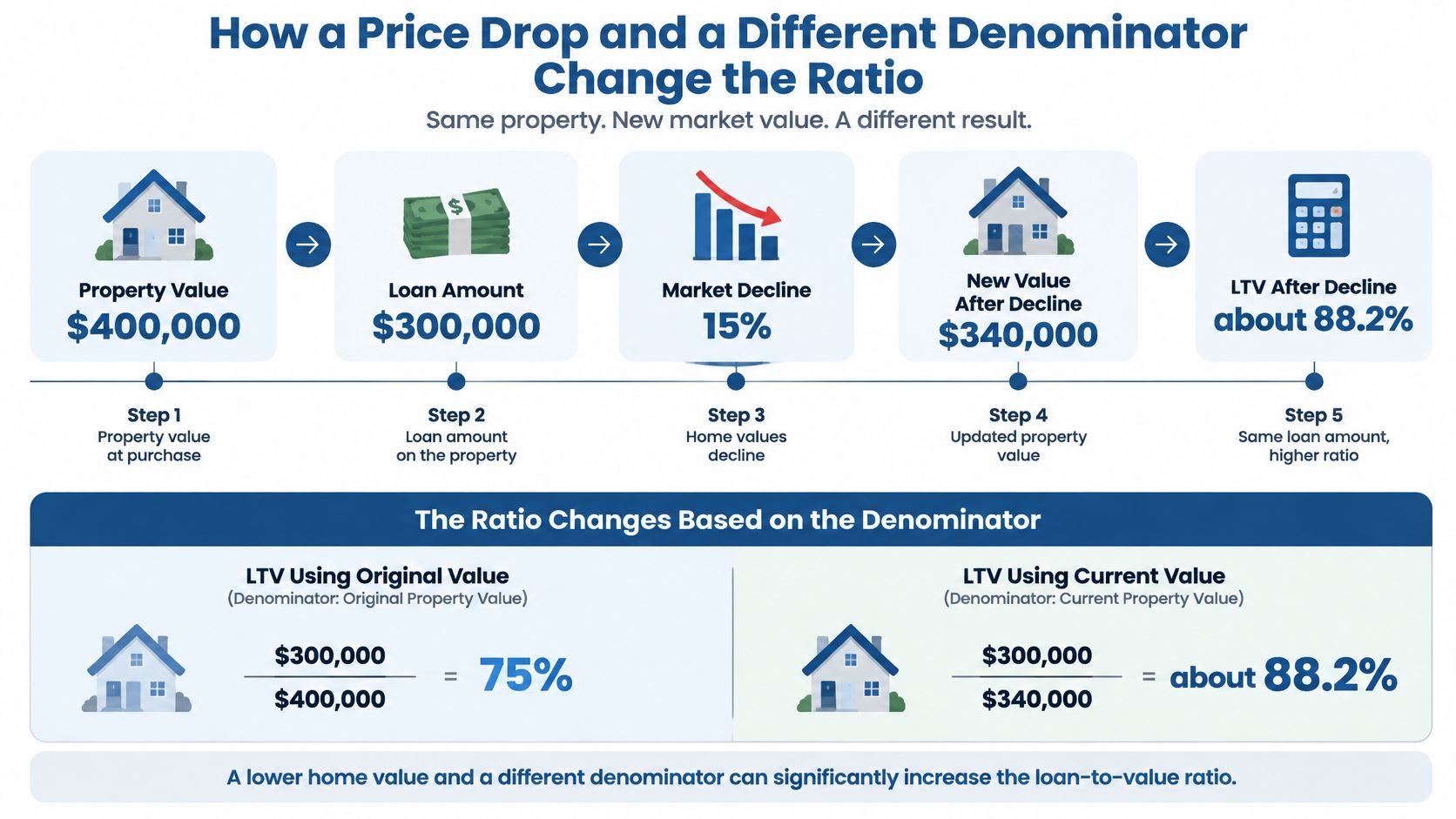
A loan can carry more debt relative to the property's value without the borrower taking out a replacement loan. A falling property value changes the denominator, while financed interest or additional advances can increase the numerator.
Consider the educational scenario associated with the mortgage option-pricing study available through the National University of Singapore repository: a $300,000 loan against a $400,000 property starts at 75% LTV, but a 15% market-value decline reduces value to $340,000 and raises LTV to approximately 88.2%. If financed interest or protective advances then increase the balance to $315,000, LTV reaches approximately 92.6%.
The investor hasn't necessarily received additional acquisition proceeds. The same project has less property value supporting a larger outstanding balance.
Following the cushion through the project
The cited theoretical study links higher LTV to greater default-option value and default risk. Its sensitivity analysis also identifies house-price volatility, interest-rate volatility, and the initial interest rate as positive drivers of default-option value.
That isn't a prediction that a particular investor will default. It explains why less starting equity gives both the borrower and lender less protection when the project encounters unfavorable changes.
LTV also shouldn't be read independently of credit and borrowing cost. A collateral percentage doesn't describe the borrower's full ability to carry the project or complete the planned exit.
For an investor, the practical monitoring questions are concrete:
- Current balance: Has the amount owed increased through draws, financed interest, or advances made to protect the property?
- Current condition: Does completed work support a revised valuation, or is the property still partly renovated?
- Exit readiness: Can the property be sold or refinanced in its present condition?
- Available cash: Can the investor fund the remaining work and carrying expenses without depending on an optimistic sale?
Protective advances deserve particular attention. These are amounts a lender may advance to protect its collateral interest, subject to the loan documents, rather than extra money freely available for the borrower's next project.
An illustrative Houston flip with different value bases
Suppose a Houston investor has a $250,000 contract price and as-is value opinion, an $80,000 renovation budget, and a supportable projected resale value near $420,000. A $175,000 acquisition loan would equal 70% of the as-is value.
Dividing that acquisition loan by projected resale instead produces approximately 42%. The arithmetic is valid, but it measures debt against a future outcome rather than the property's present condition.
That distinction matters when comparing financing proposals. A low percentage based on completed resale value can make a project look less burdened by debt than it is during demolition or unfinished construction.
Now suppose the renovation cost rises to $100,000. If the investor pays the overrun from cash, the outstanding loan may stay unchanged, but the investor has more cash exposed to the project.
If approved loan advances fund additional costs instead, the debt increases. Unless a supportable current valuation also increases, current LTV rises.
A projected resale value is an exit assumption, not proof that the unfinished property could sell for that amount today.
The same discipline applies to renovation draws. Spending money doesn't automatically create an equal amount of market value, and partially completed work may not support the value expected after final completion.
Investors can reduce guesswork through independent comparable-sales review, a written contingency reserve, milestone-based draw planning, and a maximum exposure they are prepared to carry. A refinance exit also needs attention to the receiving lender's requirements, not merely an estimated future appraisal.
The useful worksheet ends with two distinctly labeled calculations:
- Current collateral measurement: Outstanding loan ÷ supportable as-is value.
- Exit planning measurement: Expected loan at exit ÷ supportable completed value.
The latter remains a plan. Updating both as the project progresses makes LTV a working risk measure rather than a percentage filed away at closing.
Numbers to Gather Before You Apply
A file where the renovation budget totals $80,000 but the requested advances add up to $95,000 stalls the conversation before it starts. The loan officer has to ask which figure is real before any ratio can be calculated. When every number traces to a contract, budget, valuation, or stated assumption, that back-and-forth disappears.
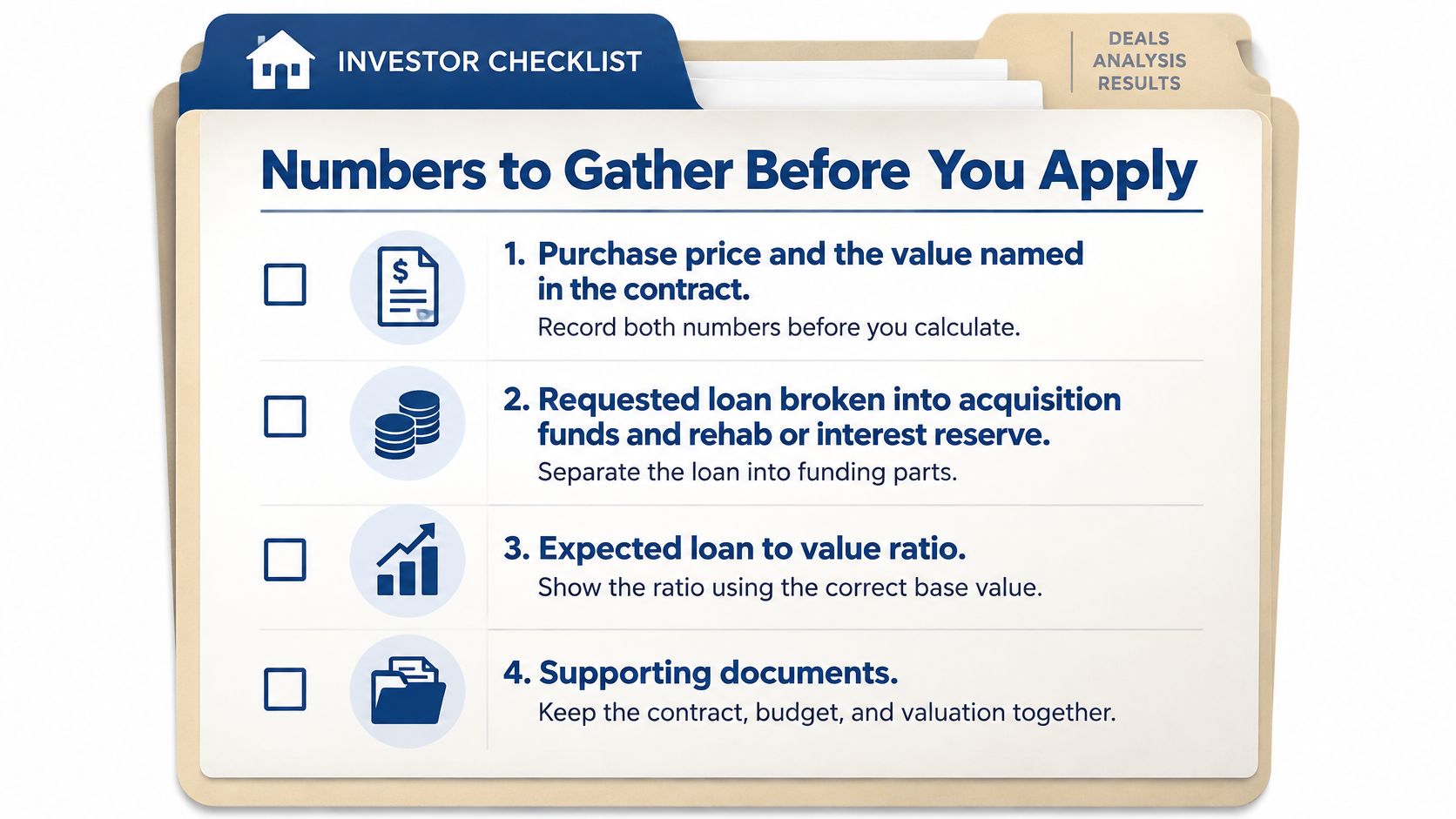
The checklist below gives those inputs a working order.
Build a usable project file
Purchase price and value basis. Include the contract price and any separate value figure named in the deal. Keep as-is and projected values on separate lines, since the earlier example showed how changing the denominator changes the ratio.
Requested financing breakdown. Separate acquisition funds from renovation financing and any interest reserve being requested. List anticipated future advances apart from money expected at closing, because each advance increases the outstanding balance in the numerator.
Property description. Record whether the collateral is a single residence, a small multifamily property, a larger apartment property, or land. Include the unit count and current condition so the loan officer can consider the relevant financing category.
Transaction purpose. Label the request purchase, refinance, or cash-out. For an existing loan, include the current balance or available payoff information rather than relying on the original borrowing amount.
Exit plan and target month. State whether repayment is expected from resale, refinance, or completion of a build followed by a defined financing event. List the expected exit month and the work that must be completed beforehand.
Contingency and selling costs. Keep a separate allowance for overruns and an estimate of disposition expenses. Those amounts help distinguish apparent property equity from potential net proceeds.
Income and experience information. For a rental or commercial hold, organize property income, property debt obligations, and relevant borrower experience. Quicklending's commercial loan qualification depends on property value, property debt to income, and the borrower's experience, rather than a single collateral percentage.
Keep assumptions separate from documents
A signed contract and an estimated resale price carry different levels of certainty. Label estimates clearly and record the assumptions behind the renovation budget, completion schedule, and exit valuation. Date every figure, because both sides of the ratio move: the balance grows with draws and accrued interest, and the value can shift with the market.
Investors preparing a rehabilitation project can use Quicklending's guide on how to apply for a renovation loan to organize the financing discussion. Documentation requirements vary by loan type and application.
Preparation checkpoint: A loan officer should be able to identify which figures are documented, which are estimates, and which depend on future work.
This is educational preparation, not legal, tax, or personalized lending advice. An appropriate licensed professional should review ownership structure and tax questions.
A dated, labeled file captures the collateral cushion as it stands today, ready to be recalculated as the project moves.
Loan to Value Ratio Questions Investors Ask
What LTV do lenders accept for investment property?
There isn't a universal investment-property limit. The acceptable ratio depends on the property, the transaction purpose, and the lender's review, and requirements can shift from one market to another. An investor should present the actual funding request and the value supporting it rather than assume a published percentage applies.
For the cash side of the same question, Quick Lending's discussion of down payments for investment property helps frame the equity contribution that belongs alongside LTV.
How do renovation draws move the ratio mid-project?
Each funded draw raises the loan balance while the property's value may not catch up until the work is finished. The cushion thins with every advance.
The ratio quoted at the closing table describes day one only.
A practical check is to run the division twice: once on funds already drawn, and once on the full commitment as if every dollar were advanced today. The second figure shows the thinnest the cushion gets before the renovation has a chance to support a higher value, and it keeps a mid-project number from looking safer than it is.
Why did the LTV change after closing?
The current ratio may rise if property value falls or if financed interest, renovation advances, or protective advances increase the outstanding balance. A borrower comparing statements should use matching dates and distinguish the current loan balance from the original loan amount or the total approved commitment.
For a renovation project, an undrawn commitment isn't the same as funds already advanced. The loan documents and current account information determine which amount belongs in a particular calculation.
Is after-repair value the right number for LTV?
The price-drop example earlier in this article showed why a projected resale value is an exit assumption rather than a current denominator. In a lender conversation, an investor can keep both numbers honest by presenting two labeled columns: the as-is value today and the projected value at completion, each supported by the renovation scope and comparable sales behind it.
That two-column format lets a loan officer weigh acquisition exposure and exit logic side by side, instead of reading a single figure that could mean either one.
Request a Quote With Your LTV Figures
Bring three numbers to a quote discussion: the requested loan, the value supporting it, and the planned repayment event. The objective is to determine whether the financing structure fits the project, since a ratio that looks comfortable at origination can tighten once interest and renovation draws begin posting to the balance.
Quicklending is a Houston-area hard money lender serving real estate investors and does not lend to consumers for personal loans. Its process is built around quick, smooth closings through a simplified intake, documentation, and decision workflow.
Match the estimate to the project
Quicklending's Residential Loan is a short-term, interest-only loan for investors purchasing single-family homes, townhouses, condominiums, multifamily properties up to four units, and lot or land held under an LLC or Corporation. The Commercial Loan includes bridge loans and interest-only loans for retail and office spaces, industrial properties, apartment complexes, and multifamily properties with five units and up. Down payment and LTV requirements may vary by market.
The closing-cost calculator estimates cash to close, proof of funds needed, and monthly payment. Its Max LTV setting offers 60%, 65%, and 70% as inputs for preparing an estimate. These figures shape the projection and are not promised loan amounts.
Every result rests on the assumptions entered. The estimate should state the value used, the financing requested, and whether renovation funding is included, so the LTV quoted today can be compared against the cushion that will remain after draws and financed interest post.
Understand the next steps
Quicklending's loan process has five stages:
- Contact Us
- Loan Officer
- Documentation
- Closing Team
- Get Your Funds
A Loan Officer contacts the borrower to learn what they want to accomplish, then offers feedback on the best options. Once the application starts, the borrower submits paperwork in a timely manner, and the Customer Relations Manager and Loan Transaction Manager make sure the closing is completed. After funding, the Portfolio Manager explains the draws and payoff process.
To begin, select Get a Quote and complete the requested information. The online application starts by choosing a loan type, Commercial or Residential. Loans can close in as little as five days, depending on the file, and no estimate should be treated as a committed funding date before the transaction has been reviewed.
Quicklending's office hours are 8am to 5pm, Monday through Friday, and the phone number is (713) 334-0762 ext 108. A prepared inquiry covers the as-is value, the requested loan, the renovation budget, and the exit plan, so the conversation can focus on the actual financing need.
Quicklending LLC offers Houston-area investment-property financing for acquisition, renovation, and transition projects, subject to review and approval. Investors ready to discuss their loan to value ratio can visit Quicklending LLC to request a quote with their as-is value, requested financing, rehab budget, and exit plan.