

Asset based lending is secured financing where the amount a borrower can access is tied mainly to the value of pledged assets, not to historical cash flow alone. For a real estate investor holding a signed contract on a property that needs work, that distinction decides whether the conversation starts with the property or with tax returns.
A bank can turn down a deal because documented income looks thin, even when the purchase price leaves a clear margin. An asset based lender starts elsewhere. The lender asks what the collateral is worth, how clean the title is, and how the loan gets repaid if the plan slips.
Table of Contents
- What Asset Based Lending Means for Real Estate Investors
- How Lenders Turn Collateral Into a Borrowing Limit
- Asset Based Lending, Hard Money and Bank Loans Compared
- Where to Find Hard Money Lenders Worth Calling
- How to Vet a Hard Money Lender Before Sending a Deal
- Outreach Templates for Your First Lender Contact
- Compare Your Options and Request a Quote
- Frequently Asked Questions About Asset Based Lending
What Asset Based Lending Means for Real Estate Investors
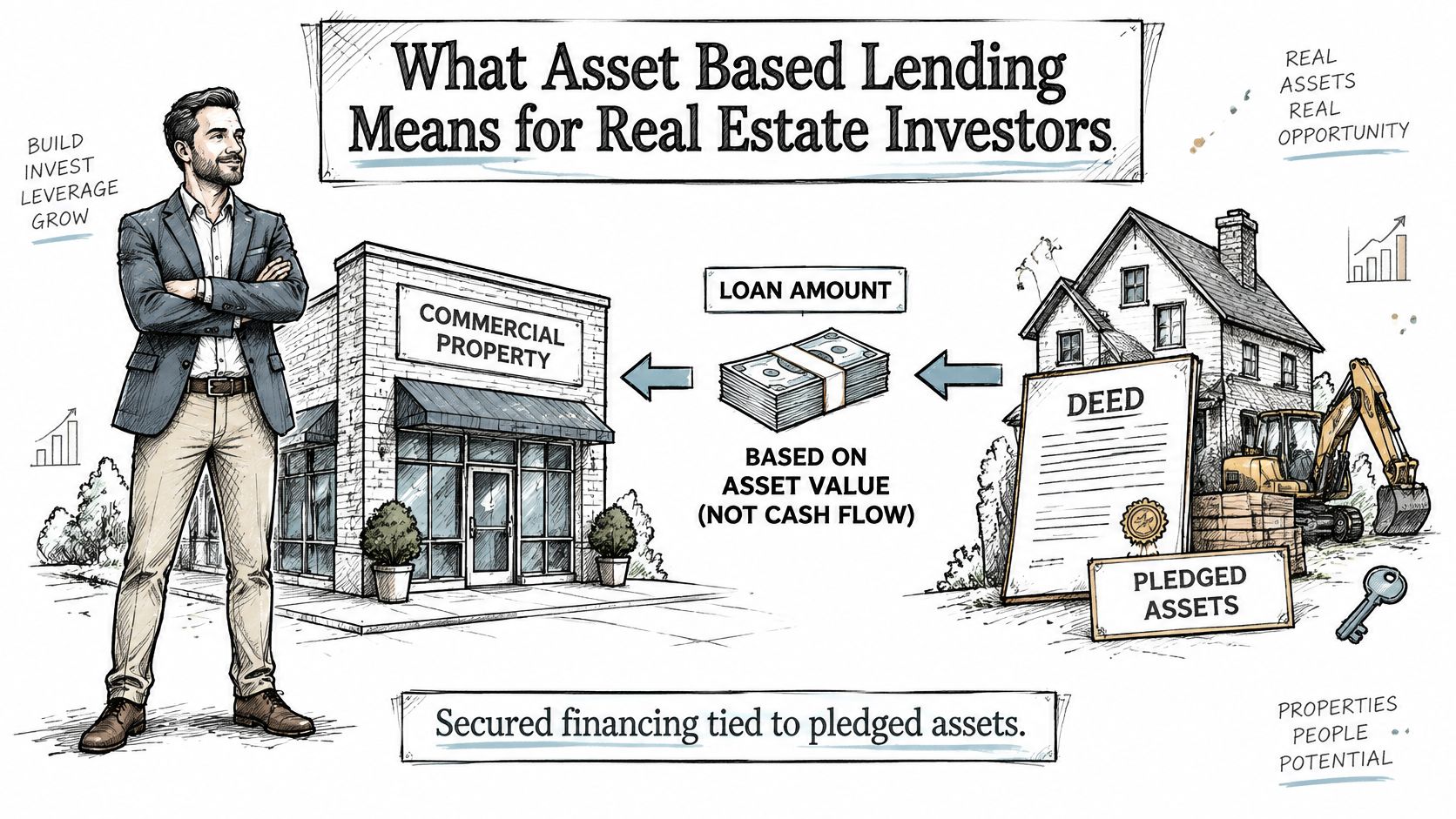
A flipper holds a signed contract on a dated ranch house, a contractor's scope in hand, and thin documented income. A bank reviewer sees the income gap first. An asset based lender sees the property first and asks whether its value supports the loan once repairs, holding costs, and selling costs are counted.
That ordering is the whole idea. The Office of the Comptroller of the Currency asset-based lending handbook describes asset based lending as a specialized product for borrowers that may carry substantial debt, inconsistent earnings, or marginal cash flow, provided the facility is fully collateralized. Conventional underwriting starts with income, credit history, and debt ratios, then checks whether the property fits program rules. Asset based underwriting runs that sequence in reverse.
Collateral Value Is Not Borrowing Capacity
Historically the product ran on accounts receivable and inventory, with equipment, real estate, and intellectual property recognized in some facilities. Real estate investors meet the property version, and here the same trap catches people: two investors can pledge houses worth the same amount and qualify for very different loans. The lender adjusts for what it can recover, so a clean title, a realistic budget, and a believable exit raise usable value while complications shave it down.
A builder sees the split clearly. A fully planned project with documented costs gives the lender something concrete to underwrite. A vague budget and an optimistic resale estimate give it nothing, even with solid past income.
The flipper's ranch house makes the risk side concrete too. Say the renovation finishes on budget but the property sits on market for two extra months. The payoff date passes, extension fees stack up, and the collateral that secured the loan becomes the lender's recovery path.
Collateral gives the lender a way to get repaid. The payoff clock still belongs to the borrower.
That gap between what a property is worth and what it can borrow is also the fastest way to sort lenders. Ask each one how it sizes a loan against the collateral, how it watches the project while the money is out, and how quickly it funds. The answers say more than the quoted rate.
How Lenders Turn Collateral Into a Borrowing Limit
Lenders don't lend against a headline value. They build a borrowing base, which is the usable amount after eligibility rules and protective discounts are applied.
The Three-Step Calculation
- Identify eligible collateral: The lender sets aside assets that are hard to collect, hard to sell, already pledged, or poorly documented.
- Apply the advance rate: The lender multiplies eligible value by a percentage it considers safe for that asset type.
- Subtract exclusions and reserves: Liens, selling costs, repair uncertainty, and other reserves can reduce available credit further.
The formula is simple. The Office of the Comptroller of the Currency examination handbook describes eligible collateral multiplied by an advance rate or discount factor, with $1 million at 80% producing an $800,000 borrowing base before exclusions or reserves.
Borrowing base at an 80% advance rate
| Eligible collateral | Advance rate | Borrowing base | Notes |
|---|---|---|---|
| $500,000 | 80% | $400,000 | Before exclusions and reserves |
| $1,000,000 | 80% | $800,000 | Before exclusions and reserves |
| $1,500,000 | 80% | $1,200,000 | Before exclusions and reserves; a lender may also apply an absolute facility cap |
Why Market Value Gets Discounted
A property's projected after-repair value isn't the same as value recognized at closing. The lender may use its own valuation, question the repair estimate, or discount for the time and cost needed to sell. Existing liens also reduce what a new lender can safely advance.
Advance rates are lender-set limits, not universal industry numbers. They differ by collateral type and by lender. An investor comparing offers should also compare how each lender calculates the down payment gap, which ties into how much down payment an investment property may require.
Availability can change after closing, too. If value drops, eligibility changes, or work falls behind, the lender may require a paydown, hold further advances, or request more collateral, depending on the loan terms.
Before signing, an investor should ask three direct questions. What value is the lender using, and who sets it? Which exclusions or reserves reduce that value? What event could cut availability after funding?
Asset Based Lending, Hard Money and Bank Loans Compared
A distressed duplex, a receivables-heavy contractor and a stabilized rental can all hold valuable collateral, yet each needs a different credit decision. Compare options on what sizes the loan, what gets monitored and how cash is released. Collateral value is the input; borrowing capacity is what remains after the lender sets its own sizing and controls.
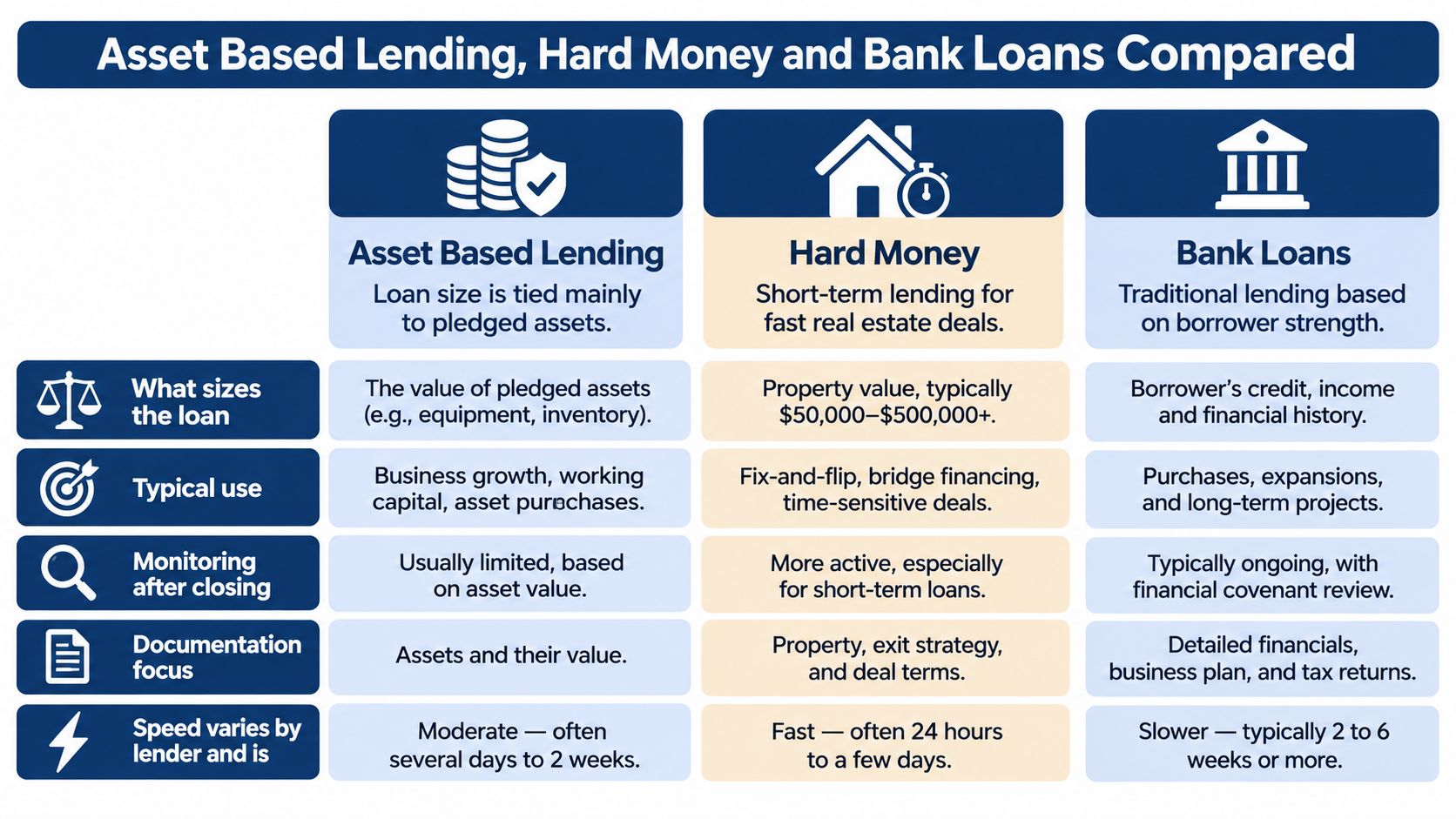
Asset based, hard money and bank financing compared
| Factor | Asset Based Lending | Hard Money Loan | Traditional Bank Loan |
|---|---|---|---|
| What sizes the loan | Value of pledged assets | Property value and deal plan | Income, credit and debt history |
| Typical use | Working capital or asset-backed facilities | Short-term acquisition, rehab or bridge needs | Longer-term financing, often after stabilization |
| Monitoring after closing | Collateral reports, audits and borrowing-base updates | Project inspections and milestone-based draws when rehab is involved | Standard loan servicing |
| Documentation focus | Receivable agings, inventory lists and valuations | Property, title, budget and exit plan | Tax returns, credit and financial statements |
| Speed | Quick for recurring collateral after the first review | Often the shortest route for a rehab or bridge need | Usually paced by full underwriting |
Which Fit Matches Which Situation
A distressed property with a defined renovation plan and a short exit usually points to hard money. The reasoning behind short-term financing advantages fits that narrow window, where the property cannot yet support conventional terms.
Receivables or inventory that turn over every month fit an asset based facility better than a one-property fix and flip. A stabilized rental with steady income points toward bank or longer-term financing, provided the borrower and property meet underwriting.
Practical filter: ask each lender the same three questions. What will you lend against? What do you monitor after closing? How do draws or releases get approved?
Match the loan to the constraint: asset, timeline or reporting burden.
Where to Find Hard Money Lenders Worth Calling
A lender search works better as a routine than as a burst of random calls. Each step below narrows the list before any application starts.
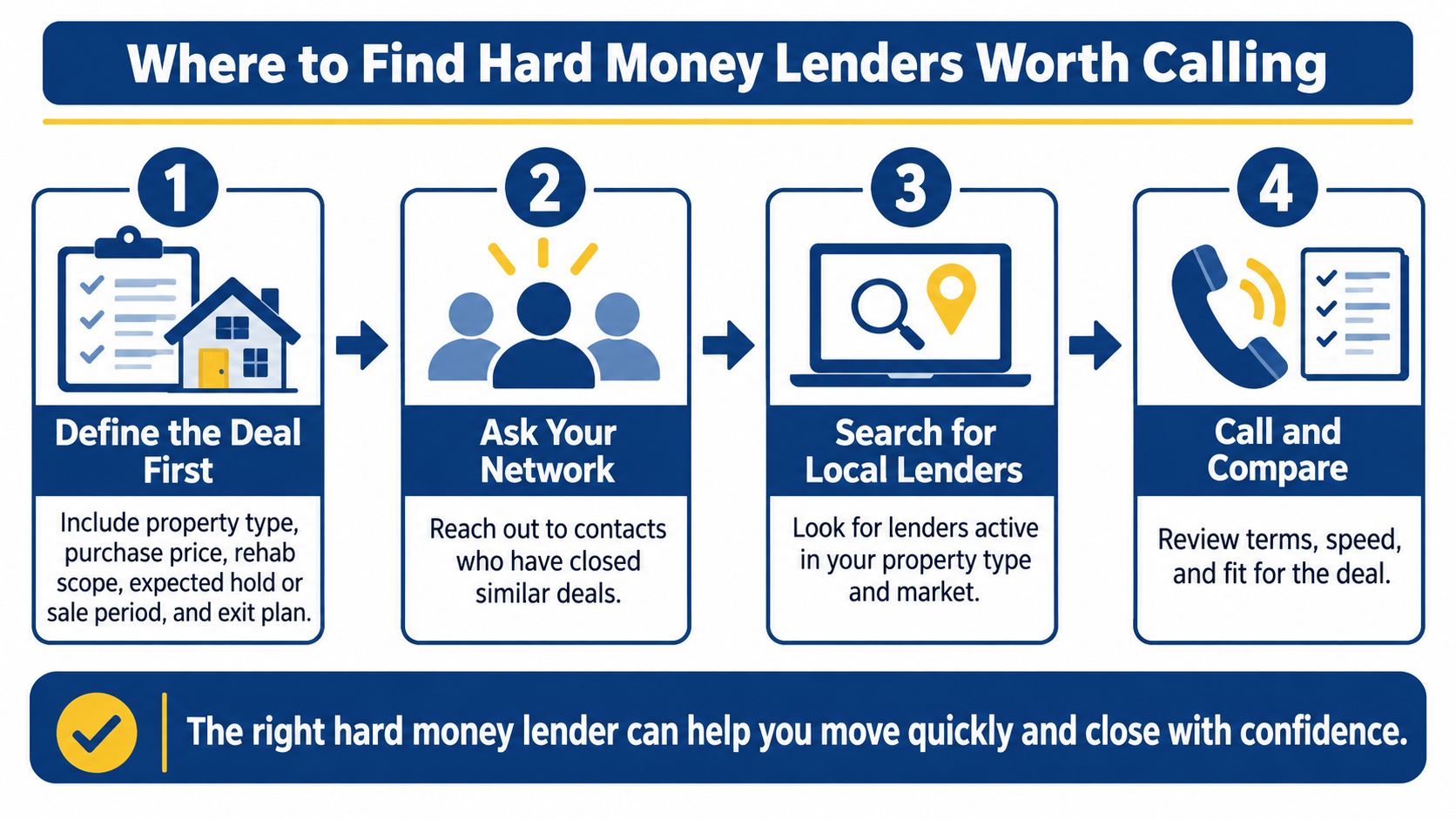
- Define the deal first: Write down property type, purchase price, rehab scope, expected hold or sale period, and exit plan. Lenders can't judge fit without those basics.
- Ask your network: Title officers, agents, wholesalers, contractors, property managers, and accountants see who closes smoothly. Referrals carry bias, though, because people recommend relationships that worked for them.
- Search online with specific terms: Combine hard money lender, the metro area, property type, and loan purpose. Read recent reviews and published closing examples rather than rankings, since reviews may be sparse for newer lenders.
- Ask past borrowers directly: Two or three borrowers can explain how the process felt from application to funding. Ask how the lender handled a change in scope, not just whether closing happened.
- Build a shortlist of three to five: Keep only lenders whose stated focus matches the deal size and property type. Lender websites describe their own process, so treat them as a starting claim to verify.
Keep One Tracker
A single deal tracker prevents the search from turning into scattered notes. Record each contact, the date, what was promised, and the next follow-up.
Local investor meetups add another check. Borrowers compare notes there without a sales pitch in the room, and repeated names usually signal consistent closings. Repeated warnings signal the opposite.
Responsiveness during this stage is useful evidence. A lender that takes a week to answer a simple fit question may not move faster when a title issue appears. That's not a guarantee either way, but it's a data point worth logging beside every name.
How to Vet a Hard Money Lender Before Sending a Deal
Speed claims alone tell you nothing about valuation method, fees, or draw timing. A lender can promise a fast close and still fund less than the deal needs, because the loan amount depends on how that lender sizes the collateral, not on how quickly it answers the phone. Vet the mechanics first, and speed becomes a bonus instead of the deciding factor.
Lender vetting checklist with questions and documents
| Criterion | Questions to Ask | What to Request in Writing |
|---|---|---|
| Lending focus | Do you lend to investors and entities for this property type? | Written summary of loan products |
| Valuation and sizing | How is value set, and what happens if the valuation comes in lower? | Valuation approach and sizing method |
| Fees and costs | Which fees apply, and when are they due? | Itemized fee schedule before application |
| Timeline | What steps run from application to funding? | Written process steps and document list |
| Rehab draws and payoff | How are renovation funds released and how is the loan repaid? | Draw schedule and payoff explanation |
| Local experience | Which markets have you closed loans in recently? | Examples of recent closings and references |
| Point of contact | Who manages my file through closing? | Named loan officer and direct contact details |
What Each Answer Reveals
Lending focus comes first because some lenders serve consumers only, while others work with investors and entities. Quicklending LLC, for example, does not lend to consumers for personal loans, so confirming audience fit saves wasted calls.
Valuation and sizing answers reveal the borrowing limit. Collateral value and borrowing capacity are different numbers. A property can appraise at one figure while the lender funds against a lower internal estimate or a capped share of the after-repair value. Ask who performs the valuation and what happens if it lands under the purchase price.
Fees need an itemized schedule with due dates, because terms vary by loan and project. Timeline answers should list steps and documents, not a fixed funding date promised before the file is reviewed.
Rehab draws and payoff show how the lender monitors the loan after closing. Ask how renovation funds are released, what inspections occur, and how payoff works at sale or refinance. I weight draw mechanics as heavily as the rate, since a stalled inspection stops the project mid-rehab.
Red Flags to Log Immediately
- Pressure to sign: Urgency before terms are readable is a warning.
- Vague fee answers: Costs that can't be itemized can't be compared.
- No named contact: A file without an owner stalls.
- Guaranteed promises: Any promise of guaranteed approval or guaranteed funding fails the test.
Send the same deal summary to each shortlisted lender. Identical input makes the answers comparable, and the gaps between them show which lender measured the deal.
Outreach Templates for Your First Lender Contact
Short, specific messages get answered. A lender scanning an inbox needs the property type, location, price range, and purpose in the first two lines. Guidance on how to apply for a renovation loan follows the same logic, since preparation shortens every later step.
Template One for a Cold Email
Subject: [Property type] financing question, [city]
There's a [property type] in [city] under consideration in the [purchase price range] range, with an estimated rehab budget of [rehab budget range]. The planned exit is [sale or refinance]. Could a short call work this week to review the lending process and whether this deal type fits?
Send this before sharing a full address. Add the exact property address after the lender confirms the deal type is a fit.
Template Two for a Referral Follow-Up
[Referrer name] suggested making contact after closing a deal with the team. The project is a [property type] in [city] with a purchase price around [purchase price range] and a renovation planned. A brief call to understand the process would be appreciated.
Naming the referrer gives the lender context and gives the borrower a warmer opening. Keep it to one short paragraph.
Template Three for a Post-Call Summary
Thanks for the call. The notes show fees of [fee summary], valuation handled by [valuation method], and an estimated timeline of [timeline stated]. The requested documents are [document list]. Please send written terms before sensitive files are shared.
This template creates a paper trail. It also surfaces disagreements early, while they're still cheap to fix.
Avoid attaching sensitive financial documents before confirming how files are handled. If there's no reply after a few business days, follow up once and add one new fact about the deal, such as a signed contract or a firmed contractor bid.
Compare Your Options and Request a Quote
Score each shortlisted lender against the seven vetting criteria. Mark every row as clear, partial, or unanswered, based only on what the lender stated in writing. Verbal confidence doesn't count as a clear answer.
Choose the two lenders with the most complete responses. A lender with a slightly slower stated timeline but a clear draw schedule often beats a lender with bold speed claims and unanswered fee rows.
Gather the Quote Package
- Deal summary: The same one-page summary sent during outreach.
- Property basics: Type, location, and purchase price range.
- Rehab budget: Line items if available, not just a single total.
- Exit plan: Sale or refinance, with the expected sequence.
A complete package does two things. It lets the lender size the deal accurately on the first pass, and it signals a borrower who will submit documents on time once the application starts. Lenders price both speed and certainty into their terms, so a clean file is worth assembling before the first call rather than after.
Quicklending LLC is one potential lending partner for real estate investors, including home flippers, renovators, builders, and multifamily investors in Houston, San Antonio, Dallas-Fort Worth, Austin, and Corpus Christi. To start, click Get a Quote on the Quicklending LLC website and fill out the information, or call (713) 334-0762 ext 108 to discuss a project.
Frequently Asked Questions About Asset Based Lending
How do I know if my property qualifies?
Collateral drives the answer. An asset based lender weighs the property's value, condition, and your exit plan more heavily than your personal income, which is why distressed or non-bankable buildings can still fund. Ask which property types the lender finances and what disqualifies a deal before you spend time on an application.
What documents does a lender usually request first?
Expect a purchase contract or property details, your borrowing entity's paperwork, a renovation budget with line items, and your exit plan. A complete file submitted once moves faster than a strong file delivered in pieces, so request the full checklist before you commit.
How much can I borrow against a property?
The property's value and your borrowing limit are two different numbers. Lenders apply an advance rate to their own valuation, then subtract existing liens, exclusions, and reserves. Ask each lender to show its sizing method in writing, because the same building can support very different loan amounts at different shops.
How long does funding take?
The timeline depends mostly on how fast title work clears and how complete your documents are when they arrive. Ask the lender for its process steps, the document list, and how draws are handled after closing, then judge any quoted timeline against what you can deliver that week.
Quicklending LLC offers short-term, asset-based hard money financing for Houston-area real estate investors working on acquisitions, renovations, and bridge needs, with every request subject to review and approval. Investors who want their property, budget, and exit plan evaluated can visit Quicklending LLC to request a quote or speak with the team about a specific project.